Get Full Government Meeting Transcripts, Videos, & Alerts Forever!
Get email alerts on the Economic Security Guaranteed Income topic
No spam. Unsubscribe anytime.
Richmond staff describe guaranteed-income pilot and plan for fourth cohort funded by city
Summary
City staff outlined the Richmond Resilience Initiative (RRI), reporting outcomes from earlier cohorts, research partnerships, eligibility for an upcoming fourth cohort targeted to single parents, and a $500,000 city-funded investment for the next round.
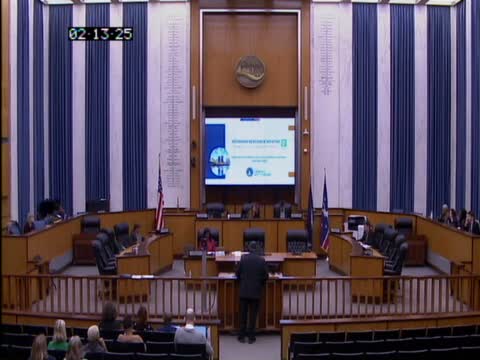
City staff and nonprofit partners presented updates on the Richmond Resilience Initiative, the city’s guaranteed-income pilot, describing multi‑year cohorts, independent research findings, and plans for a fourth cohort funded by city appropriations.
Derek Wadley, program and operations supervisor for the Office of Community Wealth Building and Richmond Resilience Initiative program manager, told the Education and Human Services committee the program provides $500 per month to eligible recipients for 24 months and aims to help working Richmond residents who earn too much to qualify for public assistance but not enough to be financially secure. “This program promotes a hand up, not a handout approach,” Wadley said.
Wadley reviewed outcomes from earlier cohorts: the first cohort (2020–2022) included 18 participants; a second cohort had 46 participants; the third targeted returned citizens and used ARPA funds. Research by the Center for Guaranteed Income Research at the University of Pennsylvania was cited for the first cohort. Wadley said the program increased participants’ savings rates (from 20% to 59% who reported any savings) and doubled average monthly savings for that cohort (from $147 to $305). He said participants showed progress on debt reduction, credit improvements and some movement toward homeownership and career advancement.
The presentation emphasized partnerships and funding sources. Philanthropic donors (including Robins Foundation and the Community Foundation) supported early cohorts; the third cohort used ARPA funds. Council approved $500,000 in the most recent budget to support RRI’s fourth cohort, which will target single parents and is intended to serve 40 participants. Eligibility described by staff includes Richmond residency, at least one child under 18, employment at or above $12.71 per hour but below the published living-wage thresholds for the city (the staff presentation cited city living-wage figures and cohort-specific maximums by household size).
Staff noted evaluation partners: the University of Pennsylvania supported evaluation of the first cohort and the Virginia Commonwealth University Research Institute for Social Equity will conduct longitudinal study work for cohorts two and three. Capricia Smith Spellman, director of the Office of Community Wealth Building, and Tracy Deshazer (project director) were present and described advocacy goals for scaling guaranteed income to state and federal levels.
Committee members asked about metrics and benchmarks for determining program success and sustainability. Wadley and other staff said quantitative measures (savings rates, credit, debt reduction, employment outcomes) are tracked and that long-term sustainability depends on policy adoption and advocacy rather than a fixed numeric threshold at the local level. A council member asked for more precise budget breakdowns (administration vs. direct payments); staff said roughly 5% might go to distribution fees with the remainder directed to stipends, and that they would follow up with a full budget for all cohorts.
Why it matters: Guaranteed-income pilots target working households falling into the “benefits cliff” and test an unconditional cash strategy to improve short-term financial stability and long-term mobility. The city‘s planned fourth cohort represents a modest but politically significant local investment to expand the program.
What’s next: Staff will provide a detailed budget breakdown for the program and share evaluation reports from the University of Pennsylvania and the VCU Research Institute for Social Equity. The fourth cohort recruitment will involve community partners and an application portal through the Office of Community Wealth Building; enrollment materials will include an online application and paper copies for those needing assistance.