Get Full Government Meeting Transcripts, Videos, & Alerts Forever!
Get email alerts on the Net Metering topic
No spam. Unsubscribe anytime.
House committee advances bill to change net metering for co‑ops and munis after hours of testimony
Summary
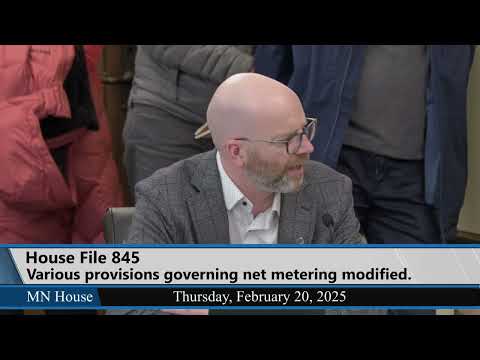
The Minnesota House Energy Finance and Policy Committee on Feb. 25 voted to place House File 845 — legislation that would change compensation for customer‑owned distributed solar in cooperative and municipal utility territories — on the general register after adopting an author’s amendment.
The Minnesota House Energy Finance and Policy Committee on Feb. 25 voted to place House File 845 — legislation that would change compensation for customer‑owned distributed solar in cooperative and municipal utility territories — on the general register after adopting an author’s amendment.
Representative Dave Baker, the bill’s author, said the measure would stop requiring cooperatives to pay the full retail rate for excess generation and instead align compensation closer to wholesale values. “This bill does not eliminate net metering,” Baker said when he introduced the measure, adding that his amendment would grandfather existing contracts and interconnection applications.
Supporters of the bill, including several electric cooperative leaders, told the committee that the current retail compensation for exported solar shifts costs to non‑solar members and has grown rapidly in a short period. Justin Johns, president and CEO of East Central Energy, said his cooperative serves about 67,000 accounts and that its engineers have found limited system‑level peak benefits from roof‑top arrays; he described the current practice as “retail rate for a wholesale product.” Ron Meyer, CEO of McLeod Cooperative Power, testified that his cooperative saw net‑metered generation grow from 28 members in 2019 to 91 members in 2024 and said payments for excess generation increased from roughly $24,000 to $160,000 in that period.
Opponents — a large group of solar businesses, installers, labor advocates and climate and rural groups — urged the committee not to enact the change as written. George Damien of Clean Energy Business (SEAM) said HF 845 “would discourage solar adoption and therefore undercut consumer choice.” Several installers and trade association representatives warned of lost jobs and business disruption if compensation were reduced to an avoided‑cost or energy‑only wholesale rate.
The Minnesota Department of Commerce’s Assistant Commissioner Lisa Polish told the committee the department shared some of the bill’s concerns about cost shifts but urged more study and careful drafting. Polish said Minnesota’s 2040 clean electricity requirements and a recent Public Utilities Commission rulemaking make it important to consider how changes might affect storage and larger distributed systems. Professor Gabe Chan of the University of Minnesota said it is reasonable to treat self‑consumption differently than exports, and pointed to the 2013 value‑of‑solar framework as an existing attempt to capture a broader set of benefits than a simple avoided‑energy price.
Several speakers asked for more data or a formal study before making sweeping statutory changes. The solar industry and advocates suggested targeted reforms, more transparency, or a cost‑of‑service study rather than an immediate rollback of retail net‑metering compensation. Representative Baker said he intends to continue working with stakeholders on technical changes, and he supported grandfathering existing systems and those with pending interconnection applications.
Committee action: Representative Baker offered an A1 author’s amendment, which the committee adopted by voice vote. Baker then moved to place HF 845, as amended, on the general register. The committee took a roll call and the motion passed 8 ayes to 7 nays.
Votes at a glance: The committee adopted the A1 author’s amendment by voice vote. The subsequent roll‑call motion to place House File 845 on the general register passed by a count of 8‑7 (tally recorded in committee; committee members present asked for roll call and the clerk recorded the result). The bill will advance to the House general register for further consideration.
The hearing included more than three dozen public and industry testifiers representing electric cooperatives, municipal utilities, solar developers, installers and advocacy groups. Testimony repeatedly returned to a short list of issues: whether a measurable cost shift exists at current levels of solar penetration in many co‑op territories; how to treat exports versus self‑consumption; whether aggregation of multiple meters on one site is available and should be clarified in statute; the cap that applies to net‑metered systems in different utility classes; and protections for existing customers and pending interconnection applicants.
Representative Baker said he welcomes continued stakeholder work on aggregation and other technical fixes as the bill proceeds. The committee chair indicated the panel will reconvene for routine business at its next scheduled hearing date.