
Planning commission recommends council approve 75-unit affordable apartment project after discussion of school preference, parking and impact fees
Get AI-powered insights, summaries, and transcripts
Sign Up Free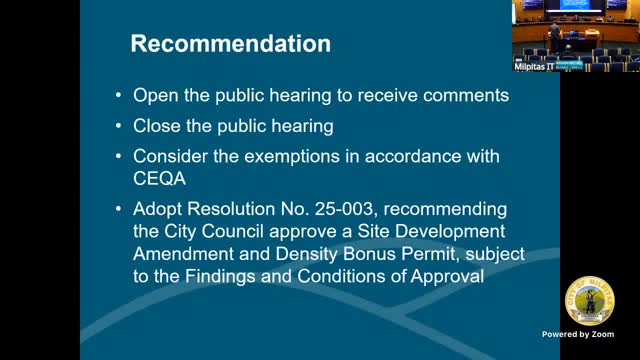
Summary
The Milpitas Planning Commission voted to recommend City Council approval of a site development permit amendment and density bonus for a 75-unit affordable apartment project proposed by Pulte Homes and Waterford Property Company after questioning over a school-district preference, parking levels and park impact fees.
The Milpitas Planning Commission on a voice vote recommended that the City Council approve a site development permit amendment (SA24-0005) and a density bonus permit (DB204-0002) for a proposed 75-unit affordable apartment building, after discussing a proposed local preference for Milpitas Unified School District employees, parking counts and impact fee calculations.
The project team, represented by Jim Sullivan of Pulte Homes, said Pulte acquired the property after the council’s earlier approval of a prior plan and that the current design, developed with nonprofit Waterford Property Company and architect KTGY, reduces building height from six stories to five and increases on-site recreational/open space to about 25% of the site. “Pulte Homes acquired the entire property as Michael had mentioned shortly after the city council had approved it,” Sullivan said.
Commissioners pressed the applicant and staff about the status and form of a proposed agreement with Milpitas Unified School District (MUSD). Planning staff and the city attorney said the draft condition of approval (condition 26) directs the developer to work with the city attorney’s office to include language in the affordable housing agreement that would benefit qualified MUSD employees, but that any separate private agreement between the developer and the district would be a contractual arrangement between those parties that the city would not necessarily be party to. As the city attorney explained, such a private agreement “would be a private agreement that the city would not be privy to.”
Representatives for Waterford explained how a school preference/local preference would be implemented under typical tax-credit and bond-financing regulatory agreements. Sean Ross, co-founder of Waterford Property Company, told commissioners the company has an extensive affordable portfolio in California and frequently includes local-preference provisions for teachers and first responders in regulatory agreements recorded on the property. “We have about 7,500 units in our existing affordable housing portfolio in California,” Ross said, and clarified that financing rules require flexibility so vacant units do not remain empty if the local-preference queue is exhausted.
Commissioners also focused on parking. Planning staff explained the project follows state density bonus law calculations for minimum parking and that the proposal calls for about 85 parking spaces for the apartment building (with additional guest parking counted on the adjacent Pulte townhome parcel). Staff said the 85-space figure follows state density bonus minimums and that the developers requested a waiver to reduce parking below the number that would otherwise be required. Planning staff said there are 46 guest parking spaces for the overall project and that the applicant’s parking model and project operator would be responsible for on-the-ground parking management.
The project team said parking is being provided primarily underground and that the operator will manage guest and overflow parking. Planning staff noted that the reduced parking approach is common for affordable housing projects that rely on state density-bonus parking standards.
Commissioners and applicants also discussed site layout and a requested front-yard/setback modification. Architect Megan Palmer of KTGY explained that the four-foot, nine-inch measurement in the requested front-yard change is measured from the back of the sidewalk and that from the curb face to the building face the distance is “over 16 feet,” because a planted parkway separates curb and sidewalk.
On impact fees, staff and the applicant explained that several impact fees apply. Pulte has paid a park-in-lieu fee previously calculated at approximately $3.9 million and the developer said school impact fees will be calculated and collected by the Milpitas Unified School District as part of the building permit process. The applicant estimated total city fees in the neighborhood of $5 million and an additional roughly $1 million in school impact fees, subject to final permit calculations.
After discussion, a commissioner moved adoption of Planning Commission resolution number 25-003 recommending that the City Council approve the site development permit amendment SA24-0005 and density bonus permit DB204-0002 subject to the findings and conditions of approval. The motion carried on a roll call with the commissioners recorded as voting "Aye": Commissioner Kong; Vice Chair Calkins; Chair Gupta; Commissioner Medina Ashby. The item will next proceed to City Council for final action.
Votes at a glance: Planning Commission recommended approval of Resolution 25-003 (motion language: "adopt resolution number 25-003 recommending that the City Council approve site development permit amendment SA24-0005 and the density bonus permit DB204-0002 subject to the findings and conditions of approval"). Vote recorded as ayes: Commissioner Kong; Vice Chair Calkins; Chair Gupta; Commissioner Medina Ashby.
The applicant estimated a construction timeline that would take about two years once financing and permitting are complete, with Waterford indicating a target start in the first quarter of 2026 pending funding and final entitlements.