Get Full Government Meeting Transcripts, Videos, & Alerts Forever!
Get email alerts on the Hathaway Scholarship topic
No spam. Unsubscribe anytime.
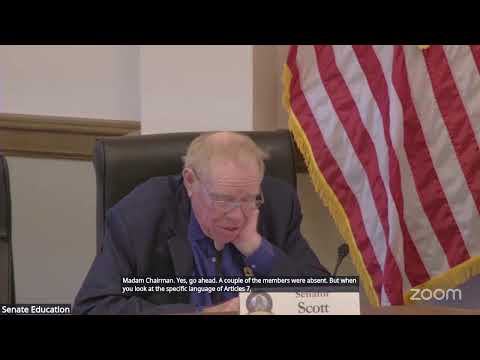
Senate panel advances Hathaway Scholarship amendment to cover long apprenticeships
Summary
The Senate Education Committee voted to pass House Bill 36 as amended to let the Department of Education and the Community College Commission write rules so Hathaway scholarship eligibility can account for multi‑year on‑the‑job apprenticeship programs that enroll students for fewer than six credit hours per semester.
The Senate Education Committee voted 4–0 (one excused) to pass House Bill 36, the Hathaway Scholarship Amendments, as amended, after testimony from the bill sponsor, Department of Education staff and representatives of community colleges.
The bill, sponsored in the House by Representative Lloyd Harshman and introduced in committee by Representative Harshman and discussed before the Senate Education Committee, would allow the Wyoming Department of Education and the Wyoming Community College Commission to adopt rules to treat longer-duration, graded on‑the‑job training programs — such as multi‑year electrical apprenticeship programs at Central Wyoming College — as eligible for Hathaway scholarship support even though individual semesters have fewer than the current six credit hours that define the part‑time baseline.
“This bill was brought to me by a constituent, has a kid in an electrician’s program,” Representative Lloyd Harshman said, describing programs in which students take a small number of credit hours each semester while doing required on‑the‑job training with a master electrician over four years. Harshman said the change would let the commission and the department “look at this and write rules.”
Wanda Maloney of the Wyoming Department of Education testified that Superintendent Megan Degenfelder supports career and technical education and supports the intent of the bill, but asked for time to review the large amendment. “The superintendent does support career and technical education,” Maloney said. Brad Barker of the Department of Education told the committee there is no flexibility in current rules to address how part‑time use of Hathaway dollars counts against a scholar’s eligibility: “There is not room in the rules to make that adjustment,” Barker said.
College representatives told the committee some noncredit and certificate programs — for example, CDL training or electrical apprenticeship — serve adult learners and can be short or spread over multiple semesters. Erin Taylor of the Wyoming Association of Community College Trustees and Dr. Lisa Watson, president of Northwest College, said the colleges and the department should work through rule language and suggested an interim study to gather more data.
Senators raised concerns that changing how part‑time awards are divided could “burn” a semester of scholarship eligibility (for example, treating a semester with three credits as using a full semester of Hathaway funds). Committee members agreed the amendment addressed the problem the bill sponsor sought to fix but noted the underlying statutory rule about dividing part‑time awards must be addressed separately in statute or via interim work.
After committee discussion the panel approved the amendment and passed HB 36 as amended. The committee record shows 4 ayes, 1 excused.
The committee and department agreed an interim study or further rule drafting with community colleges would help clarify implementation details such as how awards are pro‑rated across semesters and whether additional statutory change is needed.