Get Full Government Meeting Transcripts, Videos, & Alerts Forever!
Get email alerts on the Appropriations Vote Roundup topic
No spam. Unsubscribe anytime.
Appropriations Committee advances audits, student-data, scholarship and public-art bills; two withdrawn
Summary
The House Appropriations Committee approved four bills during a brief voting session and recorded the withdrawal of two others.
The House Appropriations Committee approved four bills during a brief voting session and recorded the withdrawal of two others.
House Bill 251, a departmental measure on audits of local departments of social services, was amended to require a financial and compliance audit every four years unless the Inspector General determines an audit should occur every three years. A staff member presenting the bill said the change “would put the bill in the same posture as it is coming over in the senate.” Committee members adopted the amendment and approved the bill on a roll call.
House Bill 298 directs the Maryland Higher Education Commission to collect data from each public institution in the state on the parental status of enrolled students, and requires institutions to place the questions on one or more existing demographic forms. The presenter said institutions must make the collected data available to the commission. The bill passed on a roll call that included recorded “no” votes from several members.
House Bill 473 expands eligibility for the Maryland Community College Promise scholarship by allowing part-time associate degree students to receive awards for up to six years while maintaining the three-year maximum for full-time associate-degree students. The bill also clarifies that students pursuing licensure, certification or participating in registered apprenticeship programs may receive the award for up to three years. The committee moved and approved the bill after brief discussion confirming that recipients must be enrolled at community colleges.
House Bill 961 bars an entity from including contract provisions that require an artist to waive copyright or rights in contracts for state public art entered before Oct. 1, 2025, while allowing an artist to voluntarily waive copyright protections. The bill also requires entities that commission state public art to register the art with the Maryland State Arts Council. The committee adopted two amendments — a technical change to the title/purpose paragraph and a second amendment authorizing voluntary waivers and adding the registration requirement — and then approved the bill.
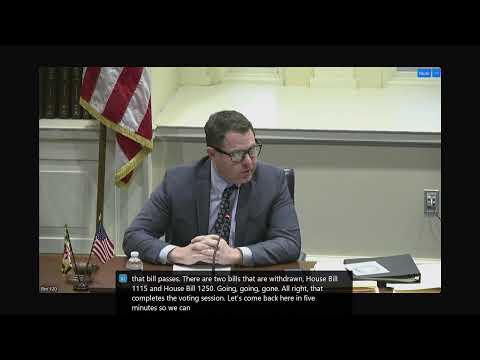
The clerk recorded the withdrawal of House Bill 1115 and House Bill 1250 before the committee adjourned for a five-minute recess to move to a regular hearing.
Votes at a glance - HB 251 (Local Departments of Social Services audits): Amendment requiring audits every four years (or three if the IG directs) adopted; bill approved on roll call. (Mover: presenter; second: not specified.) - HB 298 (Maryland Higher Education Commission — parental status data): Bill moved and passed on roll call; several members recorded no votes. (Mover: presenter; second: not specified.) - HB 473 (Community College Promise scholarship — part-time eligibility): Bill moved and passed on roll call. (Mover: presenter; second: not specified.) - HB 961 (State public art — copyright waiver and registration): Two amendments adopted; bill moved and passed on roll call. (Mover: presenter; second: not specified.) - HB 1115 and HB 1250: Withdrawn.
What this means - HB 251: The audit schedule for local departments will be four years by default, with a three-year schedule possible if the Inspector General so determines; the committee adopted the amendment to align with the Senate version and advanced the bill. - HB 298: MHEC will receive institution-level information on students’ parental status for statewide reporting; the committee’s roll call shows some opposition, though the bill passed. - HB 473: The Promise scholarship expansion formally allows part-time students (and certain apprenticeships/licensure pathways) to access awards for a longer period than previously permitted for part-time enrollees. - HB 961: The bill prevents mandatory pre-2025 copyright waivers in state public-art contracts, allows voluntary waivers, and adds a registration requirement with the Maryland State Arts Council.
Committee procedure and next steps The session consisted of a sequence of motions, amendment votes and roll calls. Specific movers or seconders were not identified consistently in the record for every motion; where a presenter moved a bill or amendment, the transcript records that action but does not always capture a named seconder. Each advanced bill will continue through the legislative process per standard House procedures.