Get Full Government Meeting Transcripts, Videos, & Alerts Forever!
Get email alerts on the Redistricting topic
No spam. Unsubscribe anytime.
Stoughton committee reviews heat maps as district weighs new elementary school vs. temporary modulars
Summary
At a Feb. 13 Redistricting Committee meeting, district staff reviewed student-location heat maps and timelines showing a new elementary could open in fall 2028 while temporary modular classrooms could be in place as early as fall 2027. Staff warned of transportation, site, utility and safety trade-offs if modulars are used.
Stoughton Public Schools’ Redistricting Committee reviewed student heat maps and planning trade-offs Feb. 13 as staff laid out how a proposed new elementary school and a fallback modular-classroom plan would affect student assignment, transportation and site logistics.
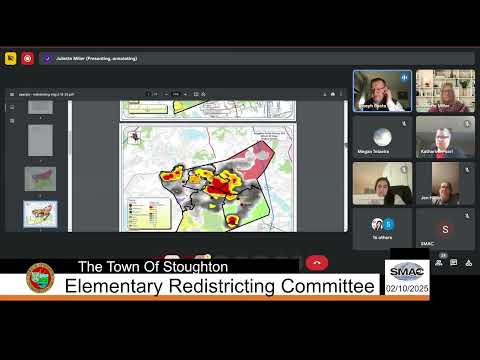
Dr. Baeta, a Stoughton Public Schools staff member who presented the maps, told the committee the “dot the squares represent our current schools” and that the new elementary site shown on the maps is “physically still in South Stoughton.” He said the district’s analysis of 2022–23 enrollment heat maps shows a concentrated population in the southernmost portion of town that would be hard to serve with nearby schools if South School were closed and no new school were built there.
The distinction matters, Baeta said, because a newly built elementary school would likely require fewer student shifts than a plan relying on modular classrooms. “There'll be less students impacted with a new elementary school than with a modular project,” he said, and added that modulars would cause broader reassignment across multiple schools.
Why it matters: The committee is doing redistricting work now to prepare for either outcome. Baeta told the group a successful April vote on the proposed new school would largely eliminate the modulars discussion; the district’s current timeline presented to the committee estimates a new building could open in September 2028 while modular classrooms could be in place by September 2027 if the new-school project does not proceed.
Details and district concerns District staff walked committee members through heat maps for individual schools and spoke about capacity and site constraints. The presentation noted that at least one nearby school is already near capacity, and that moving large numbers of students would affect multiple attendance zones.
Baeta described several practical constraints that would affect any modular plan: fire-department access requirements for spacing between modular units and the permanent building, parking and arrival/dismissal logistics, the need for additional restrooms and connections, and possible impacts to playgrounds and outdoor learning spaces. He said stormwater management, site soil testing, crane access, sprinkler and alarm systems, and utility hookups (water, sewer, electrical, heating) are among the items that would add time and cost to modular installations.
On special programs and services, Baeta said a permanent new school is designed from the start to accommodate specialized service-delivery spaces, whereas modulars present additional questions about where to locate offices and therapy spaces and whether those spaces will be safely connected to the main building.
Transportation and staffing impacts were raised repeatedly. Committee members flagged likely increases in transportation costs and the need for additional staff to supervise students who would travel farther or transition between split schedules if space becomes constrained. Committee member Catherine Weiss noted the enrollment-reporting vendor name in the minutes that were under review; she corrected it from "NASDAQ" to "NESDEC." Baeta also told the committee that Jones School currently has about 90 students on a waiting list for preschool programs, a figure he and committee members said reinforces existing capacity pressures.
Process and timeline Baeta said the district has an allocation up to $90,000 to hire a firm to prepare updated maps and analyses; that work would be timed to when the district needs it (he suggested not before 2026 if a new school is chosen, since the building would not open until 2028). He described a typical procurement and permitting sequence for modulars that could push final heat maps to roughly nine months before whatever opening date the district targets. He also said modular deliveries "are about 8 to 20 weeks from the time of the arrival of the materials," but emphasized permitting, site work and utilities add time.
Public engagement and next steps Committee members discussed public outreach. Staff said they will prepare visuals of both the new-school and modular scenarios for each building and make them available in school lobbies after vacation, and that the district will share a recorded informational program and a newsletter update. Committee members also described an upcoming Jones PTO meeting where district staff planned to present the drawings and answer parent questions; committee members agreed the event could be open to the wider district.
Votes and minutes Earlier in the meeting the committee accepted the Jan. 9 minutes with a spelling correction to the enrollment vendor name (NESDEC). The acceptance carried unanimously on a roll-call vote taken at the meeting.
The committee scheduled its next meeting for March 13 and will return with more detailed street-level enrollment mapping and scenario sketches for both a new elementary building and the modular option.