Get Full Government Meeting Transcripts, Videos, & Alerts Forever!
Get email alerts on the Children Families Funding topic
No spam. Unsubscribe anytime.
Tulsa mayor seeks $115,000 to staff new Office of Children and Families through contract with Impact Tulsa
Summary
Mayor Monroe Nichols asked the Urban and Economic Development Committee to approve a $115,000 supplemental appropriation to staff a new Office of Children, Youth and Families; the funds would go to Impact Tulsa under a contract to provide data, convening and program support and to leverage private matching funds.
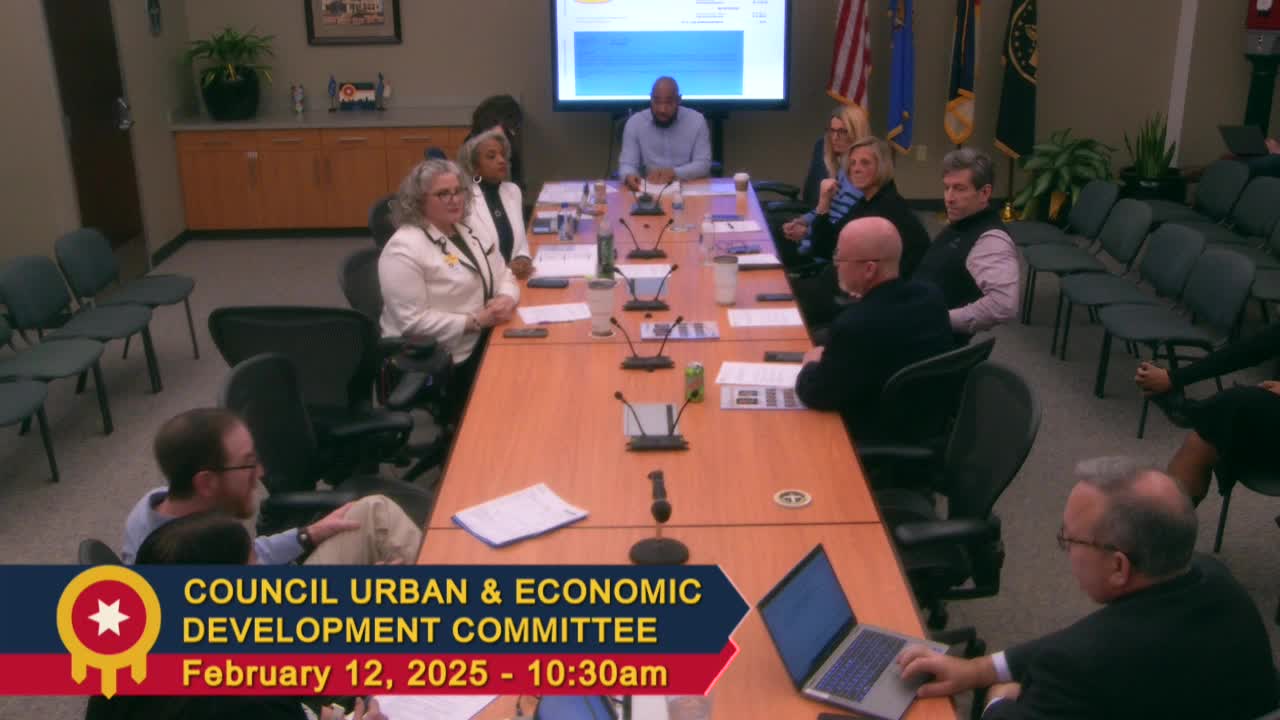
Mayor Monroe Nichols and city budget staff told the Urban and Economic Development Committee on Feb. 12 that the city will ask to appropriate $115,000 now to staff a new Office of Children, Youth and Families and to pay Impact Tulsa for that work.
The mayor said the appropriation would be seed money to hire staff, build data and planning systems and leverage private dollars. "This is us being one investor of many," Monroe Nichols said, adding that the city’s $115,000 would be used to raise a larger pool of private funding for the office.
Jared Milton of the city budget office described the item as a fiscal-year 2024–25 budget amendment moving $115,000 from savings in the finance department into the mayor’s office to fund the new office for the remainder of the year. Ashley Phillipson, who the mayor identified as serving as director of the Office of Children and Families while remaining executive director of Impact Tulsa, said Impact Tulsa will act as a data intermediary and convener rather than a direct service provider.
Phillipson told the committee Impact Tulsa already works with roughly 50 partners and 20 school districts, providing data tools and analytics to track cradle-to-career outcomes such as pre-K enrollment and early literacy. She described metrics the office will use to measure progress and said the contract will include reporting requirements. "Our team is known as a data intermediary for Tulsa County," Phillipson said.
Committee members asked for details about the contract structure, the grant-versus-contract arrangement and whether the $115,000 is recurring. Nichols and staff said the current $115,000 covers the period from roughly March through the following March; the administration expects to request additional funding in the next budget cycle and to offset part of that with privately raised dollars. Nichols said the city’s plan is to be a partner rather than the sole operator and to hold Impact Tulsa accountable for measurable outcomes.
Council members pressed for clarity on scope and accountability. Councilor Becker Wright asked whether the arrangement is sole-source; staff confirmed the city is proposing to contract with Impact Tulsa on the basis of its existing capabilities. Councilor Dallas and others asked for budget detail, whether staff or services are being bought, and how outcomes will be tracked; the mayor and Impact Tulsa representatives said the funds will largely cover staff and data infrastructure and that Impact Tulsa will report annual metrics tied to goals such as pre-K uptake and early literacy.
Nichols and Impact Tulsa officials also said that the office will focus work across multiple school districts (not only Tulsa Public Schools), citing prior and ongoing data work with Union and other districts and noting plans to build eviction- and school-participation tracking tools that cover multiple districts.
No formal council vote on the appropriation appears in the meeting transcript; staff indicated the budget amendment will be included in upcoming budget actions and that the administration expects to return with additional budget proposals in the next budget cycle. The mayor said the administration and Impact Tulsa will bring regular reports to the council and to the proposed children's cabinet.
Impact on residents: administration and Impact Tulsa staff said the initiative aims to increase pre-K enrollment, improve early literacy metrics and connect students to workforce pathways; staff said the office will both convene providers and analyze program impact so future city investments are evidence-based.
Ending: Committee members asked for district-level and zip-code breakout of data and for further detail in forthcoming budget documents. Staff said the $115,000 is intended to be catalytic and that a larger, multi-year funding request will follow during the main budget process.