Get Full Government Meeting Transcripts, Videos, & Alerts Forever!
Get email alerts on the City Finance Audit topic
No spam. Unsubscribe anytime.
Oro Valley audit: clean opinions issued; single-audit flags federal asset tracking
Summary
Auditors Baker Tilly issued an unqualified opinion on Oro Valley's fiscal 2024 annual comprehensive financial report and a clean Yellow Book report; the federal single audit was clean except for one significant deficiency related to inventory and identification of federally purchased capital assets.
The Town of Oro Valley received an unqualified ("clean") audit opinion for its annual comprehensive financial report for the year ended June 30, 2024, though auditors identified a single significant deficiency in federal grant asset tracking.
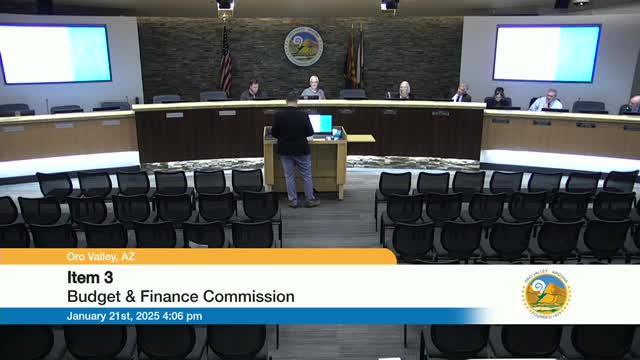
Baker Tilly lead audit partner Brian Hemmerle told the Budget and Finance Commission on Jan. 21 that the audit opinion was issued Dec. 12, 2024, and that the town also received a clean government auditing standards (Yellow Book) report. The federal single-audit report was likewise clean for the major programs tested, with one significant deficiency related to maintenance and identification of federally purchased capital assets.
Why it matters: an unqualified audit indicates the town's financial statements are materially correct in the auditors' view; the single-audit deficiency matters because it affects compliance with federal grant rules and requires corrective action to avoid future findings.
Hemmerle said the single-audit work covered the COVID-19 State and Local Fiscal Recovery Fund (SLFRF) and an outdoor recreation acquisition, development and planning grant. Auditors found no findings for those programs other than the deficiency in capital-asset records. Specifically, auditors said the town had not conducted the required biennial inventory of federally purchased capital assets and did not consistently tag or otherwise identify which assets were purchased with federal funds inside the capital-asset system. Hemmerle said management had already begun inventory observations and had started separating federally purchased assets in the accounting system.
The audit team reported other summary items: auditors found no material weaknesses, no disagreements with management, no reportable fraud, and no significant unusual transactions. Hemmerle said the single-audit threshold applied because the town expended about $3,700,000 in federal funds during the year.
Commissioners pressed staff for transaction details during the presentation. Finance staff explained a negative fund balance in the grants and contributions fund arose from timing: the town spent about $1,000,000 on the Naranja Park pump track and skate-park project before the state parks and recreation grant proceeds were received in December 2024, so the amount was recorded as deferred revenue for modified-accrual accounting and produced a temporary negative fund balance. Staff also confirmed that roughly $500,000 in ARPA funds had been transferred to and used by the water utility at council direction.
Commissioners asked about a $295,000 lease receivable recorded in the PAG/RTA fund; staff said the amount relates to cell-tower lease activity tied to right-of-way and is recorded there for historical reasons, not because PAG or RTA pay the lease. Staff said they would consider whether the lease activity should instead be recorded in the general fund in future years.
Hemmerle also discussed changes in the town's capitalization threshold required by recent GASB guidance. He said auditors reviewed the change, performed analytical testing, and did not recommend a prior-period adjustment.
On the state expenditure limitation report filed with the Arizona Auditor General, Hemmerle reported the town's statutory expenditure limit for the year was $148,400,000 and that the town's expenditures subject to the limit were $125,900,000, leaving the town about $22,500,000 below the limit. Commissioners asked whether a voter-approved limit or the state's calculation would control if the two differed; auditors said they would consult the Auditor General's Office, and staff told commissioners they expected the more conservative (lower) number would apply but agreed to verify.
The commission asked staff to review certain disclosures (Note 3 and the capital-project fund lease accounting) and directed staff to follow up with the auditor and report back at a future meeting.
For context: Baker Tilly's audit approach included summer site visits for control walkthroughs and a substantive field visit in the fall; Hemmerle said the field team typically averages four people and the audit opinion was drafted and issued in mid-December.
The commission did not take formal action on the audit report during the presentation; the item was presented for discussion.