Get Full Government Meeting Transcripts, Videos, & Alerts Forever!
Get email alerts on the Property Revaluation topic
No spam. Unsubscribe anytime.
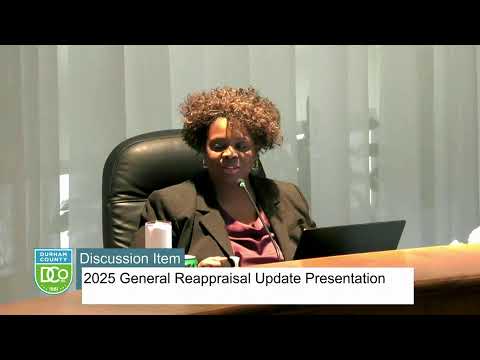
Durham tax office outlines 2025 reappraisal, shows steep home-price increases since 2019
Summary
Durham County tax officials told commissioners the January 1, 2025 revaluation reflects large market gains since 2019 and outlined appeal dates and relief programs including state exemptions and a county low-income homeowner fund.
County tax staff told the Board of Commissioners on Monday that the January 1, 2025 reappraisal reflects sharp increases in local home prices since the county’s last mass appraisal, and outlined the appeals timetable and property-tax relief programs for residents.
Tax Administrator Charles Doyle and staff reviewed market data showing median sale prices rising in recent years. “January in 2019 median sale price in Durham County was $239,500. As of October 2024 the median sale price in Durham County was $419,500,” Doyle said, citing county sales data. The tax office said staff used sales through Dec. 31, 2024, as the closing date for market evidence supporting the Jan. 1, 2025 valuation date.
Doyle said reappraisal is required by state law and the county aims for valuation models that predict current market price for properties that sold; the office will measure accuracy using standard mass-appraisal statistics such as the sales-ratio and coefficient of dispersion. He said the county’s goal is to align assessed values as closely as possible with market values and noted that property values remain fixed until the next reappraisal unless a qualifying physical change occurs.
Tax staff gave the board a schedule for outreach and appeals: appraisal notices were to go out in late February or early March, the online appeals module was expected to open in early March, and the county’s Board of Equalization and Review will convene in May with hearings running through mid-June. Staff also described tax-relief programs: state-administered programs such as the elderly and disabled homestead exemption (current total-owner income limit cited in the meeting: $36,700) and the disabled-veteran exclusion; and a county-managed Low Income Homeowner Relief (LIHR) program administered by Durham Department of Social Services.
DSS reported growing use of the local LIHR fund: staff said applications and approvals have risen year over year and that the county program had dispersed significant funds during the most recent cycle. Commissioners asked staff to work with DSS on ways to collect recipient impact information so the board can document how relief funds affect households.
Discussion also addressed the fiscal mechanics of a revaluation: County staff and the county budget director explained that the board will calculate a revenue-neutral tax rate following the reappraisal (a lower tax rate that would produce approximately the same tax revenue as before the revaluation). Any increase above the revenue-neutral rate would produce additional revenue only if the board adopts it during the annual budget process.
Tax staff noted the revaluation could mean widely different outcomes across neighborhoods depending on the distribution of sales and local market pressure. Commissioners asked for visual materials and maps that show where values rose most sharply; staff said those products are available internally and that the county will publish more mapping and dashboard materials for the public.
Ending: Tax staff encouraged residents to use upcoming informational sessions and the online appeal portal if they have questions about their new values, and said staff will continue outreach through February and March.