Get Full Government Meeting Transcripts, Videos, & Alerts Forever!
Get email alerts on the Zoning Variance topic
No spam. Unsubscribe anytime.
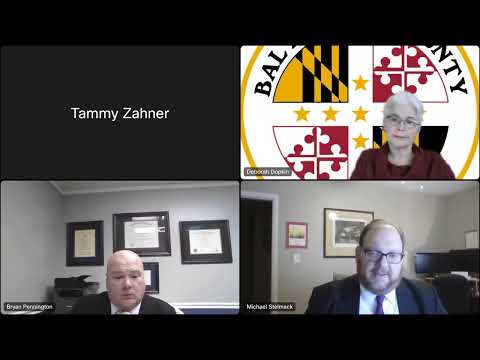
Hearing panel finds property not unique in Joseph and Lisa Stella variance petition for 3529 Bay Drive
Summary
A Baltimore County hearing panel concluded the property at 3529 Bay Drive did not meet the "uniqueness" requirement for an administrative variance, and members said collateral estoppel did not apply; the panel said it would issue a written opinion.
A Baltimore County hearing panel concluded during a recorded deliberation that the property at 3529 Bay Drive did not meet the legal "uniqueness" requirement for an administrative variance sought by Joseph and Lisa Stella, and the panel said collateral estoppel did not bar reconsideration of the matter.
The petition, filed as case number 24-095A, sought multiple variances, described in the hearing record as a request for "a side yard setback of 2 and a half feet in lieu of the required 50 feet, a street setback of 22 feet from the center line in lieu of the required 75 feet, and to permit 19% building coverage in lieu of the 15% requirement." Panel members said they had conducted a de novo hearing on Oct. 23 and were now deliberating toward a written decision.
Board member Topkin said she had "listened to the entire recording and read all the memoranda, studied the exhibits," and concluded that "collateral estoppel applies" did not — explaining the site's plan and facts differed from the earlier proceeding. Topkin added that she did not find the property sufficiently distinct from other waterfront lots on Bay Drive and therefore did not find the first prong of the variance test (uniqueness) satisfied: "I do not think it is as unique as Mister Richards would have us believe."
Board member Stelmack agreed that the earlier opinion cited by counsel did not include findings of fact the panel could rely on and noted factual differences: "The house there was, I guess, destroyed from the hurricane. It really had more to do with the house than the garage, which was, you know, essentially grandfathered at that point." Another panel member reviewed the Batson case cited by counsel and said the requirements for collateral estoppel were not met because the issue of uniqueness and practical difficulty had not been litigated in the prior opinion.
Panel members also expressed sympathy for the applicants but said sympathy did not equate to meeting the statutory standard. Topkin said applicants "have an absolute right to replace the garage," but that the petition had not met the legal standard for the requested variances: "I'm not unsympathetic. I just don't think they've met the law."
No roll-call vote or formal motion was recorded in the transcript. The panel indicated consensus that the uniqueness prong was not satisfied and that collateral estoppel did not apply, and the chair said the panel would go off the record and issue a written opinion reflecting its deliberations.
Background and procedure: The panel framed the matter as a petition for an administrative variance under the Baltimore County Zoning Regulations (BCZR), identified in the record as "BCZR section 1A.4.3.B.0.2(b)." The matter was described as located in the Fifteenth Election District, Fifth Councilmanic District. Panel members referenced a de novo hearing held Oct. 23 and a prior case (referred to in the record as the Batson case) when discussing collateral estoppel and whether prior findings could bind the panel.
The panel did not provide specific findings of law or a final written order in the transcript; it instead concluded deliberations and said a written opinion would be issued that will formalize the panel's conclusions.