Get Full Government Meeting Transcripts, Videos, & Alerts Forever!
Get email alerts on the Public Utilities Regulation topic
No spam. Unsubscribe anytime.
Committee rejects bill letting Public Service Commission pause parts of later rate cases during lawsuits
Summary
A legislative committee declined to give the Public Service Commission statutory authority to stay portions of subsequent general rate cases while earlier rate-case rulings are under judicial review, voting 3-2 after testimony from the bill sponsor, the commission and utilities.
Representative Tony Locke introduced House Bill 218 to the Corporations, Elections & Political Subdivisions Committee, saying the intent was narrow: to give the Public Service Commission an explicit statutory tool to stay portions of a later general rate case when a prior rate-case decision is being litigated on legal or procedural grounds.
The bill’s sponsor summarized the change as granting the commission flexibility. "May stay each part of the subsequent general rate case related to the issues under judicial review until the resolution of the judicial review including any appeal," Representative Tony Locke told the committee, describing the bill’s principal text.
Supporters and opponents gave conflicting legal and practical assessments. Chris Petrie, deputy chairman of the Public Service Commission, said the agency supported the engrossed, discretionary language because it preserves needed flexibility: "with the change to May ... it does leave the commission with critical discretion as to whether to implement a stay on any aspect of a rate case." Petrie said mandatory stays would risk operational problems such as "rate pancaking," where delayed recoveries accumulate and later are collected together.
Rocky Mountain Power's attorney, Nathan Nicholas, urged the committee to reject the bill on constitutional grounds. Nicholas told the panel the measure risked violating equal protection and due-process principles by singling out utilities that seek judicial review and by creating a punitive effect that would discourage litigation: "It's useless tool and it's unconstitutional, at its core," he said. Nicholas also pressed possible takings and separation-of-powers concerns and warned of rate shock from compounded deferred rate recoveries.
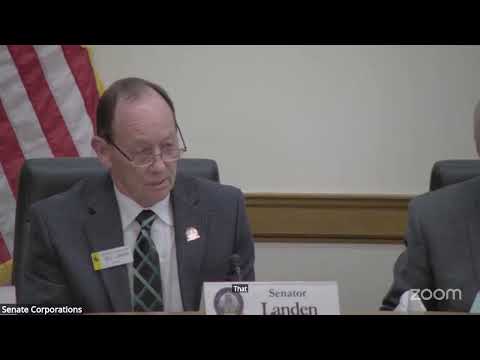
Committee members questioned scope and retroactivity. Senator Bonner asked whether the bill would apply to cases already in litigation; Representative Locke said the intent was not to reach back and change the law for already-completed proceedings, but committee discussion and later amendment negotiation focused on clarifying that effect. Committee members also probed whether the bill would apply to all types of utilities; Locke said it applied to any utility filing a general rate case but that the commission’s amendment narrowed the scope to general rate cases and replaced a mandatory "shall" with a permissive "may."
After a round of testimony and floor conversation, the committee adopted a handful of drafting amendments (including changing the word "requiring" to "authorizing" in one place) but split on the policy. A roll-call panel vote recorded three no votes and two ayes; the chair announced HB 218 "has failed the committee, and will be postponed." The committee discussion left open the possibility of revisiting the concept during the interim.
Votes at a glance: House Bill 218 — Committee action: failed. Recorded roll-call showed two ayes and three noes; the committee reported the measure postponed.
Why it matters: If enacted, the bill would have given the commission explicit statutory discretion to pause litigation-linked issues in subsequent general rate cases. Supporters said the change would help avoid legal uncertainty when the same legal rules are being disputed; opponents said it risks constitutional challenges and practical consequences for ratepayers and utilities.
Where it stands: The committee voted to postpone HB 218; sponsors or staff indicated the topic could be revisited in interim work or later sessions.