Get Full Government Meeting Transcripts, Videos, & Alerts Forever!
Get email alerts on the Fraudulent Documents Property Crime topic
No spam. Unsubscribe anytime.
Judiciary Committee approves felony penalty for use of fraudulent documents to claim property rights
Summary
The House Judiciary Committee unanimously advanced Senate File 11, a bill creating a felony offense for knowingly using false or fraudulent documents to gain or remain in possession of property, prompted by testimony about sophisticated fraudulent rental schemes and identity of squatters.
The House Judiciary Committee voted unanimously to advance Senate File 11, a two-page measure that makes it a felony punishable by up to 10 years in prison for a person who intentionally uses a document the person knows or reasonably should know is false or fraudulent to gain or remain in possession of property or to claim a right to property.
Committee members said the bill responds to increasingly sophisticated schemes in which people present forged leases or other documents to law enforcement or property owners to assert rights. Representative Chastick, a committee member, said the bill is intended to cover not only fake leases but also fraudulent claims such as forged liens.
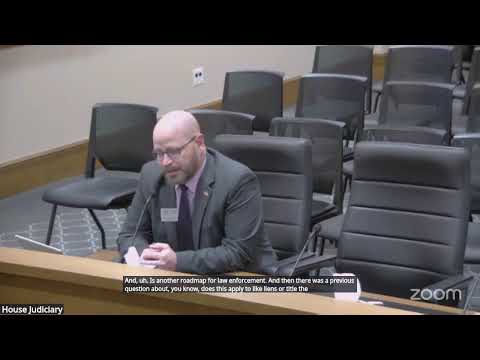
Alan Thompson, executive director of WASCOP, told the committee the provision provides prosecutors another tool for cases that can follow lengthy investigations into complex fraud schemes. "That doesn't mean he has rights to that property but it also doesn't mean he committed a felony because that investigation is gonna be a drawn out investigation to figure out ... who this third party person is," Thompson said, explaining that the statute creates an avenue for charging fraud after the facts are developed.
A lawyer for Wyoming Realtors, Miss Eberkite, testified in support, saying owners and tenants have seen increasingly sophisticated falsified documents used to delay eviction and that the statute would help address that trend. Representative Feiler asked whether the bill would place officers in the difficult position of determining document authenticity during initial encounters; Thompson and others countered that the measure targets post-incident investigation and prosecution rather than instant determinations at the scene.
The bill defines "document" broadly to include written, electronic or other forms and defines "property" as real property improved by a dwelling or structure. The text presented to the committee states explicitly that "a person is guilty of a felony, punishable by imprisonment of 10 years" for the described conduct.
Representative Filer moved the bill out of committee; Representative Singh seconded. On final roll call the committee recorded nine aye votes and no nays, advancing the measure to the House floor.
Committee discussion emphasized that law enforcement discretion during initial contacts is preserved and that this statute is aimed at giving prosecutors an additional charge for schemes that use forged or fraudulent documents to mislead victims and delay removal from property.