Get Full Government Meeting Transcripts, Videos, & Alerts Forever!
Get email alerts on the Missing Persons Reporting topic
No spam. Unsubscribe anytime.
House Judiciary Committee advances bill requiring prompt reporting of missing persons to NCIC and NamUs
Summary
The House Judiciary Committee reviewed and amended Senate File 114, directing Wyoming law enforcement to accept credible missing-person reports without delay and to enter records into federal and national clearinghouses; the committee approved the bill as amended.
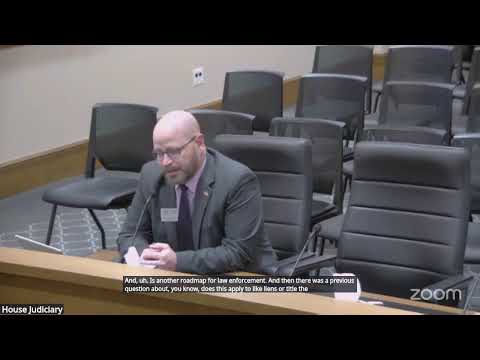
The House Judiciary Committee on Valentine’s Day considered Senate File 114, a bill that would require Wyoming law enforcement agencies to accept credible reports of missing persons without delay and to enter required information into federal and national clearinghouses such as the National Crime Information Center (NCIC) and the National Missing and Unidentified Persons System (NamUs). The committee adopted an amendment adding the words “without delay” to a clause about which agency will accept a report and voted to advance the bill out of committee 9-0.
Senator Landon, the bill’s sponsor, told the committee the measure grew from work by sheriffs, chiefs of police and the Attorney General’s Office to address inconsistent handling of missing-adult reports. "This bill describes a process that prioritizes which agency is responsible for accepting the report and thus, diminishing that duplication," he said, describing the proposal as a way to reduce delays and confusion among agencies and nonprofit search groups.
The bill is intended to fill gaps for missing adults that advocates and law enforcement say exist in Wyoming. Kara Chambers of the Wyoming Attorney General’s Office told the committee the language is meant to ensure agencies accept reports even when the missing person is not a Wyoming resident or was last seen out of state. "If the person is a Wyoming resident, even if they went missing in another state, Wyoming can take the report," Chambers said.
Advocates described gaps in current practice. Desiree Tonoco, director and founder of Missing People of Wyoming, said her nonprofit began as a Facebook group and now has about "nearly 35,000 members," and that inconsistent reporting has left many cases out of federal databases. "This is why this bill is so important because it will incorporate standards for reporting missing people that most states already have," Tonoco said in remarks read by Chambers.
Sheriff Blackburn, testifying by video, and Alan Thompson, executive director of WASCOP (Wyoming Association of Chiefs and Sheriffs), described cases in which a vehicle or other evidence suggested a missing person but no report had been entered in a timely way. Thompson said the bill narrows exceptions and "require[s] more acceptance of it," making it clearer to law enforcement what the expectation is.
Lena Deckert of the Wyoming Survey and Analysis Center at the University of Wyoming presented research the state commissioned showing 40 states plus the District of Columbia have mandates requiring entry of missing-adult cases into state or federal databases; by contrast, Wyoming currently lacks a statutory requirement. Deckert told the committee the center did not make a recommendation but provided the landscape to inform policy discussion.
Key provisions discussed and clarified in the hearing include required timelines for database entry: the bill distinguishes juveniles and adults, naming a 2-hour NCIC reporting requirement for anyone under 21 and an 8-hour requirement for adults over 21. Committee members pressed for precision on a clause that would permit an agency to decline taking a report if another agency "will accept" it; Representative Webb proposed and the committee adopted an amendment inserting the words "without delay" after "will accept" to reduce the chance that responsibility would be deferred and cause a report to languish.
Representative Webb moved the amendment, which passed on a roll call. The committee then voted to pass Senate File 114 as amended; the chair indicated he would carry the bill to the House floor.
The bill’s text also directs timely reporting to the NCIC and to the National Missing and Unidentified Persons System (NamUs) so information can be broadcast statewide and nationally. Witnesses and lawmakers repeatedly emphasized that faster database entry increases the chance of finding evidence and getting information to the public and partnered organizations quickly.
The bill drew support from law enforcement groups, the Governor’s office and nonprofits that work with families of missing people and with tribal communities. Kit Wintland, special counsel and policy adviser for Gov. Mark Gordon, and James Sorrells, the governor’s liaison, told the committee the governor supports the measure and noted the Missing and Murdered Indigenous Persons Task Force’s work to improve coordination.
The committee recorded the amendment and final action in public session and gave the bill a do-pass recommendation; committee members said the bill could be further refined in subsequent steps but expressed broad support for reducing delays and improving statewide reporting.
Votes at a glance: the committee adopted Representative Webb’s amendment (insert the words "without delay" after "will accept") and advanced Senate File 114 as amended. The amendment and the committee’s do-pass action were recorded as 9 ayes, 0 nays.