Get Full Government Meeting Transcripts, Videos, & Alerts Forever!
Get email alerts on the Tourism Promotion Districts topic
No spam. Unsubscribe anytime.
Ohio committee hears second hearing on bill to allow hotel-led tourism promotion districts
Summary
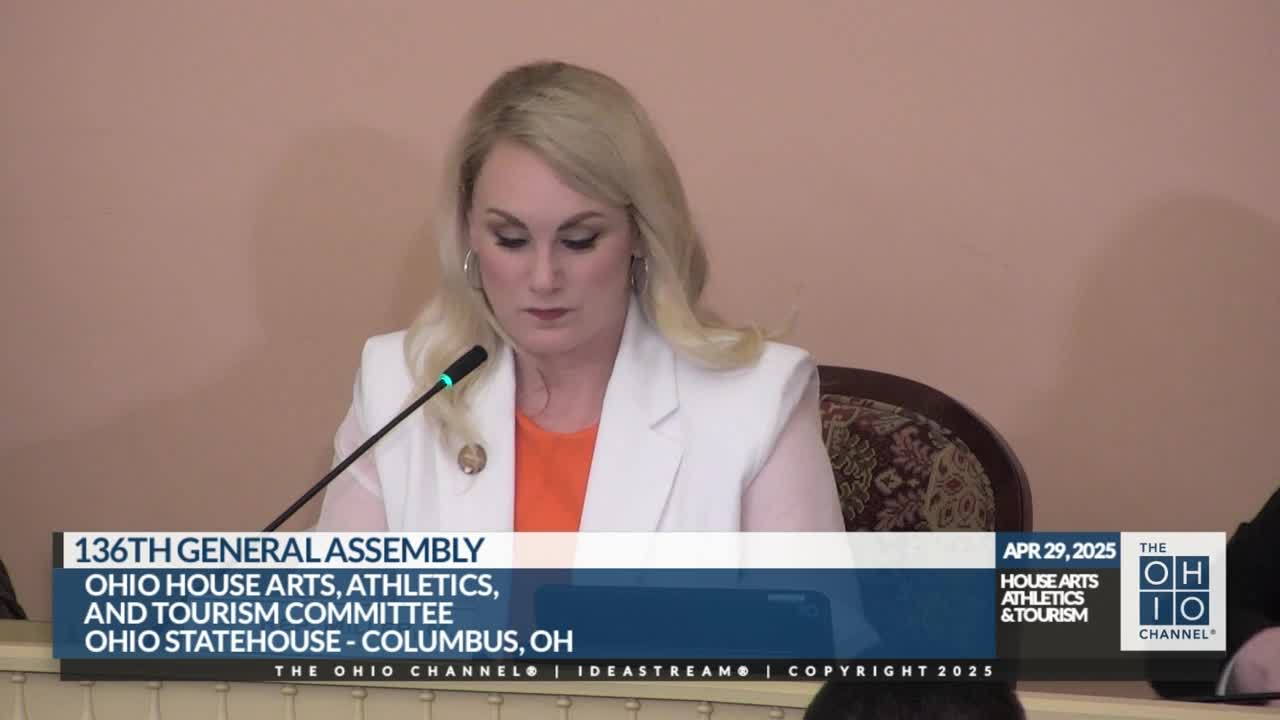
House members held a second hearing on House Bill 138 on the House Arts, Athletics and Tourism Committee, during which proponent witnesses from Destination Cleveland, Experience Columbus, hotel operators and a funding consultant outlined how locally formed tourism promotion districts could increase visitor spending while committee members probed constitutional, competitiveness and oversight concerns.
House members held a second hearing on House Bill 138 on the House Arts, Athletics and Tourism Committee, during which proponent witnesses from Destination Cleveland, Experience Columbus, hotel operators and a funding consultant outlined how locally formed tourism promotion districts could increase visitor spending while committee members probed constitutional, competitiveness and oversight concerns.
The bill would permit a local community, at the request of local hotel businesses, to create a tourism promotion district (TPD) that can levy a compulsory assessment on lodging to fund destination marketing, event support and other visitor-related services. "We are the civic organization that markets Cleveland to consumers and convention planners outside of the region," said Gordon Taylor, chief sales officer for Destination Cleveland, describing how tourism currently drives Cleveland’s economy and how a TPD could have helped hotels that hosted the American Society of Association Executives conference in 2024.
Why it matters: proponents said the districts would generate incremental revenue from visitors — not local taxpayers — that can be used to attract conventions and overnight stays, which they argued produce significantly more local spending than day-only visitors. "A visitor that stays the night spends three times more money than a visitor that comes in for the day," said Brian Ross, president and CEO of Experience Columbus, who told the committee Columbus had $8.2 billion in direct visitor spending in 2023 and that those dollars support restaurants, retail and transportation as well as hotels.
Proponents’ pitch and examples
Representatives of major hotels and destination marketing organizations said the TPD is a permissive tool that communities could adopt only if local hotels vote to create a district and agree on boundaries, assessments and a plan. Steven Stewart, general manager of Hyatt Regency Columbus, and Bob Magazini, general manager of the Cleveland Marriott Downtown at Key Tower, told the committee HB 138 would allow hotel communities to tailor districts to local needs. "HB 138 gives those in this space the ability … to set up these districts as we feel is needed," Stewart said.
Several witnesses emphasized that similar districts already exist in other states: "Tourism promotion districts are a proven funding tool used in more than 200 communities across 23 states," said Adam Oakley, general counsel for the Pizzuti Companies, echoing other testimony. Witnesses described typical uses including marketing to out-of-region travelers, events support, and coordinated sales efforts to secure large conventions.
Committee scrutiny: taxation, competitiveness, oversight and boundaries
Committee members asked detailed questions about potential legal and economic downsides. Ranking Member Representative Jerrells asked how the bill reconciles language that could encumber existing lodging-tax revenues with what he called "Ohio's constitutional restrictions on appropriation authorities." Gordon Taylor said he could not speak to the bill’s legal mechanics and that decisions about assessments and boundaries would rest with the hotels and districts if the law permits them to form.
Several members raised competitiveness concerns: if a locality already has a high lodging tax rate, adding an assessment could make the market less competitive for price-sensitive groups. "We have some of the highest taxes when it comes to hotels," Representative Jerrells said in questioning, and asked whether consumers could be deterred by higher total rates. Proponents responded that host communities typically study competitive sets and that small increases have not always moved average rates above peer cities; Experience Columbus shared internal analyses indicating Columbus’s average rates remain low compared with many peers.
Members also asked about equity for smaller, family-owned lodging properties and the possibility that a single large hotel or chain could initiate a district that spans distant jurisdictions. "House 138 allows a single hotel to initiate these districts," Jerrells observed, and asked whether a district could stretch across counties in ways that would misalign priorities. Witnesses and the consultant said boundaries are a local decision and that multi-jurisdictional districts are common because travelers view destinations across municipal lines; John Lambeth, president and CEO of Civitas, said districts generally focus on points of consensus where stakeholders agree there will be benefit to tourism.
Accountability and legal classification
Committee members sought specifics on oversight and transparency. Representative Jerrells noted the bill’s plan requirements can be brief and asked how the public could confirm funds are spent as promised. Oakley and Lambeth said the statute includes oversight provisions such as annual reporting and that districts are typically governed by boards composed primarily of assessed hotels; Lambeth added that local governments retain authority to intervene if funds are misused.
On whether assessments are a tax, Lambeth said: "I would not call it a tax. It's compulsory. The reason I say it's not a tax is the word assessment normally has a connotation of benefit, meaning we have to give benefit back to, in this case, the hotels, the primary payers." He added that assessments are compulsory in effect and that transparency to consumers is important: "It absolutely has to be disclosed. But in advance, it has to be disclosed."
What happened at the hearing
The committee heard proponent testimony from: Gordon Taylor (Destination Cleveland); Steven Stewart (Hyatt Regency Columbus); Bob Magazini (Cleveland Marriott Downtown at Key Tower); Adam Oakley (Pizzuti Companies); Brian Ross (Experience Columbus); and John Lambeth (Civitas, consultant). Committee members pressed witnesses on constitutional limits, the effect on consumer prices, the treatment of small lodging operators, multi-jurisdictional boundaries and reporting requirements. Several witnesses pledged to follow up with more state comparisons or legal details where they could not answer on the spot.
Next steps
No committee vote was taken at the second hearing. Chairwoman Miller closed the session and reminded members of an upcoming tourism roundtable and additional testimony scheduled for the next committee meeting.
Ending note: The bill’s supporters framed HB 138 as a permissive, hotel-led tool to increase overnight stays and visitor spending; committee members said they will continue to scrutinize the bill’s interactions with existing lodging taxes, disclosure requirements and how districts will be bounded and governed.