Get Full Government Meeting Transcripts, Videos, & Alerts Forever!
Get email alerts on the Open Government topic
No spam. Unsubscribe anytime.
Douglas County commissioners briefed on Kansas open-meetings and records rules after expansion to five-member panel
Summary
Douglas County Board of County Commissioners held a work session on Jan. 15, 2025, to review the Kansas Open Meetings Act and the Kansas Open Records Act as the board transitions from three to five members, County Counselor John Bullock told commissioners.
Douglas County Board of County Commissioners held a work session on Jan. 15, 2025, to review the Kansas Open Meetings Act and the Kansas Open Records Act as the board transitions from three to five members, County Counselor John Bullock told commissioners.
The session, which was informational and did not accept public comment or include votes, focused on when gatherings of commissioners become open-meetings events, how electronic communications can create a meeting, the rules for executive sessions, and how public-records requests are handled under Kansas law.
John Bullock, county counselor, told the commission, “If I know the answer, I’ll tell you. And if I don’t, I’ll get it for you.” He framed the session as an opportunity to discuss practical steps for compliance as the board’s quorum threshold changed from two to three members when the body expanded to five.
Defining a meeting and the risk of “serial” meetings
Bullock summarized the legal test used to identify a meeting under the Open Meetings Act: a gathering of a majority of the body that involves interactive communication about the business or affairs of the commission. He said simply appearing together in public does not automatically create a meeting, but added that discussing official business in those settings does.
When Commissioner Gene Dorsey asked whether three commissioners attending the same public event before they were sworn in would be permissible, Dorsey said, “Last Sunday … three of us attended a meeting. And I’m pretty confident none of us knew the other two were gonna be there. Is that permissible?” Bullock replied that such attendance is allowed, noting, “It’s okay. Provided that you’re avoiding the characteristics that create a meeting.”
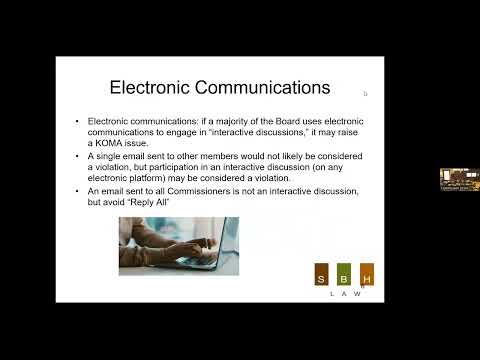
Bullock warned that electronic interactions — texts, emails, social-media posts and “reply all” messages — can create the appearance or substance of an interactive discussion. “Please, at all times, avoid reply all,” he said, explaining that staff often adds that admonition when sending email to multiple commissioners to prevent inadvertent interactive communications.
Staff briefings, scheduling and staff coordination
Bullock told commissioners it is appropriate for staff to brief individual commissioners and to coordinate non-decisional items such as schedules or attendance at community events. He cautioned, however, that it would be improper for staff to conduct a serial poll of commissioners (for example, soliciting individual reactions and relaying them to others) if the intent is to facilitate an agreement among a majority.
Executive sessions and privileged topics
The presentation reviewed statutory exceptions that can justify recessing into executive session, including personnel matters, attorney–client privileged communications, preliminary discussions on real-property acquisition and trade secrets in economic-development negotiations. Bullock said motions for executive session should state the subject matter and the statutory justification without revealing confidential details, and must state when the open meeting will resume.
Bullock noted the attorney–client privilege belongs to the government entity, not any individual commissioner, and that an individual commissioner cannot unilaterally waive that privilege. He also warned that asking county counsel detailed legal questions in open session can waive privilege by making the answer part of the public record.
Ex parte communications, due process and quasi-judicial matters
The counselor described the distinction between legislative matters and quasi-judicial matters (such as individual land-use decisions). He said there is no general statutory requirement to disclose ex parte contacts, but when the board considers a quasi-judicial matter, applicants must have a fair opportunity to respond to evidence the commission will consider. In those cases commissioners should disclose the gist of any outside communications about the matter so the applicant can address them during the hearing.
Open records (Kansas Open Records Act)
Bullock reviewed the county’s practice under the Kansas Open Records Act, stressing that records are presumed open but that the statute contains numerous exemptions. He told the commission that responsive records may reside on county servers, staff computers or personal devices, and recommended using official email accounts for county business to simplify searches in response to public-records requests. “They can live on your cell phone, they can live on your tablet, they can live in your file cabinet at home,” Bullock said.
He said the county seeks to work cooperatively with requesters to narrow broad or burdensome requests and to apply statutory exemptions where appropriate. Bullock noted that the statute contains more than 50 exceptions; the county cites any exception relied upon when withholding material and seeks to be transparent about what it does and does not provide.
Public comment and meeting procedures
Bullock told the commission that Kansas law does not require public-comment periods, but the county’s practice is to allow public comment at business meetings. He reiterated that final action must occur in public and that the commission should avoid deciding votes or forming binding agreements outside of noticed public sessions.
No formal actions taken
The Jan. 15 work session was informational. No votes or formal actions were taken during the work session; the board recessed until its 5:30 p.m. business meeting, where public comment and votes occur.
Ending
Commissioners said they appreciated the refresher and indicated they would continue to develop office practices (for example, routing scheduling requests through staff and using official accounts for county business) to reduce the risk of inadvertent open-meetings or open-records problems. The county counselor offered to return for follow-up questions as the new five-member commission establishes norms.