Get Full Government Meeting Transcripts, Videos, & Alerts Forever!
Get email alerts on the Infrastructure Services topic
No spam. Unsubscribe anytime.
Baltimore County staff present 2025 Basic Services maps; sewer deficiency remains at Richland Manor, 10 traffic intersections marked Level F
Summary
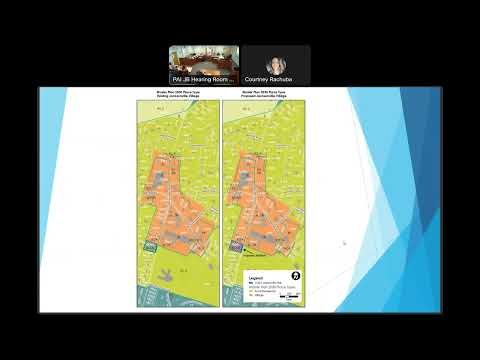
County staff told the Planning Board on Feb. 6 that the 2025 Basic Services maps show no water deficiencies, one sewer-deficient area at the Richland Manor plant and 10 traffic intersections rated Level F.
Baltimore County Department of Public Works and Transportation staff presented the county's 2025 Basic Services maps for public water, sanitary sewer and transportation at a Planning Board public hearing Feb. 6.
Andrew Brown, project manager in the Bureau of Engineering and Construction (Sewer Design), told the Board that the water basic services map "remains no deficient areas," reporting that hydrant fire-flow testing met the required standards. Brown said fire-flow testing follows the standards of the National Board of Fire Underwriters and is performed by the City of Baltimore on a multi-year cycle.
On sewer, Brown said the 2025 map shows one deficient area and five areas of concern, unchanged from the prior year, but noted the county completed substantial rehabilitation work in 2024. "In 2024 alone, over 18,000 feet of new or replacement sewer mains were installed," Brown said, and the county rehabilitated more than 74,000 feet of sewer main. Those projects have enabled the county to begin closing sanitary sewer overflow (SSO) structures in several locations, he said.
Brown identified the deficient area as the Richland Manor Wastewater Treatment Plant in Perry Hall. He said during heavy rain the plant's incoming flow can exceed 80% of its reserve capacity, and under Maryland Department of the Environment (MDE) guidance the plant is considered deficient during those conditions. Brown said the county has completed one rehabilitation project in the area, is permitting a second, and is advancing a project to build a pumping station that will ultimately replace the treatment plant.
The five areas of concern are the Herring Run/Parkville area (SSO structure noted as closed on Jan. 23 for structure 401 but change came too late for the 2025 map), Marnat Road (SSO 113), Brooklynville (a designation influenced by County Council Bill 17-24), Powder Mill (SSO structures 22, 203a, 23b and 24), and Catonsville (SSOs 116, 117 and 118). Brown said closures and relief sewers will allow the county to remove some areas from the map, but several closures depend on projects or relief sewers to be constructed by Baltimore City or by private developers as conditions of development approvals.
Christopher Nebre of the Traffic Engineering Bureau presented the transportation basic services map. "We have 10 level of F intersections and 1 level of E intersection," Nebre said, listing the Level F intersections presented: National Pike at Rolling; Delona at Charles; Bloomsbury at Frederick; Burke at York; Falls at Seminary; Falls at Joppa; Falls at Green Spring Valley; Falls at Chowan; Frederick at Rolling; and Joppa at Loch Raven at Perring and Putty Hill (transcript list paraphrased). He said the E intersection was identified at Joppa and Perring Parkway.
Nebre noted that some changes from the 2024 map reflect Council bills that modified shed boundaries (the presentation cited Council Bill 17-24 as an example affecting the Frederick Road/South Rolling Road shed). He also said reserved trips for the intersection of Perring and Joppa increased from 17 to 83 for a developed site; that change appeared on the 2025 map.
Board members asked staff about coordination with Baltimore City (for sewer relief sewers), how the Basic Services maps interact with county redevelopment goals and revitalization districts (staff said revitalization districts are exempt from the moratorium tied to Level F traffic sheds), and when changes in state or council legislation would take effect. Brown and Nebre emphasized many sewer improvements require multi-year projects, permits and, in some cases, cooperation with outside agencies under a consent decree.
The public hearing drew no members of the public to speak on the maps; the Board closed the hearing after questions and discussion.