Get Full Government Meeting Transcripts, Videos, & Alerts Forever!
Get email alerts on the Municipal Services Infrastructure topic
No spam. Unsubscribe anytime.
City presents municipal services overview; officials flag $1.6B–$2.1B deferred maintenance and staffing shortfalls
Summary
City staff presented an overview of Public Works, Utilities and Youth, Parks and Community Enrichment, describing daily operations, funding sources, deferred-maintenance backlogs, vacancy rates and near-term budget strategies including fees, rate adjustments and technology investments.
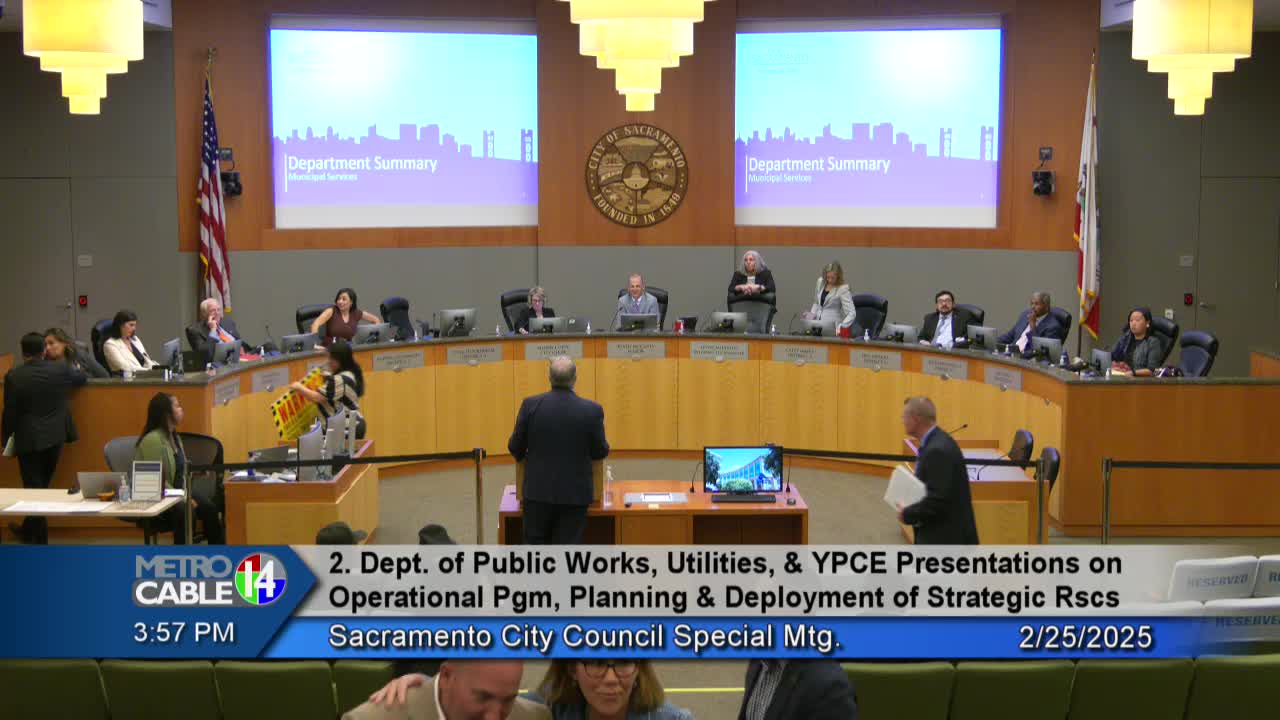
City department heads on Wednesday gave a consolidated briefing on Municipal Services that summarized operations, funding and critical infrastructure needs across Public Works, Utilities, and Youth, Parks and Community Enrichment (YPSI).
Assistant City Manager Ryan Moore introduced the session and described municipal services as an extensive portfolio of daily functions the city performs "literally everywhere in the city of Sacramento every day." The presentation covered operating budgets, staffing, deferred maintenance backlogs and near-term fiscal strategies.
Nut graf: Presenters said the city relies heavily on enterprise funds, grants and Measure U; they flagged multi-hundred-million-dollar deferred-maintenance backlogs in parks and buildings and multibillion-dollar needs in transportation and utilities, and recommended a mix of fee adjustments, technology investments and targeted efficiencies to maintain core services.
Public Works Director Matt Eierman summarized that department's scope and scale: 768 employees, roughly a $241 million operating budget and responsibility for 3,100 lane miles of roadway, 40,000 streetlights and 152 city-owned facilities. He reported a 22% vacancy rate in Public Works and a transportation deferred-maintenance backlog of about $1.6 billion and a facility backlog of roughly $120 million.
"Our work touches nearly every aspect of daily life," Eierman said, listing storm and flood protection, traffic signals and an inventory of more than 100,000 trees. He described illegal dumping as an ongoing workload (roughly 1,600 service calls and 5.6 million pounds of refuse removed annually) and noted the department's capital-investment and grant activity.
YPSI Director Jackie Beauchamp described recreation, parks and youth programming across 237 parks, 15 community centers and 17 pools, with a $67 million departmental budget (about $46 million funded by Measure U). She said YPSI issued nearly 3,000 park permits and saw more than 34,000 older-adult visits last year; the division reported a deferred-maintenance backlog exceeding $130 million across parks and facilities.
Beauchamp also outlined a scholarship fund and fee-waiver programs for youth and older adults; she said the department had approved about 254 scholarships to date and has awarded more than $62,000 for aquatics scholarships during the current fiscal cycle.
Utilities Director Pravani Vandia described water, wastewater and drainage operations and the regulatory complexity those services face. She said utilities is responsible for roughly 1,600 miles of drinking-water distribution pipe, two drinking-water treatment plants, more than 25 billion gallons of treated water annually and wastewater/drainage systems with more than 880 miles of pipe.
Vandia gave the largest consolidated deferred-maintenance figure: about $2.1 billion across water, wastewater and drainage systems. She also said the city must balance rate-setting constraints (Proposition 218 rules) with regulatory mandates and the rising costs of specialized staffing and infrastructure work.
Directors identified a menu of near-term budget strategies: fee and rate adjustments phased to reduce sudden impacts, parking-meter expansion and modernization, permit/validation updates, workforce retention efforts, and targeted use of automation and customer-service technology. Eierman and Vandia said automated enforcement and improved reporting systems could reduce response costs and improve data for prioritizing investments.
Councilmembers asked about grant-seeking capacity, partnerships and use of technology to maintain service levels with fewer staff. Beauchamp said the department will pursue state grant programs and work with neighborhood associations and private partners for matching funds and capital projects. Vandia and Eierman noted that many regulatory mandates arrive with little lead time and require rate adjustments to fund compliance work.
Ending: The presentation was informational and council members asked for follow-up detail on proposed fee changes, scholarship program outcomes and potential avenues for bond or grant funding to reduce deferred maintenance. No votes were taken; staff said they will supply additional budget and program-level proposals as the fall budget process proceeds.