Get email alerts on the Prison Funding And Staffing topic
No spam. Unsubscribe anytime.
Governorproposal seeks nearly $459 million in amended FY25 to boost Georgia prisons staffing, contraband interdiction and facility repairs
Summary
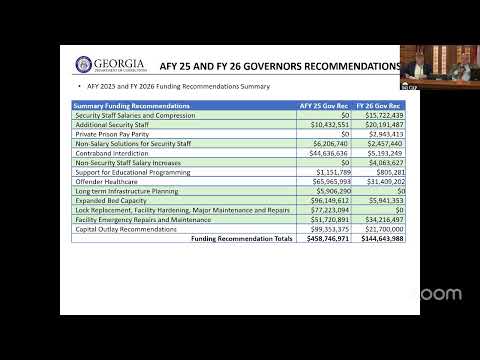
The governor's office and Georgia Department of Corrections outlined a package of amended FY25 and FY26 budget requests totaling roughly $458.7 million in FY25 and $144.6 million in FY26 to add correctional staff, upgrade locks and security technology, expand bed capacity and cover rising inmate health costs.
ATLANTA — The governor's office and the Georgia Department of Corrections presented a multi-part budget package to the Joint Appropriations Subcommittee on prisons seeking $458.7 million in the amended FY25 budget and $144.6 million in FY26 to address staffing shortfalls, contraband brought by cell phones and drones, aging lock and control systems, and rising health-care costs.
The proposal, presented to the subcommittee by Commissioner Tyrone for the Department of Corrections, would fund hiring and compensation changes, technological investments such as managed-access cell-phone interdiction and officer tablets, expanded drone detection and digital forensics capacity, and large capital outlays including modular housing units and lock-control replacements.
The governor's recommendations incorporate consultant findings from Guidehouse, the Moss Group and CGL, Commissioner Tyrone said, and divide items into near-term operational requests (staffing, tablets, body cameras) and capital or multi-year projects (modular units, lock replacements, a proposed long-term acute care unit).
Staffing and pay: Commissioner Tyrone said the department currently lists about 26,100 open positions systemwide and is proposing targeted hires and pay adjustments rather than attempting to fill the entire vacancy count immediately. The package includes funding to add 882 correctional officers (presented as phased hires) and career-path salary schedule changes; a separate FY26 line would provide a 4% salary increase for correctional officers. Tyrone said hiring and net retention has improved recently: the department netted 672 officers in FY23, 569 in FY24 and 243 year-to-date in FY25.
Recruitment and training: The request includes $2.8 million to centralize and enhance recruitment and retention marketing (the department's vendor was named as Chanley Group in testimony), $900,000 for scenario-based training simulators, and funding for officer tablets (about $2.5 million in amended FY25 and $2.4 million in FY26). Tyrone said 1,050 tablets were deployed and the plan is to reach roughly 1,600 statewide and bring all 35 state prisons live by the end of calendar year 2025.
Contraband and safety technology: The package seeks substantial funding for managed-access cell-phone interdiction and related managed-access infrastructure with a request described in the presentation as funding managed access and interdiction at additional locations (the testimony cited a total of 27 locations after expansion) and $34 million was shown for that work. The proposal also includes drone detection at two additional locations, bringing the total to 25 systems, at a cited cost of $966,000, and $1.4 million for a digital forensics unit to analyze contraband phones and devices. Tyrone testified the newer managed-access systems the department is piloting capture more signals and are more effective than older systems.
Use-of-force and accountability tools: The governor's plan would replace and standardize body cameras and taser systems (funding shown as $2.7 million in amended FY25 and $1.7 million in FY26). The recommended devices integrate taser activation with automatic camera recording; Tyrone said the vendor (Axon) provides an audit trail showing timestamps, trigger activations and related metadata, and that policies generally require cameras be on during use-of-force incidents.
Offender services and health care: The department requested $50.9 million in amended FY25 and $31.2 million in FY26 for increases in contracted physical, pharmacy, mental and dental costs tied to population growth. The package also seeks $15 million in amended FY25 (and a smaller FY26 amount) to establish department-owned electronic health records so GDC would control clinical data rather than depend on a private vendor. Tyrone described a proposed long-term acute care (LTAC) unit to bring high-cost, hospital-level care behind the wire; the request showed $6.2 million in FY26 and testimony estimated current off-site acute-care claims at about $2,000 per day and roughly $16 million annually.
Education and reentry programming: The governor's plan would fund replacement Chromebooks (about $450,000 in amended FY25) and expand GED testing capacity (a $701,000 contract increase tied to growing demand). The department cited recidivism reductions among inmates who complete educational and vocational programming: examples provided included a 20.9% recidivism rate for education participants and 13.6% for vocational programs.
Facility infrastructure and beds: The package asks for $93.2 million in amended FY25 to deploy four high-security modular housing units (described as 504 additional beds, double-bunked in the planned configuration) to free state beds for lock and control replacements and other major repairs. The presentation also requests funds for lock and control system design and construction at multiple facilities, a series of major repair and maintenance items, and project management: a backlog and repair pool of tens of millions of dollars was shown across several budget lines. Tyrone testified the lock-and-control work and facility hardening will take multiple years and that modular units can be delivered and sited faster than building new permanent capacity.
Questions from committee members focused on implementation details: how many of the 26,100 open positions are currently funded, the timeline for bringing all lock and control replacements online (testimony cited a multi-year effort estimated at about five to six years), the projected return on investment for an LTAC unit, and whether private prisons have additional capacity that could be used more quickly than modular construction. Tyrone and staff said some private beds (about 446 beds cited) are available under contract and that modular units could be on-site within roughly a year.
What happens next: Committee members repeatedly said they would press the department for further detail on costs, timelines and procurement approaches (for example, how project managers and tiger teams would be funded and how contracting would be managed). No formal votes or appropriations were recorded during the presentation; the briefing concluded with members asking staff for follow-up breakdowns and timeline details and with the subcommittee adjourning.
Ending: The presentation summarized the governor's recommended total of about $458.7 million in amended FY25 and $144.6 million in FY26 and the commissioner asked for the subcommittee's favorable consideration. Committee chairs and members signaled they would continue detailed review and follow-up hearings before any final appropriation decisions are made.
AI generated
The text on this page is AI generated. Summaries, highlights, and analysis are all produced from the original source material.
AI can make mistakes, so if you spot one, and we will fix it for everyone.
Note: the source content is unaltered by us. Any content source we link to, be it a video, an audio recording, a transcript, or a document, is presented exactly as its publisher released it. That publisher is usually a government body, sometimes an individual official or another organisation.