Get Full Government Meeting Transcripts, Videos, & Alerts Forever!
Get email alerts on the Lone Fir Memorial Apology topic
No spam. Unsubscribe anytime.
County briefed on Lone Fir memorial design and community request for apology over Chinese section erasure
Summary
Multnomah County commissioners heard a presentation on the history of the Chinese section of Lone Fir Cemetery and a community request that the county issue a formal apology for past actions that led to the erasure of graves and funerary practices.
Multnomah County commissioners heard a presentation on the history of the Chinese section of Lone Fir Cemetery and a community request that the county issue a formal apology for past actions that led to the erasure of graves and funerary practices.
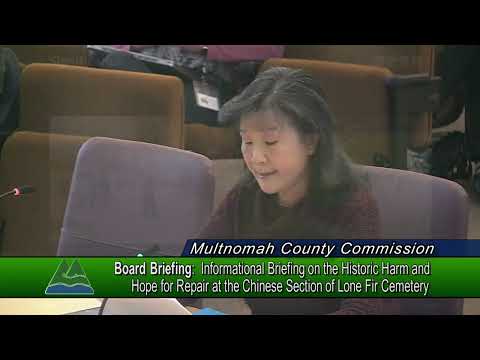
The presentation, given to the Board of Multnomah County Commissioners during a board briefing, combined archival research, community testimony, and preliminary designs for a memorial and interpretation at Block 14, the burial area historically used by Portland’s Chinese community. Helen Ying, immediate past president and current vice president of the Portland Lodge of the Chinese American Citizens Alliance, and Karen Vick Kaye, senior planner with Metro and project manager for the memorial, led the presentation along with Michael Yuan, principal and lead designer at KNOT Studio.
The request for an apology grew from community meetings and research that documented removal of burials, incomplete cemetery records, and construction over portions of the Chinese burial ground in the mid-20th century. Karen Vick Kaye said research identified "a minimum of 2,892 Chinese people" once buried at the site and that cemetery sextons recorded burial names or locations less than 10 percent of the time. A traditional plaque at the historic altar reads, "We honor you as though you were present."
Designers showed an approach that blends a ‘‘grove’’ of culturally significant ginkgo trees with a memorial pavilion containing spirit tablets engraved from recovered burial ledgers. Michael Yuan said the preferred concept, called the Opening, combines a quiet grove for reflection, restored ritual elements and a pavilion to display tablet inscriptions and interpretive material so the site can serve for public education and ancestor practices.
Metro has allocated $4,000,000 from parks and bond funds to the memorial design and construction. Kaye told commissioners the project team’s 60% design cost estimate puts the full project around $4,600,000, leaving an approximate $2,300,000 capital gap after prior consultant and outreach costs. She said roughly $1,000,000 of Metro funds has been used for consultant fees and about $500,000 for research, outreach and permitting, leaving about $2,300,000 available for capital construction at this time. Kaye estimated ongoing operations and maintenance at roughly $50,000 per year, or an endowment on the order of $1,700,000 to $1,800,000 to cover perpetual upkeep.
Commissioners who spoke praised the community-led work and said an apology is warranted. Commissioner Grama Edwards said, "Personally I think an action, an apology is definitely called for given the historic harm by Multnomah County officials." Commissioner Moyer said the memorial would be "a very appropriate and valued addition to the cemetery." Commissioner Jones Dixon, who identified herself as a funeral professional, said she was "fully supportive" of drafting an apology and allocating funds to advance the memorial.
No formal vote or ordinance was taken during the briefing. Commissioners expressed support for continuing to work with community partners and Metro; several commissioners said their offices will coordinate next steps on timing and scope. The project team said construction documents are underway and the project is expected to go out to bid in the coming summer, subject to funding and permitting.
Background presented at the briefing traced use of Block 14 for Chinese burials beginning in the late 19th century, the presence of funerary infrastructure such as an altar and bone house, and mid-20th-century removal of some burials to make way for a county building. The county building was later deconstructed and the land transferred to Metro, which reincorporated it into Lone Fir Cemetery. Community advocates located burial ledgers and prompted archaeological surveys that found evidence of human remains, prompting the memorial planning effort and public discussion about repair.
Speakers emphasized that work on the site must avoid ground disturbance where ancestors may remain. The designers described an Area 3 approach with minimal ground disturbance and raised/imported materials in sensitive zones to protect possible remains while allowing ritual practice and interpretation.
The county briefing ended with commissioners committing to continued engagement with community organizations, Metro and the design team to refine funding, timing and potential county involvement in an apology and long-term stewardship.
At the conclusion of the item the board moved on to other agenda matters; no county resolution or formal vote on an apology was adopted during the briefing.