Get Full Government Meeting Transcripts, Videos, & Alerts Forever!
Get email alerts on the Budget Recommendation topic
No spam. Unsubscribe anytime.
Open Space committee recommends FY2026 budget to Board; explains funding sources and undesignated account
Summary
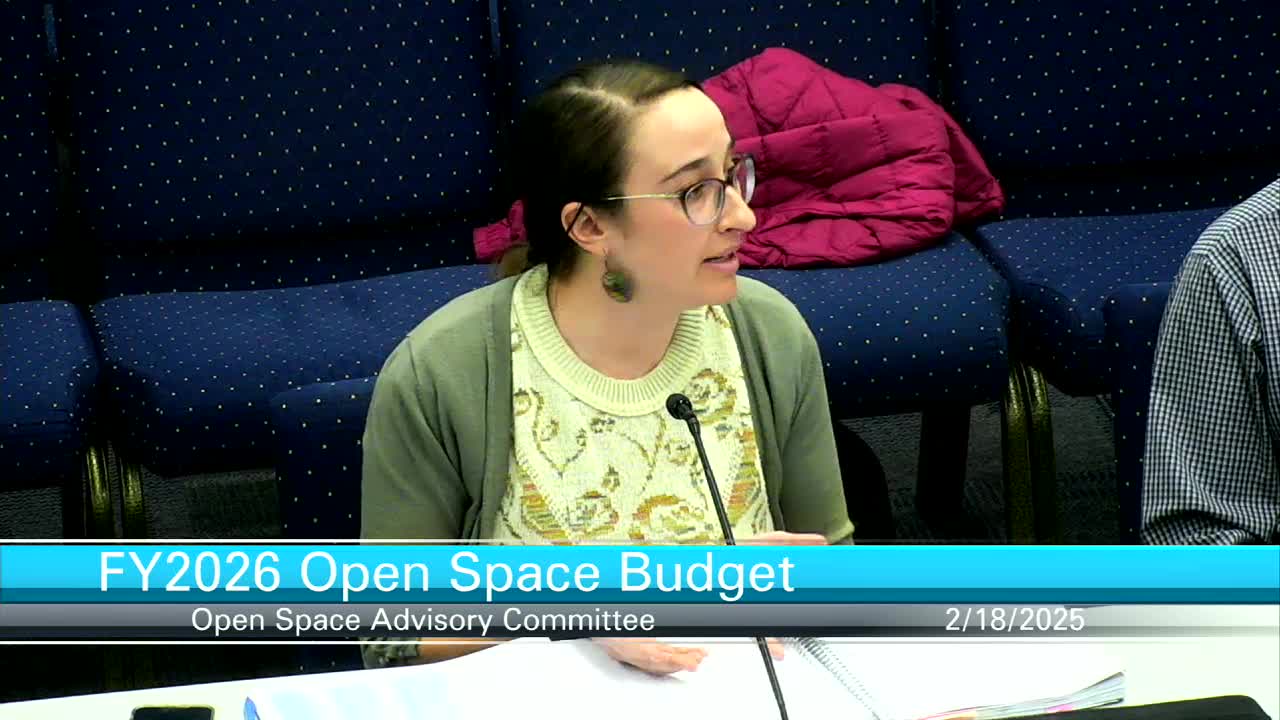
After a staff presentation, the Open Space Advisory Committee voted unanimously to recommend the draft fiscal-year 2026 open space budget to the Carson City Board of Supervisors. Staff outlined the Question 18 sales-tax funding split, existing grant-backed projects and the city’s undesignated open-space savings account.
The Carson City Open Space Advisory Committee voted unanimously to recommend the draft fiscal-year 2026 open space budget to the Board of Supervisors.
Lindsay Boyer, open space manager, provided a budget overview that tied the draft FY2026 spending plan to the previously approved “Question 18” quality-of-life sales tax. “We are funded by the quality of life, sales tax initiative, question 18,” Boyer said, explaining the split: open space receives 40 percent, parks capital 40 percent and parks maintenance 20 percent of that revenue stream.
Boyer described how unspent quality-of-life funds roll into an undesignated account that the city treats as a savings or match fund for future acquisitions and capital projects. Jennifer Budge, parks and recreation director, clarified the limits on that account: “That undesignated account, we can't spend out of that directly ever. We actually have to go through a process through the internal finance committee or to the board of supervisors to ask to be able to spend that money directly. But I look at that like Lindsay does is kind of our savings account.”
The draft budget includes allocations for staff positions (some shared across Parks & Recreation), maintenance and professional services, seasonal staffing, equipment replacement (including a proposed replacement for a tool-cat maintenance vehicle), and capital-improvement project funding drawn from the undesignated account when needed. Boyer said larger capital requests — for example, roof work at Silver Saddle Ranch — would be programmed as capital-improvement projects and would draw on those savings or grant matches.
Committee members asked detailed questions about budget variances, grant dependencies and the process for moving funds within the open-space budget; Budge and Boyer described the augmentation and departmental procedures for reallocating line items and obtaining approvals for larger expenditures. Several members expressed concern about federal grant stability and asked staff to monitor grant agreements closely.
Following discussion, a motion to recommend the FY2026 open space budget to the Board of Supervisors passed unanimously.
The recommendation will be transmitted to the Board of Supervisors as part of the city’s wider tentative budget process.