Get Full Government Meeting Transcripts, Videos, & Alerts Forever!
Get email alerts on the Environment topic
No spam. Unsubscribe anytime.
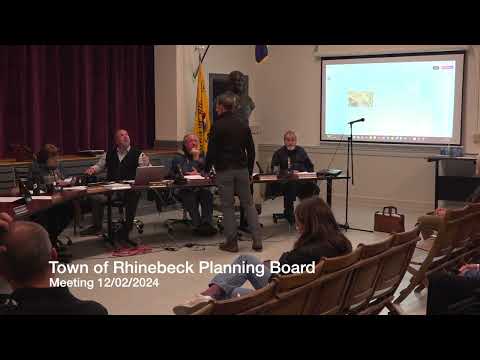
Planning Board completes SEQRA Part 2 review for Rockledge redevelopment and plans Part 3; schedules public-review steps
Summary
After extended discussion of water supply, wastewater, habitat and other environmental topics, the board concluded Part 2 of SEQRA for the Rockledge redevelopment, directed staff to draft Part 3 (determination of significance), and agreed to circulate the draft for public review ahead of further hearings and ZBA proceedings.
The Rhinebeck Planning Board completed a detailed Part 2 review under SEQRA for the proposed Rockledge redevelopment project and directed staff to prepare a draft Part 3 (Determination of Significance) for public circulation and comment. Board members asked staff to coordinate timelines so public input can be considered before the board finalizes its SEQRA determination and before Zoning Board of Appeals action proceeds.
The Part 2 discussion covered groundwater and water-supply testing, wastewater infrastructure options, habitat and species concerns, floodplain and stormwater management, and consistency with town plans. Planning and consultant presentations summarized engineering reports (including a 72-hour pumping test reported in an April 2023 WSP engineers’ report), habitat assessments (observations about potential use by northern long‑eared bats and state‑listed plant species), and stormwater designs following the county’s stormwater manual.
On groundwater, the board reviewed off‑site monitoring results from the applicant’s tests. Multiple off‑site wells monitored during July 2020 and January 2021 pumping tests showed no discernible drawdown attributable to the applicant’s well pumping, and the applicant’s engineers reported on three on‑site bedrock wells whose stabilized pumping rates met anticipated needs. Based on the materials, the board found no or small SEQRA impacts related to water-supply drawdown but asked that ongoing monitoring and permitting with the New York State Department of Health and local health department be documented.
For wastewater, the applicant proposed upgrades to on‑site systems and eventual ownership/operation by the Dutchess County Water and Wastewater Authority (DCWWA). Board discussion covered the proposed package treatment plant location, discharge points and permitting requirements under NYSDEC, and the need for a full DEC permit application. The board directed that any DEC/permitting milestones be tracked in the project file.
On plants and animals, the board reviewed a habitat assessment that identified sensitive areas and buffers (including buttonbush pools and off‑site intermittent woodland pools) that the applicant’s plan avoids. Consultants noted records of northern long‑eared bat occurrences within a regional radius and state‑listed plants nearby; the applicant proposed seasonal tree‑cutting restrictions and mitigation measures consistent with DEC guidance to reduce risk to bats and turtles. Board members discussed establishing a conservation‑area overlay or protected habitat easement in the site plan as an additional mitigation measure; staff noted CAB suggestions and recommended further mapping and explicit conservation commitments in the final plan set.
The board also discussed land-use consistency. Members reviewed the RC‑5 zoning district purpose, adaptive‑reuse provisions for historic buildings, and county housing needs data. The board found the proposal generally consistent with zoning and comprehensive-plan goals—particularly the town’s policy encouraging adaptive reuse of historic buildings—while noting concerns about scale, clustering, and the project’s relationship to surrounding low-density development. The board agreed that those policy considerations, along with mitigation measures proposed for habitat and stormwater, will be addressed in a written Part 3 determination.
Next steps: staff will draft Part 3 (a proposed Negative Declaration or Positive Declaration draft depending on the board’s conclusions) and circulate it to the public in advance of a scheduled public hearing period. The board expects to continue public engagement while related ZBA variance proceedings continue; the board and staff also plan to coordinate with Hudsonia, DEC, NYS Department of Health, DCWWA and other agencies for required reviews and escrowed funds for independent inspections where consultants recommended them.