Get Full Government Meeting Transcripts, Videos, & Alerts Forever!
Get email alerts on the Housing Displacement topic
No spam. Unsubscribe anytime.
Community members press Austin Community Development Commission for an "equity overlay" to limit displacement
Summary
Dozens of speakers urged the Community Development Commission to push the city to adopt an equity or anti-displacement overlay that would evaluate zoning changes for displacement risk and require community-centered benefits, citing long-running gentrification in East Austin and the Eastern Crescent.
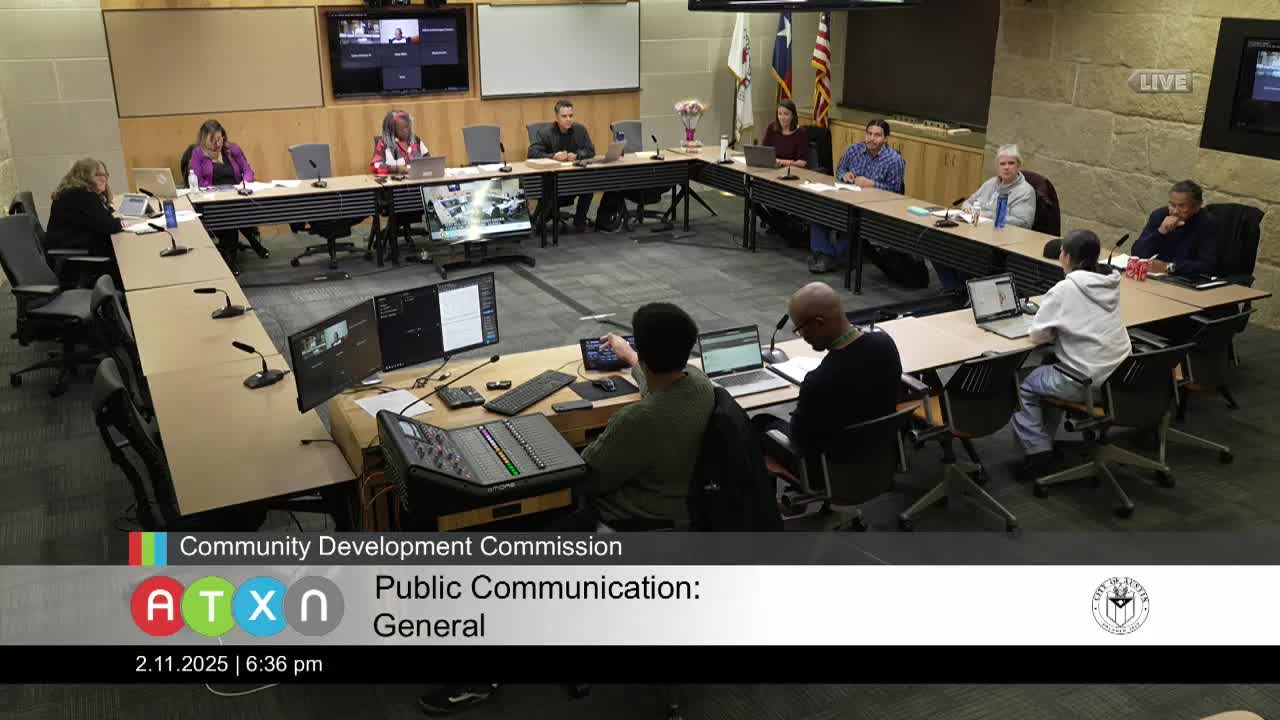
Dozens of Austin residents and organizers urged the Community Development Commission at its February meeting to back an "equity overlay"—a geographic policy tool they say would require city decision-makers to evaluate zoning and development proposals for displacement risk and concrete community benefits.
The requests came during the meeting's public-communications period, when multiple speakers representing Community Powered ATX, Go Austin Vamos Austin and other neighborhood groups described long-standing displacement in East Austin and across what they called the Eastern Crescent. "The new zoning changes only benefit the rich and leave the low incoming workers displaced," said Adrian Macias, identifying himself as a youth coordinator for POTA. Celine Rendon, an organizer with Community Powered ATX who said she lives in District 8, told commissioners: "We need real affordability, stronger tenant protections, and a commitment to preserve our neighborhoods, not just more high rises we can't afford to live in."
Speakers laid out several recurring requests: that the commission and city council require project-level review of displacement risk; that zoning changes include enforceable community benefits such as permanently affordable housing, health care or green space; and that any overlay be crafted with direct leadership from frontline residents. "The overlay should be crafted by community members directly impacted by displacement," Rendon said. "The overlay should encourage truly affordable density rather than incentivizing market rate unaffordable development."
Commissioners and staff discussed next steps during the meeting. Several commissioners said they supported convening or backing a formal study of how an overlay might work; commissioners also asked staff for clearer public outreach and better documentation of candidate/election processes for community seats on the CDC. Multiple speakers and commissioners asked the commission to make a clear, public recommendation to city council on the overlay concept.
Why it matters: Speakers tied zoning tools such as HOME, DB90 and transit-oriented changes to rising displacement pressures they said are reshaping long-time Black, Brown and working-class neighborhoods. Advocates urged the commission to use its advisory role to ensure that city decisions do not accelerate displacement and that community-led priorities shape any new rules or programs.
Context and next steps: Commissioners said staff and the consultant working on a city feasibility study for an equity overlay would return with findings and recommended options. Members of Community Powered ATX and other neighborhood groups indicated they would continue advocacy and requested the commission consider formal recommendations to council or an advisory role in crafting overlay language. The commission voted at the meeting to form an elections/process working group (see separate article) and asked staff to return with clearer outreach plans.
Ending: Several residents who spoke said the overlay was only one part of a broader strategy needed to protect long-time residents. "We need to start addressing zoning cases based on their impacts on affordability, on displacement risk, and environmental concerns instead of blindly just following developer interests," an organizer said during public comments.