Get Full Government Meeting Transcripts, Videos, & Alerts Forever!
Get email alerts on the Hospital Safety Workplace Testing topic
No spam. Unsubscribe anytime.
Committee rejects bill requiring random drug testing for hospital ‘‘safety-sensitive’’ employees after split testimony
Summary
Senate File 129, which would have required hospitals to maintain random drug-and-alcohol testing programs for employees in safety-sensitive roles and to use the Wyoming Professional Assistance Program for positive tests, failed to pass out of committee after testimony revealed definitional, cost and scope concerns.
Sponsor Senator Larson brought Senate File 129 to the Labor, Health & Social Services Committee on Jan. 24 after citing a local news story that a hospital district had suspended its random testing policy. The bill would require hospitals to operate a random drug-and-alcohol-testing program for employees who hold or seek “safety sensitive” positions, require removal from safety-sensitive duties after a positive test, require evaluation and treatment through the Wyoming Professional Assistance Program, and direct the Department of Health to promulgate implementing rules.
“ I think our hospitals maybe need a little direction,” Senator Larson told the committee, citing an article about West Park Hospital District’s decision to suspend a random testing policy and the district’s estimate that it had terminated roughly 15 employees over five years for positive THC tests.
The Department of Health’s deputy director Franz Fuchs told the committee the department would work with hospitals to develop rules that balance patient safety and operational efficiency. “Wewould probably work with industry to develop requirements for drug testing on a random basis that are sort of balancing the needs between patient safety and efficiency,” he said. Fuchs and Office of Health Care Licensing lead Laura Hudspeth said the department’s current licensing surveys focus on patient safety and staffing but not on employee HR policies; they suggested rulemaking would be required to set testing frequency and coverage.
Jason Wolf of the Department of Workforce Services said the agency offers a voluntary workers’-compensation discount for employers with a testing program: “we give a discount, a 10% discount on their base rate for their workers' compensation,” and his staff noted the agency’s rule requires participating employers to test at least 20% of covered staff annually.
Hospital representatives and clinicians urged local control and warned of costs. Josh Hannes of the Wyoming Hospital Association said many hospitals already test pre-employment and on reasonable suspicion and that policies are often set by local hospital boards. Senator Brennan, who identifies her professional background as an ICU nurse, said hospitals “do a great job” and urged leaving testing to local policies.
Public commenters included Richard Jones of Wyoming Citizens Against Normalization, who said he supports statewide requirements and told the committee, “I would like to have the assurance that every person from the janitor to the surgeons, is not impaired in some fashion.” A retired U.S. Marine and former law‑enforcement officer who testified as a private citizen described training as a drug‑recognition expert and urged random testing because of risks associated with impairment, particularly from marijuana and sedatives.
Committee members raised several recurring issues: how to define “safety sensitive duties” in statute; whether to apply a requirement only to hospitals or to broader categories of licensed health facilities (the Department of Health said there are 31 hospitals and roughly 276 licensed and certified providers statewide); who would bear testing costs (witnesses estimated per-test costs at roughly $50–$120 and said employers typically bear random-testing costs); and whether the state should require programs that some hospitals already handle locally.
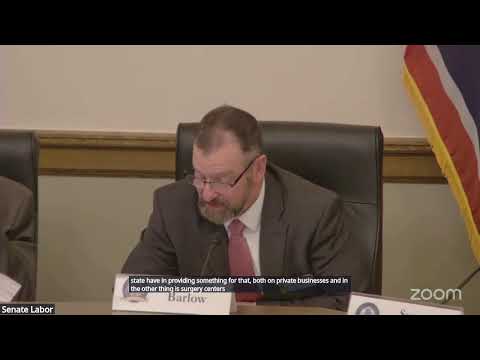
After discussion, the committee voted on a motion to advance the bill. The roll call produced a committee result the clerk summarized as one aye, three no and one excused; the chair announced the bill did not pass out of committee. Members indicated the topic might be better developed as an interim study with clearer definitions and cost analyses before a statutory requirement is considered.