Get Full Government Meeting Transcripts, Videos, & Alerts Forever!
Get email alerts on the Transportation Traffic topic
No spam. Unsubscribe anytime.
Oxnard staff outlines intelligent-transportation upgrades and signal-timing benefits; pilot timing cut travel times on key corridors
Summary
City traffic consultant presented the city—s intelligent transportation systems (ITS) capabilities and explained how updated signal timing on Ventura and Oxnard corridors reduced modeled travel times and fuel use; the presentation estimated minutes saved on sample runs and flagged the need to modernize older signal controllers.
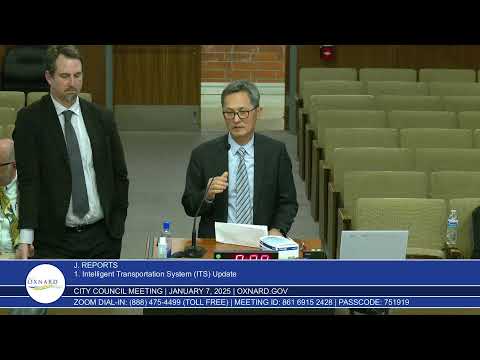
At the Jan. 7 Oxnard City Council meeting, the city—s traffic consultant gave an overview of the city—s intelligent-transportation systems (ITS) and the role of updated traffic-signal timing in reducing travel time, idling and emissions.
Andrew Yee, a principal traffic engineer with LSR Enterprise, summarized Oxnard—s traffic-management capabilities, including a traffic-management center at City Hall, fiber-optic communications and video feeds from signalized intersections. Yee said Oxnard maintains about 168 signalized intersections in the city; many have modern controllers but some still use older equipment that limits additional data collection and remote-control functions.
Yee described ITS features used to identify and respond to signal malfunctions, to permit remote timing adjustments, and to collect traffic, bicycle and pedestrian counts for later analysis. "When you have an ITS system, you can see what is going on at each intersection in your city," Yee said. "It detects malfunctions and gives you a quick response so they can be fixed," which lowers delay and safety risk.
He also outlined the technical trade-offs in signal timing and coordination: intersections require a cycle length that divides "slices of green" among all approaches and pedestrian clearance times; longer cycle lengths can increase stops and delay while shorter cycles improve flow but must still serve each approach safely. Yee described the process of setting cycle length and coordinating signals along corridors so platoons of vehicles can travel with fewer stops.
Yee presented before-and-after model results for recent timing work. For one corridor segment on Ventura Road, the traffic-management model showed a reduction in a systemwide travel-time metric from 625 minutes (before new timing) to 583 minutes (after implementation) during the morning peak. Measured sample runs on a corridor segment showed an average point-to-point travel time drop from 10 minutes 21 seconds to 7 minutes 20 seconds after new timing — an improvement Yee said would reduce idling and fuel consumption. The model also estimated an approximate reduction of about 100 gallons of fuel use in the peak period and lower carbon-monoxide emissions on the corridor following the new timing.
Councilmembers asked technical and policy questions about data access and older controller hardware. Councilwoman Carmen Rodriguez asked who controls and who can request the traffic count and video data; Yee said city staff retain the data and that police or others may request it through usual records-request or investigative channels. Mayor Pro Tem Teran asked about differences between older controllers and newer "Omni" controllers; Yee said newer controllers offer greater flexibility, remote access and expanded data collection while the older controllers impose operational limits.
Yee and Public Works Director Michael Wolf said the city will continue incremental timing improvements and controller upgrades where budget and coordination allow. No council action was taken; the presentation was informational. Councilmembers praised the analysis and asked staff to continue reporting on corridor results and on opportunities to modernize controllers for long-term performance improvements.
Ending: City staff said ITS and updated timing produce measurable reductions in delay and emissions on corridors where work has been completed. The council asked for follow-up briefings as upgrades and controller replacements proceed.