Get Full Government Meeting Transcripts, Videos, & Alerts Forever!
Get email alerts on the Public Transit topic
No spam. Unsubscribe anytime.
Dallas transportation committee backs resolution to support full DART funding after agency update
Summary
The City of Dallas Transportation and Infrastructure Committee voted to draft a resolution backing full funding for the Dallas Area Rapid Transit (DART) 1¢ sales tax after a DART presentation on ridership, station upgrades, bus shelter plans, transit-oriented development and the regional Transit 2 review.
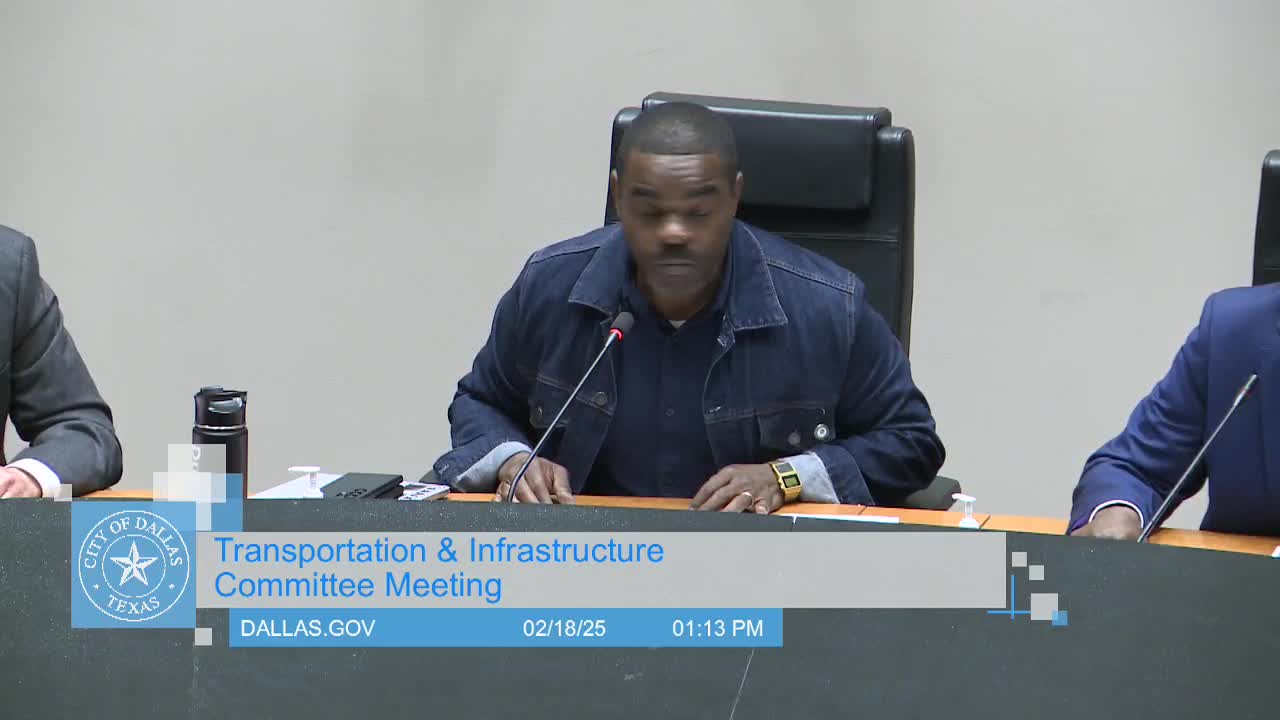
The City of Dallas Transportation and Infrastructure Committee voted on Feb. 18 to craft a citywide resolution supporting full funding of the 1¢ sales tax that funds Dallas Area Rapid Transit, after receiving a detailed update from DART leadership and a regional briefing on the Transit 2 planning effort.
DART Chief Executive Officer Nadine Lee told the committee she came to “provide an update to the T R and I committee, on all things DART,” and outlined the agency’s ridership recovery, safety and operations work, and near-term capital and station projects. Michael Morris, transportation director at the North Central Texas Council of Governments, briefed the committee on Transit 2 — a regional set of recommendations and financial scenarios addressing long-term operations, service modernization and growth.
Why it matters: The committee vote is a formal step by the city to signal support for maintaining the full local sales-tax revenue that funds DART. That funding stream is central to DART’s operating and capital plans; DART leaders and regional staff warned the committee that reductions in that revenue would affect service, safety investments and system modernization at a time of shifting travel patterns since the pandemic.
Most important facts - The committee motion to draft a resolution backing full DART funding was made by Council member Carolyn Schultz; the motion passed with one recorded no vote (Council member Mendelson). The committee instructed staff to prepare formal language for consideration by the full City Council. - DART reported systemwide ridership of about 55.6 million rides in fiscal 2024, approximately 83% of pre-pandemic levels; the city of Dallas accounted for about 42.3 million rides in FY24. DART said roughly 52% of those rides are on buses and 40–42% on light rail. - DART described a set of safety and customer-experience investments: adding 100 uniformed security officers, an expanded cleaning regimen, elevator attendants at some stations, and a pilot “DART Cares” program focused on people experiencing homelessness. - DART’s GoLink microtransit now covers 30 zones (about 400 square miles) and serves roughly 7,000 riders per day; slightly more than half of GoLink ridership occurs within the city of Dallas. - The agency described a 3–5 year program to roll out a new bus-shelter design across the system. Dee Leggett, DART chief development officer, said the shelter rollout will be coordinated with City of Dallas sidewalk and ADA ramp priorities using public transportation improvement funds.
Details from the DART presentation DART’s strategic plan “Point B,” approved in June 2024, centers six goals including service quality, environmental sustainability and “Fantastic Spaces” — an initiative to activate stations and property around transit with development and public amenities. As part of DART Transform, the agency plans fleet replacements for buses and rail vehicles, platform raising for level boarding at some stations, and unified rail signaling across the four light-rail lines. DART said City Place Station will receive a full-length platform raise, replacement of six major escalators and two inclinators, and other station refinements; construction for City Place was described as beginning this fall with phased implementation.
DART Chief Executive Officer Nadine Lee summarized the agency’s market position and finances: DART reported that the D2 downtown rail project has been moved outside the agency’s 20-year financial plan and that the board directed reprogramming of funds toward near- and mid-term system modernization. Lee said some D2 funding assumptions had relied on federal grants and debt and that the original ridership and headway triggers in the 1990 master interlocal agreement (ILA) are unlikely to be achieved on the pre-pandemic timetable.
Streetcar, ownership and governance Lee reminded the committee that the City of Dallas owns the Dallas Streetcar and DART operates it under the master ILA; the streetcar averages about 500 riders per day and runs roughly every 20 minutes. The June 2023 partnership agreement between the city and DART commits Dallas to develop a sustainable governance and funding structure for future streetcar operations, while DART serves as technical advisor.
Bus shelters, last-mile service and customer needs Committee members pressed DART on the timeline and prioritization for bus-shelter and sidewalk improvements in southern Dallas. Dee Leggett said DART is designing a new shelter, piloting five prototype locations, and expects a 3–5 year rollout that will be coordinated with the city’s sidewalk and ADA ramp prioritization. Leggett also said DART is developing a smaller-scale shelter variant for low-capacity stops and will provide the Council an updated map and timeline of the shelter rollout.
Safety, outreach and social-service partnerships DART’s police chief, Charlie Cato, described the agency’s multidisciplinary response team and partnerships with Dallas Fire-Rescue, the Office of Homeless Solutions and Parkland Health. Chief Cato said the team’s one-year pilot reduced “emergency detention” arrests as the leading arrest category, although ambulance call volume did not fall during the pilot period. The panel discussed Narcan (naloxone) deployment; DART officials and city members said a meeting on station-based Narcan deployment is scheduled.
Regional planning and Transit 2 Michael Morris of the North Central Texas Council of Governments presented Transit 2, a multi-task program that includes legislative strategy, fare-collection review, microtransit growth, next-generation traffic signal priority for buses, and finance scenarios developed with McKinsey. Morris emphasized that the region faces large population growth and that unincorporated development in perimeter counties — and the loss of extraterritorial jurisdiction (ETJ) authority for some local governments — are driving longer trips and rising congestion. Morris said Transit 2 recommends aggressive infill and transit-oriented development around existing transit stations as a way to increase system revenue, reduce vehicle miles traveled and improve air quality.
Governance, the Ernst & Young report, and next steps Committee members and DART board members discussed an Ernst & Young study that compared jurisdictional contributions and service levels. Multiple speakers — including DART CEO Nadine Lee and Board Chairman Gary Slagle — said the study should be refined because it is a single-year snapshot and did not incorporate Silver Line costs or other assumptions that materially affect the city-by-city results. Slagle said DART is pursuing a campaign to gather supportive resolutions from member cities and that the agency’s board and staff are seeking to work with member cities and the legislature to preserve full funding.
Committee action Council member Carolyn Schultz moved that the Transportation and Infrastructure Committee prepare a resolution in support of full funding for DART’s 1¢ sales tax and submit it to the full City Council; the motion carried with one recorded no vote by Council member Mendelson. The committee asked staff to work with DART to prepare the resolution language and to identify Dallas priorities for potential DART project lists or infill opportunities to strengthen the city’s case in regional discussions.
What’s next DART and City of Dallas staff will exchange details on the bus-shelter rollout map and timeline, continue workshops on area planning and transit-oriented development, and coordinate on legislative outreach. The Transit 2 financial scenarios prepared by McKinsey were described as imminent and expected to be presented to boards and member cities in the coming days.
Quotes attributed in the meeting (selection) - "We wanted to provide an update to the T R and I committee, on all things DART," Nadine Lee, CEO, DART. - "So, yes. We do have a 3 to 5 year program," Dee Leggett, chief development officer, DART, on the shelter rollout. - "We have Narcan. We're we have to put it. We have saved lives," Charlie Cato, chief of police and emergency management, DART, on naloxone availability and overdose response. - "This board majority of this board is in sync on what we've talked about today," Gary Slagle, chairman, DART board, closing the agency portion of the meeting. - "Do you need a resolution of support from us? What do you need from us to really send this message home that Dallas supports (full funding)?" Council member Carolyn Schultz.
Ending The committee’s directive to prepare a formal resolution signals a coordinated City of Dallas effort to press for maintaining the sales-tax funding that underpins DART’s operating and capital plans. DART leaders said they will continue to work with city staff on bus-stop and shelter priorities, station-area development plans and legislative outreach as Transit 2 scenarios and McKinsey’s financial projections are finalized.