Get Full Government Meeting Transcripts, Videos, & Alerts Forever!
Get email alerts on the Climate Forestry Delta topic
No spam. Unsubscribe anytime.
Skagit planners weigh climate, forest resiliency and delta infrastructure in 2025 plan update
Summary
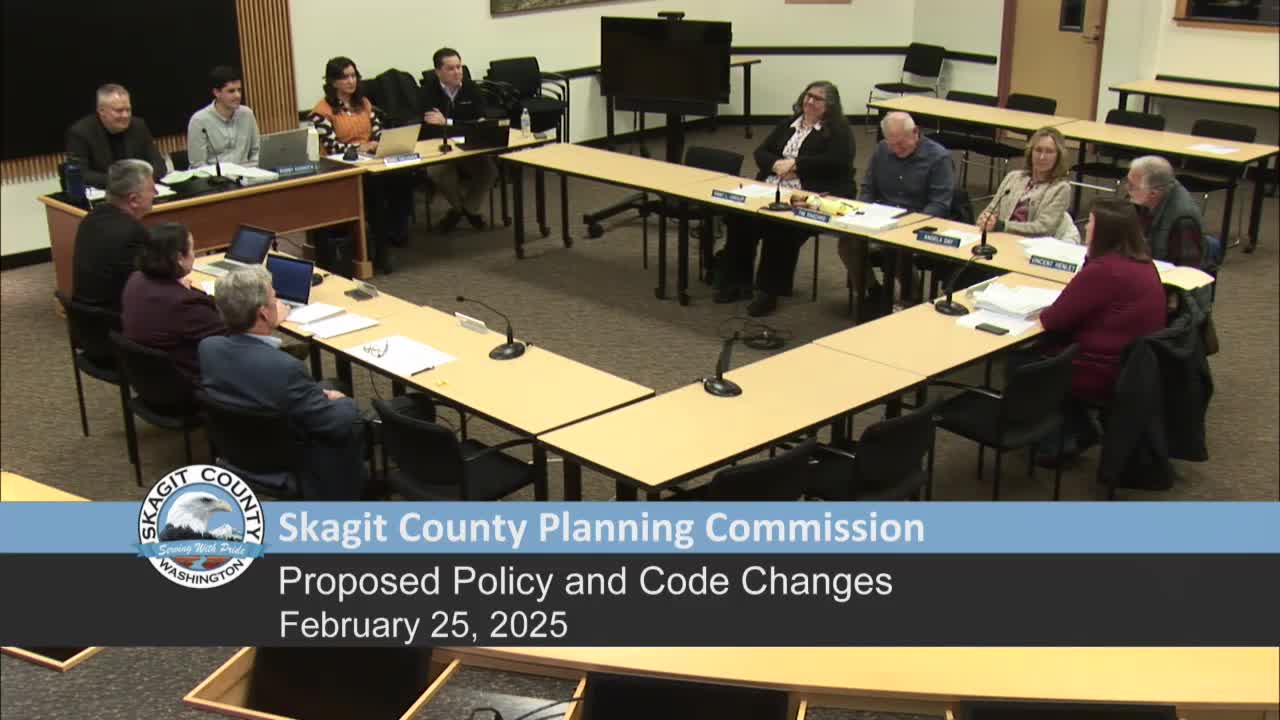
Skagit County officials used the Feb. 25 joint meeting to discuss how the comprehensive plan's climate element should treat forestry, wildfire risk, and engineered infrastructure on the Skagit'Samish Delta.
Skagit County officials used the Feb. 25 joint meeting to discuss how the comprehensive plan's climate element should treat forestry, wildfire risk, and engineered infrastructure on the Skagit'Samish Delta.
Commissioner Roscoe (first referenced as chair in the meeting) and other commissioners said the Forestry Advisory Board's comments deserve serious consideration. Kendra Smith of the Forestry Advisory Board was specifically credited by a commissioner for coordinating the board's input. Planning staff said they are drafting a forest-resiliency subsection within the climate element and will return to the Planning Commission with suggested language that either supplements existing policies or identifies gaps.
Several commissioners raised concerns about the greenhouse-gas inventory prepared by the Department of Commerce and how the county's forest carbon was characterized in the report. One commissioner said the inventory's treatment of sequestration versus tree-cover loss (and how the analysis accounts for wood products and replanting) was buried in an appendix and could be misunderstood; staff said the county would document and respond to technical comments in its comment record. A county commissioner also cited a University of Washington study as an analysis the county wants to reference in its narrative about forest carbon.
Battery energy storage systems: Planning staff and commissioners discussed whether the climate-vulnerability assessment should address the siting and fire probability of battery energy storage systems. Staff said such safety and permitting issues are typically handled in permitting and development standards, and that the county could address them through development regulations, emergency-response planning or permit conditions rather than in the vulnerability appendix itself.
Skagit-Samish Delta infrastructure: Commissioners repeatedly raised the role of tide gates, saltwater dikes and drainage facilities in preserving agricultural land on the Skagit-Samish Delta. Staff noted an added policy that reads, in sum, that the county will "participate in and develop an integrated strategic investment plan in partnership with Skagit tribes and drainage districts to holistically address sea-level rise, habitat enhancement and farmland preservation on the Skagit-Samish Delta." Commissioners asked staff to make the role of tide gates and drainage infrastructure clearer in the plan text.
Why it matters: county leaders described forestry and delta infrastructure as central to both the local economy (timber and agriculture) and to climate mitigation and adaptation strategies. Commissioners cautioned that some national or state-level analyses may mischaracterize local forestry practices and that the plan should make the county's assumptions transparent.
Ending: staff said they will review Forestry Advisory Board recommendations, craft targeted policy language for a forest-resiliency subelement, and identify whether specific measures belong in the climate element, in implementing regulations or in related plans such as shoreline management and hazard mitigation.