Get Full Government Meeting Transcripts, Videos, & Alerts Forever!
Get email alerts on the Housing Affordability topic
No spam. Unsubscribe anytime.
Skagit County commissioners discuss limits, incentives and a $3 million workforce housing allocation
Summary
At a Feb. 25 joint meeting, commissioners and planners discussed affordable housing requirements from state law, county roles (zoning and incentives), and a $3 million allocation from county economic-development funds aimed at workforce housing up to 80% area median income (AMI).
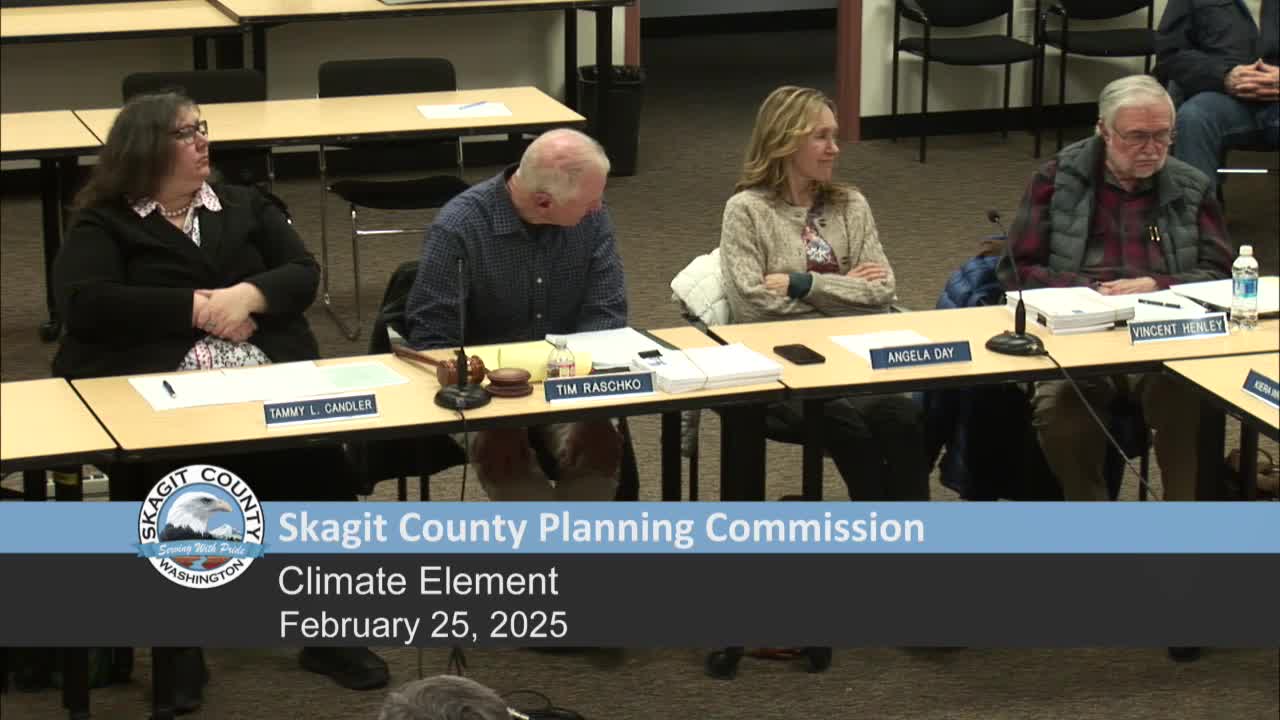
Skagit County commissioners and Planning Commission members discussed affordable housing on Feb. 25, emphasizing the difference between the county's policy role (zoning and incentives) and the private and non-profit sectors' role in actually building subsidized housing.
Commissioner Dan Henley (first referenced by name in the meeting) warned that the comprehensive-plan goal to "produce opportunities for a full range of housing affordability countywide for all income groups" raises difficult questions about how to serve the lowest-income brackets. Planning staff and consultants said the county's primary tools are land-use designations and incentives; local government can create opportunities but cannot compel private builders to construct specific housing types.
Commissioners and staff described how the county and cities converted population allocations to housing-unit targets across AMI buckets, and they noted the particular shortfall of housing at the lowest AMI levels (0—2% and 30—5% AMI), which typically requires subsidies or tax-exempt financing to be feasible. Staff and a commissioner said duplexes, accessory dwelling units (ADUs) and duplex/townhome zoning can increase the supply of "more attainable" housing but will not, on their own, generate deeply subsidized units for the lowest-income households.
Funding and local levers: commissioners said the county has limited direct funding but can direct incentives and use economic-development dollars. At the meeting, a commissioner said the Board recently adopted a resolution setting aside $3,000,000 from economic-development funds for workforce housing targeted up to 80% AMI and noted an additional $4,000,000 set aside for economic-development projects. Staff described the economic-development monies as tied to a local 0.09 sales-tax allocation used for economic development purposes (as discussed in the meeting transcript); commissioners said these funds will be used to support projects recommended by a task force and shaped in coordination with city partners.
Why it matters: Commissioners said zoning and local incentives are necessary but insufficient to produce subsidized housing for the lowest AMI bands. They described county actions -- setting aside economic-development dollars, working with cities, and prioritizing grants that favor projects backed by an adopted comprehensive plan -- as ways to attract outside funding.
Ending: staff and commissioners urged the public and developers to review the draft housing element and policy matrix ahead of the March 11 Planning Commission hearing and to submit written comments by March 13.