Get Full Government Meeting Transcripts, Videos, & Alerts Forever!
Get email alerts on the Budget topic
No spam. Unsubscribe anytime.
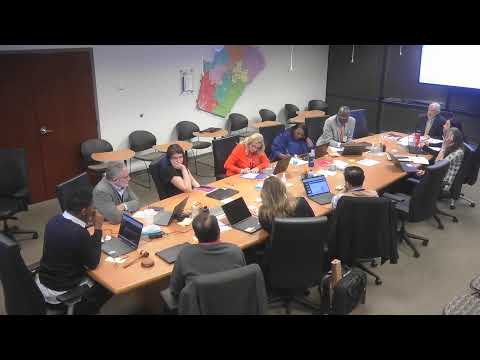
Wake County Schools finance committee reviews fund-balance categories, vaping settlement and risks from federal funding pause
Summary
Finance staff walked the Wake County Schools finance committee through GASB 54 fund-balance categories, the district—oard—und policy (8101), vaping-settlement receipts and a pension reserve; members discussed possible use of reserves if a federal funding pause continues.
Mr. Neer, a finance staff member, told the Wake County Schools Finance Committee that "there's a body called the Governmental Accounting Standards Board, GASB, that defines exactly what fund balance is for governmental organizations and agencies in this country," and said the district reports fund-balance classifications under GASB Statement No. 54.
The presentation, titled "Fund Balance 101," summarized the district's June 30, 2024 fund-balance statement and explained which portions represent cash available for new spending and which are reserved or represent noncash items. "These amounts —aren't all dollars— and most are not available to be utilized," Mr. Neer said, describing inventory and encumbrances that must be reported but are not spendable.
The memo reviewed each major category shown in the district's audited report. Items and amounts cited in the committee meeting included: roughly $4.9 million in nonspendable inventory (supplies, fuel, transportation parts); about $9.3 million categorized as "stabilization by state statute" (accounts receivable and carry-forward purchase orders); $11.3 million "assigned for special projects" (the largest drivers being targeted enrollment funds and vaping-settlement receipts); $15.58 million reserved for insurance (self-insured workers' compensation and claims); a $4.3 million pension reserve to address potential state invoiced liabilities; about $1 million in flexible-benefits withholdings; $32.4 million shown as prior-year budgeted use of funds to balance the then-current year's budget; and $39.3 million of unassigned fund balance, which the presenter said represents roughly 1.7% of the district's operating budget and is intended for emergencies or one-time uses.
Committee members asked how some of those categories are handled in practice. Mr. Neer said targeted-enrollment and other designated reserves are locked down once appropriated into a budget line: when the board approves a fund-balance appropriation (for example, targeted enrollment), "it is locked down and just used for that purpose." Trish Posey, identified in the meeting as the district finance officer, joined the discussion about appropriation procedures and encumbrances.
Board policy 8101 (titled Undesignated Operating Fund Balance in the district policy book) was discussed as the policy that governs the district's unassigned fund balance. Mr. Neer summarized two policy tenets reported to the committee: a target maximum of 6% of the subsequent year's county appropriation, and a rule that no more than 50% of the July 1 unassigned balance be used to fund the following year's budget. He said the board has, in past downturns (the Great Recession and the pandemic), waived parts of the policy to retain or deploy additional funds; at the time of the presentation the unassigned balance was below the 6% target, so no waiver was expected for the coming budget.
Committee members pressed on several potential near-term contingencies. The most discussed was a federal-level pause described in an Office of Management and Budget memorandum and reported in the meeting as a temporary hold on some federal grant cash flows. Vice Chair Swanson and other members asked whether the district would be able to use fund balance to cover payroll and program costs while federal funds are paused. Mr. Neer and Ms. Posey said the district could cover such short-term interruptions with available balances, but emphasized the unassigned balance is limited. Presenters told the committee they had been able to draw federal cash the same day but warned that, as of the meeting, the pause was described in some places as a hard stop at 5 p.m. and guidance was still being unpacked by the state Department of Public Instruction.
The committee heard projected-salary figures cited by staff for programs funded by federal grants: staff reported approximately $41 million in projected salaries for federally funded educational-program positions through the end of the fiscal year and roughly $20 million in projected salaries for child nutrition programs. Staff cautioned those were projections and that federal- versus state- versus locally funded positions can be complicated to map.
Discussion also covered vaping-settlement receipts the district has received and expects to receive. Mr. Neer said the district received roughly $2.9 million to date (with nearly $300,000 apportioned to charter schools) and anticipated additional payments of about $1.5 million from Jewel and $1.3 million from Altria, for a remaining expected total just under $6 million overall. Staff said the settlements did not legally mandate a programmatic restriction on how the district uses the money, but the board had chosen to reserve the receipts for student-related programs.
On pension liability, presenters described a reserve (about $4.3 million at June 30) intended to cover potential state-invoiced pension costs that became payable after litigation concluded. Mr. Neer said the district will adjust that reserve annually and noted an internal process exists to challenge invoices if certain certification criteria are met.
Committee members requested clear, plain-language communication for parents and staff about the potential effects of any federal funding pause. Several board members asked staff to prepare digestible materials for the upcoming board meeting so the public could understand, in concrete terms, which services and payroll categories could be affected if federal grants are held up.
The meeting concluded after a round of questions and staff remarks. The committee approved the minutes from the January 16, 2024 meeting at the start of the session and adjourned at the end of the presentation.