Get Full Government Meeting Transcripts, Videos, & Alerts Forever!
Get email alerts on the Sidewalk Vending topic
No spam. Unsubscribe anytime.
San Gabriel council introduces sidewalk vending ordinance with new trash and noise rules
Summary
The City Council introduced Ordinance No. 718 to regulate sidewalk vending under state law (SB 946/972), adding council amendments that prohibit vendors from disposing trash in public or private cans and restrict amplified sound, lighting and signage unless approved as part of a permit; council voted 5-0 to introduce the ordinance.
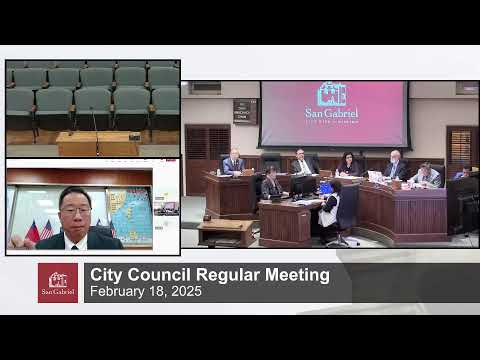
The San Gabriel City Council introduced Ordinance No. 718 on first reading Tuesday, adopting local regulations for sidewalk vendors in response to state law (Senate Bills 946 and 972) and approving council amendments to strengthen trash and noise controls. The motion to introduce and waive full reading passed 5-0.
Acting Community Development Director Samantha Tewasark explained the ordinance implements state rules while preserving allowable time, place and manner regulation. The proposal, she said, incorporates definitions and requirements drawn from the state bills, distinguishes between “roaming” vendors (who complete transactions while moving) and “stationary” vendors (fixed-location transactions), and ties vending permits to compliance with the California Retail Food Code.
Key requirements in the ordinance as introduced include: a seller’s permit filed with the California Department of Tax and Fee Administration, a Los Angeles County Public Health permit where required, and a city business license; issuance of a one‑year vending certificate (with or without conditions) after documentation is submitted; an initial education period during implementation, followed by warnings and escalating penalties for violations; minimum sidewalk width (9 feet) and a 4‑foot clear path; and distance/place restrictions including prohibition within 500 feet of farmers markets and specified buffers from hydrants, driveways, building entrances and intersections. The ordinance also prohibits stationary vendors in residential areas and limits roaming vendors in residential areas to nominal daytime hours (the draft references 9 a.m. to 6 p.m.).
Council debate focused on enforcement, sanitation and public‑safety safeguards. The ordinance as amended requires vendors to carry a waste disposal bag or container for trash and expressly prohibits disposal of vendor trash in public or private trash cans (council amendment to subsection H). The council also added a new subsection (K) restricting amplified sound, flashing lights, digital signage or other visual media unless expressly approved in a vending permit; the council discussed making no amplified sound allowed as a practical standard. City staff clarified fines for unpermitted vendors escalate from $250 to $1,000, and the city can pursue civil injunctions in court if fines are ignored. The city attorney said the city can tow or remove vehicles in instances that create an imminent public health or safety hazard.
Council members discussed enforcement roles: the city’s code enforcement, police department and county public health will participate; staff said enforcement will be initially collaborative with the health department and police, then predominantly a code enforcement responsibility after community outreach. The ordinance directs staff to add fee amounts to the city fee schedule at a later date. There were no public comments at the hearing.
The motion to introduce Ordinance No. 718 as amended (adding the trash prohibition language and the noise/lighting/signage subsection) was made by Council Member Herrera Avila, seconded by Council Member Ding, and passed on a roll‑call vote of 5-0 (Council Members Chan, Ding, Herrera Avila, Vice Mayor Menchaca and Mayor Wu voting yes). The ordinance is scheduled for second reading and possible adoption at the next regular council meeting; if adopted it would become effective 30 days later.