Get Full Government Meeting Transcripts, Videos, & Alerts Forever!
Virginia Tech review finds Greene County water/sewer model generally prudent but flags omitted units and short‑term risks
Summary
An outside review by Virginia Tech found the county's water and sewer financial model "reasonable and prudent" based on current data but noted the model excludes certain approved residential units and commercial projects; local commenters and finance reviewers said alternate housing-start assumptions produce large funding shortfalls.
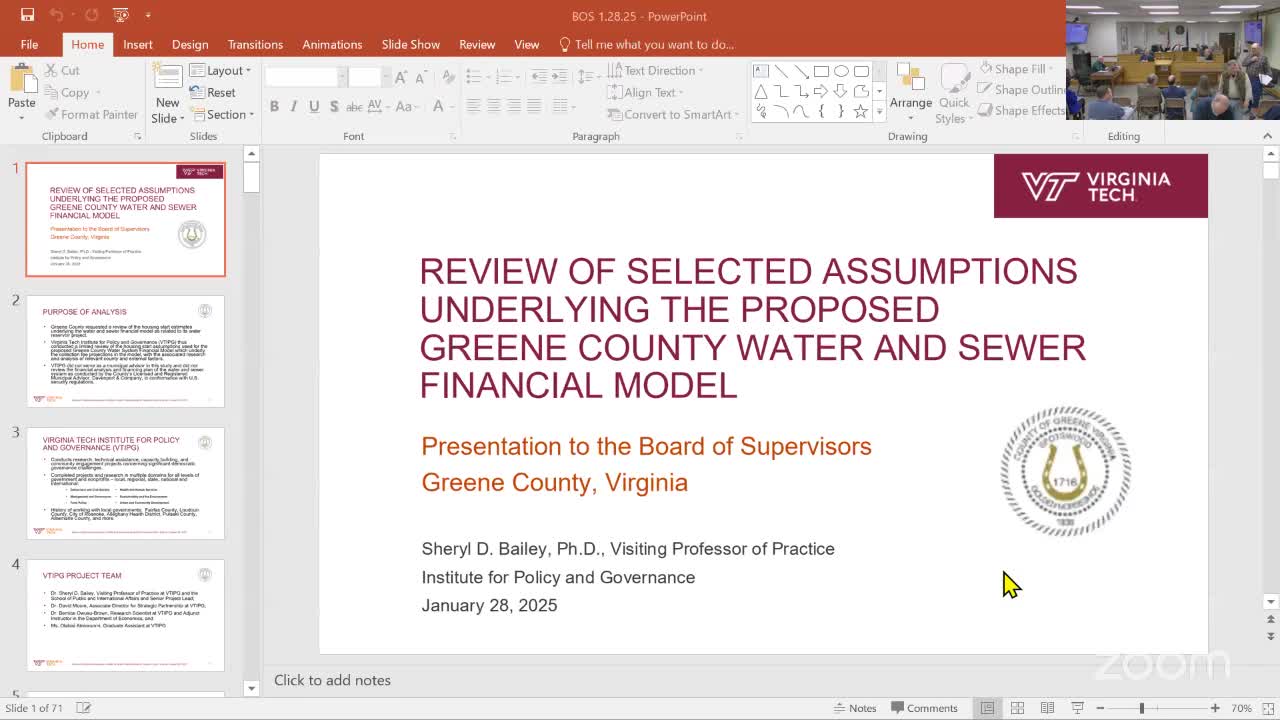
Dr. Cheryl Bailey, a visiting professor at Virginia Tech's Institute for Policy and Governance, told the Greene County Board of Supervisors that her team's limited review of the county's water and sewer financial model focused on the housing-start assumptions underlying a proposed water reservoir project and found the model to be "reasonable and prudent" given the data the reviewers examined.
The Virginia Tech team examined planning documents and projects the county identified as having "current activity," visited the proposed reservoir site and treatment plant, and compared local trends with state and national demographic and economic indicators. "We reviewed the history of the water reservoir project," Bailey said, and described a multi-decade effort tied to the state's regional water supply planning requirements that followed the severe 2002 drought.
The review included a technical amendment: one project's record of approved units was updated such that the net change was 64 approved units. Bailey said those 64 units were outside the model as presented to her team and that "the analysis and finding conclusions...remain unaffected." She told supervisors the model intentionally omits some approved residential projects and all commercial and nonresidential projects with current activity; that omission, she said, creates a "buffer" or "insurance" below the line if buildout is slower than expected.
Bailey said the model also applies further conservatism in later years: the team calculated that within the first…
Already have an account? Log in
Subscribe to keep reading
Unlock the rest of this article — and every article on Citizen Portal.
- Unlimited articles
- AI-powered breakdowns of topics, speakers, decisions, and budgets
- Instant alerts when your location has a new meeting
- Follow topics and more locations
- 1,000 AI Insights / month, plus AI Chat