Get Full Government Meeting Transcripts, Videos, & Alerts Forever!
Get email alerts on the Federal Legislative Agenda topic
No spam. Unsubscribe anytime.
Tualatin councilors review draft 2025 federal agenda, focus on transportation earmark and community grants
Summary
City staff and consultants presented a draft federal legislative agenda Dec. 9, 2024, prioritizing a $3 million transportation earmark, community development funding, continued support for electric-vehicle charging and railroad crossing elimination programs, and monitoring federal tax policy affecting municipal bonds.
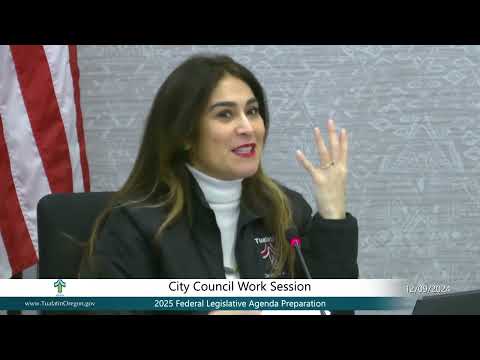
Tualatin city staff and outside consultants presented a draft 2025 federal legislative agenda during a Dec. 9, 2024, City Council work session, asking the council for feedback and direction before returning in January for formal adoption.
The draft list of potential federal priorities includes a $3,000,000 earmark request for a transportation project at the 60/Fifth, Borland and Staggart corridors; increased or maintained funding for Community Development Block Grant (CDBG) programs; continued support for the Community Fueling Infrastructure (electric-vehicle charging) program; continued funding for the Railroad Crossing Elimination Program; and monitoring federal actions that could affect tax-exempt municipal bonds.
The discussion matters because federal funds and policy choices could affect Tualatin projects already under study, the city’s ability to compete for grants and earmarks, and the funding environment for local infrastructure projects. With a new federal administration and Congress arriving in January and a separate state legislative session ahead, staff framed the federal agenda as part of a multi‑level advocacy approach.
Dan Bates, of Thornwood Partners, reviewed themes that have guided the city’s requests, saying the city and its consultants previously identified “transportation and housing, as well as downtown revitalization and resiliency and the environment” as priority filters for both state and federal advocacy. Bates noted the recommended federal funding request is timed to match a forthcoming earmark opportunity tied to the local alternatives analysis performed for the intersections. Megan George, Tualatin’s deputy city manager, told council the $3 million figure reflects the preliminary cost for a feasible alternative identified in the city’s study and that staff believe the timing aligns with potential congressional requests.
Greg Burns, co‑leader of Thornwood’s local government practice in Washington, D.C., framed the national political landscape for the council and emphasized the continued importance of bipartisan support in Congress, saying “the secret to effective governing will continue to be bipartisanship.” Burns and Bates urged the council to prioritize items that will resonate with congressional members and administration priorities, including projects tied to economic development and private investment leverage.
Councilors asked for refinements and additional outreach. Councilor Brooks urged cautious language on the CDBG line item and recommended the city seek to “maintain” the program’s funding rather than request an increase given likely federal budget pressure. Several councilors asked staff to prepare lists of potential local partners and draft letters of support for two local projects that were specifically raised for state and federal advocacy: seismic valving at local reservoirs and the Veterans Plaza shade structure. Staff suggested possible partners to solicit letters from, including Clean Water Services, Washington County emergency management, veterans groups (VFW), local economic development organizations (the Chamber of Commerce), and conservation or public‑health groups for the shade project.
Council members also discussed other items on the draft list. Staff said the city has not yet compiled a letters‑of‑support list for the electric‑vehicle charging item because funding streams remain uncertain, but the council discussed outreach to auto dealers, apartment and rental housing stakeholders and other local businesses as future steps.
No formal vote or final adoption of the federal agenda occurred at the work session. Staff said they will revise the draft based on council feedback and return to council on Jan. 13, 2025, for formal adoption and to finalize talking points for the city’s congressional delegation and other partners.
Ending
City staff and Thornwood Partners consultants left the council with a request for specific direction on a short list of federal priorities and with specific outreach tasks: prepare letters of support for two highlighted local projects, refine the CDBG language (maintain vs. increase), and finalize the $3 million earmark request timing. The council will revisit the draft agenda at its Jan. 13 meeting for formal adoption.