Get Full Government Meeting Transcripts, Videos, & Alerts Forever!
Get email alerts on the Middle Housing topic
No spam. Unsubscribe anytime.
Milwaukie staff outline middle-housing options; council asks for incentives, tree-code changes and monitoring of state rulemaking
Summary
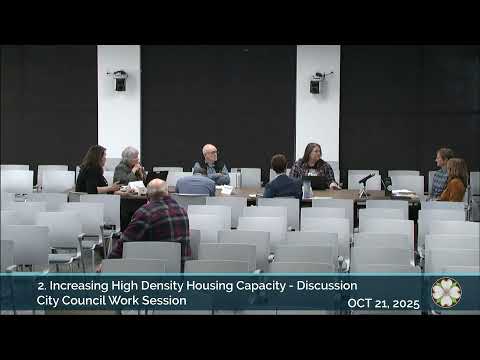
City staff briefed the Milwaukie City Council on middle-housing implementation after a July town hall, noting state requirements in House Bill 2001 and HB 2138. Councilors directed staff to monitor DLCD rulemaking through Jan. 1, 2027, return with tree-code proposals and study incentives and communications for developers and neighbors.
Milwaukie city staff on Tuesday summarized public feedback on middle housing and asked the City Council for direction on several follow-up steps, including studying incentives for green space, monitoring Oregon Department of Land Conservation and Development (DLCD) rulemaking on House Bill 2138, and returning with proposals on tree protections and code enforcement.
The discussion grew out of a July 28 town hall and an online Engage Milwaukie page. Laura Weigel, Milwaukie’s community development director, told the council the town hall drew about 60 attendees and the city collected 35 in-person questions and 22 online comments. “For anyone tuning in new to the discussion, What is middle housing? Middle housing describes housing types that are kind of between single detached homes and apartment complexes,” Weigel said, listing duplexes, triplexes, fourplexes, townhomes and cottage clusters as examples.
Why it matters: State law requires cities to allow middle housing where single-family homes are permitted. Weigel told the council that House Bill 2001 established the framework and that the more recent HB 2138 has refined the rules and is still undergoing rulemaking at DLCD. Staff warned that draft DLCD model code may leave few local design standards and advised caution on making local code changes until state rulemaking stabilizes.
Staff summary and council direction
Weigel and Vera Colias, the city’s planning director, presented five main themes from the town hall: concerns about increased density, design and appearance of new units, impacts to trees and open space, questions about what the city can regulate under state mandates, and worries about affordability. Staff said the city already has about 60 middle-housing units built or under construction since 2020 and is receiving more community comment as those projects proceed.
On specific next steps, the council gave staff these directions: - Monitor DLCD rulemaking and place a marker to review lot-coverage and separation standards on Jan. 1, 2027, rather than adopting code changes now that might become nonconforming under future state rules. Staff noted DLCD’s draft model code is in flux and that DLCD recommended not adopting local changes that could later conflict with statewide rules. - Develop ideas and return with options for incentives aimed at encouraging usable common open space, tree canopy and design outcomes (for example, stormwater or sewer system development charge adjustments, height bonuses, or fast-tracked review), and report back when staff has more market information. - Return at the council’s Dec. 2 meeting with proposals on tree protections that address both development-related removals and nondevelopment maintenance, including possible fee structure changes and options to limit removal during development. - Prepare communications for neighbors and developers, including a developer “checklist” and a public tip sheet that explains what is permitted and whom to contact for concerns during permitting and construction. - Consider a staff study session on fee-in-lieu-of-construction (FELOC) policy for right-of-way improvements (sidewalks, curbs, gutters) before any programmatic change; staff said FELOC is currently small on many permits and would require program management if expanded.
Code standards, incentives and design
Council members asked whether the city should revisit local design standards or lot-separation and lot-coverage rules. Staff advised restraint: Colias and Weigel said DLCD’s rulemaking could render local changes nonconforming and noted DLCD’s draft model code contains relatively few design standards. The council agreed not to reopen design standards now but asked staff to pursue incentive options that could achieve neighborhood goals — for example, concentrating green space in cottage-cluster designs, or offering adjustments to stormwater and sewer SDCs for shared kitchens or co-housing models.
Trees and fee-in-lieu of tree preservation
Councilors pressed staff for stronger protections for mature trees removed through development. Staff told the council the city will return with possible code and fee changes aimed at making tree removal more costly or preserving large trees, while recognizing separate allowances for routine private maintenance. One councilor requested data on tree removals in development projects so the council could calibrate fees or alternatives to a fee-in-lieu approach.
Sidewalks, FELOC and liability
Staff described variability in the city’s practice of accepting fee-in-lieu payments for right-of-way improvements. The city manager’s office said making FELOC a systematic program rather than an ad hoc practice would require dedicated program management. Councilors asked for a study session on whether to require construction of sidewalks by developers or to accept FELOC more often. Staff also confirmed that adjacent property owners remain responsible for sidewalk maintenance and liability under current practice.
Parking and neighborhood management
Councilors discussed resident-parking permit regulation (Traffic Regulation 470). Staff said the regulation has never been implemented in Milwaukie and cautioned neighborhood parking management is resource-intensive and not always needed; the council asked staff to monitor parking complaints and inform neighborhoods about options rather than start citywide implementation now.
Zoning, hubs, corridors and the housing production strategy
The council also discussed the city’s housing production strategy and related zoning questions. Weigel reported the city received a DLCD grant to assess barriers in the High Density Residential (RHD) zone and to scope that consultant project. Several councilors asked staff to ensure that work looks at neighborhood-scale mixed-use options (SMU/NMU) and corridors such as 30th Street and King Road, not only larger apartment-scale outcomes. Staff said the DLCD-funded work will analyze the existing RHD boundaries and technical fixes first; if additional changes are needed, a second, broader planning phase would be scoped later and would likely include economic/market feasibility analysis and more neighborhood engagement.
Quotes
“We held that in person event here on July 28. We had 60 people come out,” Weigel said while summarizing public participation and questions collected online and at the town hall.
On the DLCD timeline and the model code, staff said the state’s rulemaking is still in early stages and recommended the city avoid code changes that could later become nonconforming under the statewide rules.
What’s next
Staff will return with targeted materials and options in coming months: a developer checklist and communications plan, a December presentation on tree-code options, and a plan to monitor DLCD rulemaking with a Jan. 1, 2027 marker on lot-coverage and separation standards. The DLCD-funded RHD analysis will begin once the consultant is onboarded and produce recommendations for technical fixes; any proposal to expand RHD or add mixed-use parcels would be scoped separately and involve additional engagement and feasibility work.
The council did not take a formal vote on any code amendments during the session.