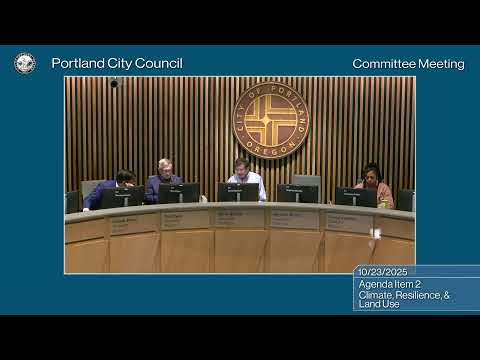
Portland committee previews annual update to Clean Energy Community Benefits Fund plan
Loading...
Summary
Staff from the Portland Clean Energy Community Benefits Fund (PCEF) presented a preview of the Climate Investment Plan (CIP) annual review, explaining program status, funding areas, and next steps while councilors asked about fund flexibility, nonprofit capacity and how allocations are tracked and reported.
Portland city staff on Thursday gave the Climate Resilience and Land Use Committee a preview of the annual review process for the Portland Clean Energy Community Benefits Fund’s Climate Investment Plan, outlining current program status, funding areas and the timeline for committee and council consideration.
The Climate Investment Plan (CIP) is a five-year framework that guides how the city administers the voter-approved fund. “This is our 5 year road map for our community climate investments,” said Sam Barrasso, program manager for the Portland Clean Energy Community Benefits Fund, explaining the plan’s role in setting allocations for community grants and strategic programs.
The plan divides work into seven funding areas including energy efficiency and renewable energy, transportation decarbonization, green infrastructure, regenerative agriculture, capacity building, climate jobs/workforce and a category for other greenhouse-gas-reducing projects. Staff said the renewable energy and energy-efficiency portfolio is the largest single share of funding, receiving about 51 percent of the plan’s five‑year allocations.
Presenters — Eric Engstrom (director, Bureau of Planning and Sustainability), Barrasso, and James Valdez (strategic partnerships and policy manager for the Clean Energy Fund) — walked committee members through program examples and the review steps the PCEF subcommittee has used. They said the plan was adopted by council in 2023 and updated in late 2024, that many programs are still ramping up, and that the subcommittee’s draft amendment is out for public comment. James Valdez said the subcommittee’s recommendation is expected in mid‑December and staff aim to bring amendments to council in January for action effective July 1, 2026.
Staff outlined program examples and rough allocations cited in the presentation: a clean‑energy multifamily affordable housing program (described as roughly $63 million administered by the Housing Bureau), an “energy friendly homes” program (described as $140 million), a building energy efficiency grant administered by Prosper Portland (described as $25 million with about 86 applicants), and an energy‑friendly public schools program (described in the presentation as about $120 million). Staff also described a $20 million e‑bike rebate pilot and a set of transportation decarbonization investments administered by PBOT and other bureaus. For community grants, staff said the five‑year total for community grants is planned at about $300 million and that the current grant cycle is expected to award roughly $67 million this fall.
Committee members focused questions on three topics: fund flexibility and how “locked” allocations are; nonprofit capacity to absorb large grants; and how outcomes and geographic distribution will be tracked. Co‑Chair (Novick) and other councilors pressed staff on how much of the five‑year plan is already contracted or otherwise committed versus what remains unencumbered and available for reallocation by future councils or by annual budget decisions. Staff said allocations provide a planning trajectory but that line‑by‑line budget commitments still require annual council budgeting; some funds are contracted and therefore effectively committed, while other amounts are only allocated in the CIP and could be reconsidered in later budget cycles.
On nonprofit capacity, Councilor Novick and others raised concerns that very large awards can strain small organizations. Angela Pervadelli, interim deputy program manager for PCEF, said, “Every single application goes through a pretty thorough financial assessment,” and described a review that includes three years of financial information, financial staff subject‑matter review, and ‘‘stage gating’’ — pause points after initial funding disbursements to confirm the project and financial controls before further funds are released. She also pointed to a specific capacity‑building program (SP‑10) and technical assistance the bureau offers to help organizations scale.
Councilors also asked about reporting and district‑level tracking. Staff said the program maintains a public dashboard and is working to expand the data available by council district and by project type. Staff said newer grant rounds capture whether projects are district‑focused and that reporting improvements are planned for the dashboard as programs mature.
Several councilors requested clearer materials before the full council work session, asking for a breakdown showing which dollars are administered directly by city bureaus, which are awarded to external partners (for example schools and TriMet), and which are reserved for community grants. Staff agreed to prepare more detailed slides and examples (including why some large capital projects take multiple years to spend) for the full‑council briefing scheduled next week.
No formal votes were taken on the CIP during the committee meeting; the committee approved meeting minutes for prior sessions by unanimous consent. Staff asked for public feedback on the draft subcommittee recommendation and the related redline edits now posted for public comment.
The committee’s next steps, as outlined by staff, are: complete the PCEF committee review and recommendation in mid‑December, incorporate public comment and committee adjustments, then present the annual CIP update to city council in January for consideration ahead of the fiscal year 2026 budget cycle.