Get Full Government Meeting Transcripts, Videos, & Alerts Forever!
Get email alerts on the Sbe Contracting Mission Bay Schoolyard topic
No spam. Unsubscribe anytime.
OCII review finds SFUSD schoolyard contracting fell far short of SBE goals; commissioners demand documents and follow-up
Summary
The Commission on Community Investment and Infrastructure heard that McCarthy SFUSD’s work on the Mission Bay elementary schoolyard reached roughly 6% small‑business participation against OCII’s 50% SBE contracting goal, and ordered staff to obtain missing outreach and monitoring records from SFUSD and the contractor.
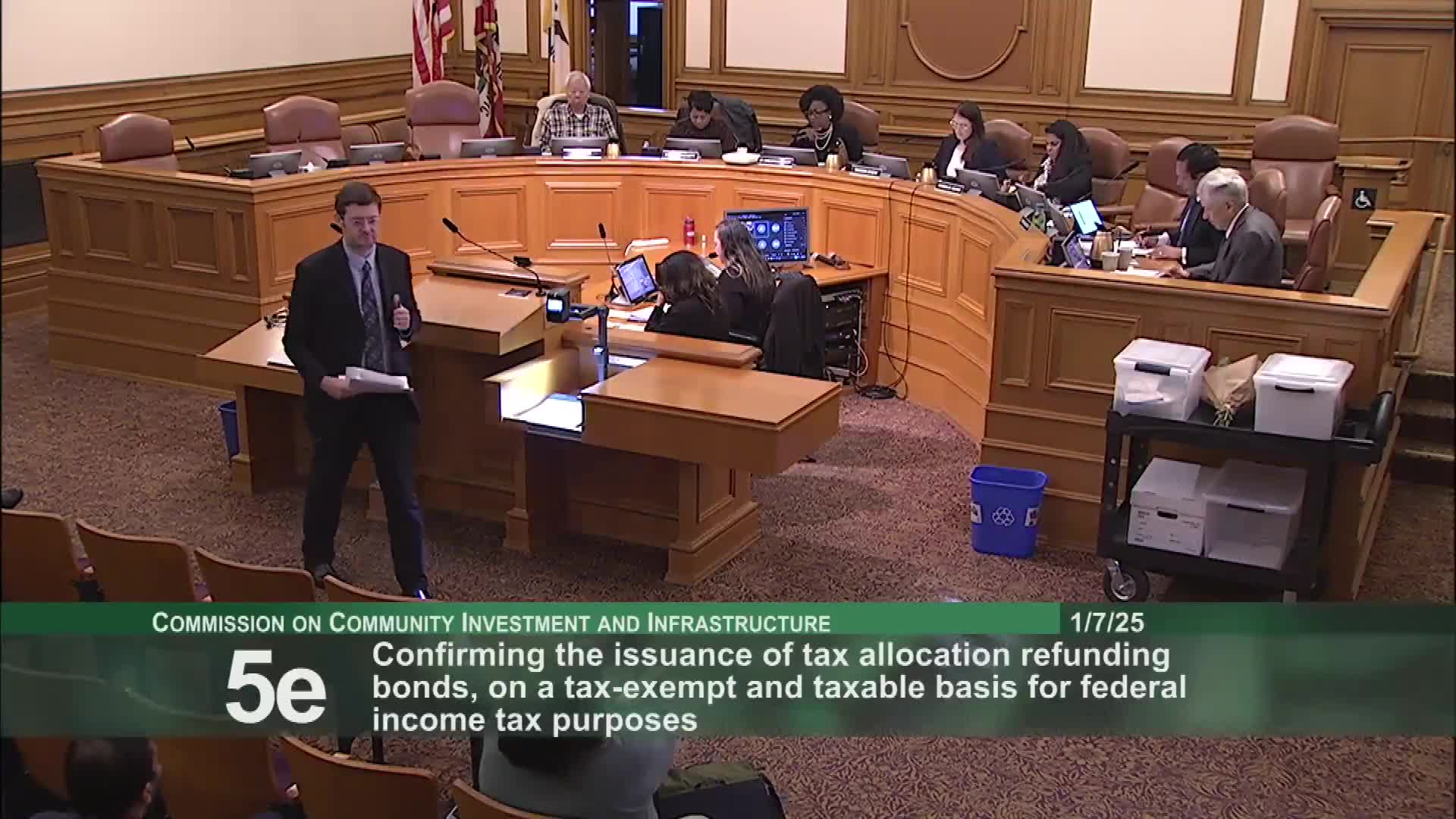
The Commission on Community Investment and Infrastructure (OCII) reviewed a staff analysis on Jan. 7 that found San Francisco Unified School District’s (SFUSD) Mission Bay elementary schoolyard contracting fell far short of the agency’s small-business enterprise (SBE) participation goal.
OCII’s senior contract compliance officer, Maria Picot, told commissioners that OCII’s SBE policy sets a 50% contracting goal for eligible projects, with first consideration to project-area SBEs and then San Francisco-based SBEs. “At the time of the reporting, McCarthy’s efforts resulted in an SB participation of just under 6% for the schoolyard related scopes on this project,” Picot said.
The finding prompted extended debate among commissioners, public commenters and OCII staff about whether SFUSD and prime contractor McCarthy met the policy’s advertising, outreach, unbundling and monitoring requirements. Commissioner Bavette Brackett, who led much of the questioning, said OCII staff had repeatedly been excluded from pre-bid meetings and that SFUSD and McCarthy had promised OCII they would follow OCII SBE requirements when the commission approved a design-build approach in 2020.
“Had this commission known that they would not follow our SBE policies, we would have never approved this project in 2020 to move forward in this way,” Commissioner Brackett said. She characterized the current 6% result as unacceptable and said the commission needs contemporaneous documentation from SFUSD and McCarthy to evaluate compliance.
OCII staff summarized which SBE good-faith elements were met, partially met or deficient. Staff judged McCarthy sufficient on some outreach elements—advertising in local/regional outlets and contacting many firms—but deficient on two principal points: contract sizing (unbundling) and contemporaneous monitoring. Picot said McCarthy did not unbundle the schoolyard work from the larger design-build contract and that OCII staff typically must review bid tabs contemporaneously to verify compliance; in this case OCII received bid tabs only after selections had been made. OCII staff characterized the result as five elements met, one partially compliant, and two deficient.
Commissioners and staff discussed specific procurement practices SFUSD and McCarthy used. Staff reported McCarthy solicited prequalification from 188 firms and staged a two-step process (prequalification then bids for prequalified subs). Commissioners raised concerns that the advertised time windows sometimes amounted to only 14–21 days of active bid submission rather than the 30 days OCII policy expects, and that the pre-bid presentations did not include OCII’s SBE policy goals.
Public commenters, including retired redevelopment employee Oscar James and Bruce Agud of the Mission Bay Elementary School Community Steering Committee, urged stronger efforts to direct contracting dollars to local and project-area businesses. James said he had seen historic efforts—such as a city booklet of contractors and subcontractors—that helped local firms compete and urged OCII to revive similar tools.
OCII staff and the deputy director, Mark Sleskin, said the department will ask SFUSD and McCarthy for additional documentation: the non-duplicative list of the 188 firms contacted, bid tab buyout logs showing which scopes were awarded to which subcontractors (and for what dollar amounts), records of advertising placement (including whether the city Purchasing Department site was used), and evidence of any technical-assistance or bond/insurance support provided to SBEs. Picot acknowledged the constraints imposed by the design‑build model and by SFUSD’s use of a project labor agreement (PLA) in parts of the project, but stressed the commission’s SBE requirements were part of the reimbursement terms.
Commissioner Brackett also asked for a precise accounting: OCII staff reported the schoolyard buyout log reflected an approximate schoolyard contract total of $11,236,462 and indicated that SB contracting dollars were under 6% (OCII staff later provided an approximate SB contracting figure of about $673,808 based on those buyout logs during the meeting). OCII staff committed to provide a more precise breakdown of the dollar amounts and the scopes awarded to SBEs in forthcoming material.
The commission did not take formal disciplinary action at the meeting. Staff said the presentation was informational and asked for time to obtain missing records. Chair Scott said staff would collect the documentation and return with follow-up information; the chair also said he would refer the matter to the City Attorney’s Office and the Ethics Commission for guidance on commissioners’ duties and roles, and OCII staff said they would continue outreach to SFUSD to obtain the records needed to assess compliance.
Commissioners pressed whether OCII could withhold reimbursement if McCarthy and SFUSD were found noncompliant; OCII staff said reimbursement is limited to eligible expenses under the reimbursement agreement and that a denial of reimbursement would be a formal action requiring its own process. Staff noted McCarthy had not yet submitted reimbursement requests or change orders for the schoolyard at the time of the meeting.
The extended public and commission discussion ended with no immediate vote; OCII staff said they would return with additional records and a more detailed accounting of which bid packages and scopes produced the small‑business awards.
Ending: The Commission directed staff to pursue missing documentation from SFUSD and McCarthy, to report back to the commission with detailed buyout logs and advertising/outreach records, and to consult the City Attorney’s Office and the Ethics Commission on next steps and on whether any closed‑session legal briefings are appropriate.