Get Full Government Meeting Transcripts, Videos, & Alerts Forever!
Get email alerts on the Farmland Preservation topic
No spam. Unsubscribe anytime.
Northampton County staff recommend roughly $254,000 in ACAP grants for six farm projects
Summary
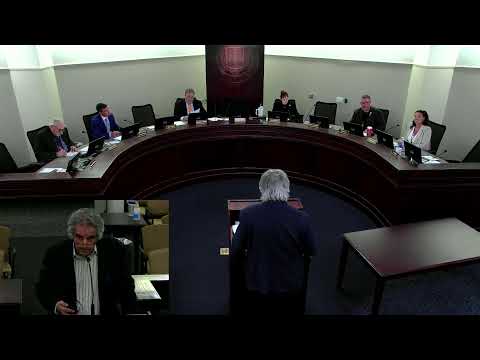
At the Oct. 16 Energy, Environment and Land Use Committee meeting, Northampton County Farmland Preservation staff reviewed staff changes, preservation milestones and recommended six Agricultural Conservation Assistance Program (ACAP) awards plus a contract amendment funded by a state Clean Streams Fund allocation.
Ryan Shaw, Farmland Preservation Division administrator, gave the committee an update Oct. 16 on staffing, recent preservation milestones and recommended awards from the Agricultural Conservation Assistance Program (ACAP).
The county’s Farmland Preservation Division has a new administrator (Ryan Shaw), a new resource specialist (Claire Wesner) and a newly hired technician, Isabella Velas (on vacation during the meeting). The office moved from the Greystone Building basement to the Louise Moore Park Farmhouse, 151 Country Club Road, Easton.
Shaw said the county has preserved 271 farms on more than 20,000 acres and currently has 11 farms in the easement process accounting for just over 550 additional acres. He reviewed ACAP background: the program was established through Pennsylvania’s Clean Streams Fund and provides financial and technical assistance for on-farm best management practices intended to reduce nonpoint-source pollution to streams and other waters. Shaw said the state initially allocated Northampton County $1,095,543 from an earlier round of ACAP funding; those funds were allocated to projects and operating expenses and are expected to be spent by the end of the calendar year. The State Conservation Commission subsequently allocated $240,000 to Northampton County for the 2024–25 state budget cycle, Shaw said; that allocation must be spent by 2026.
Shaw reported completed ACAP activity and new recommendations. To date the county has completed six ACAP projects—including three waste storage facilities and three prescribed grazing improvements—across six agricultural operations; the county reported those completed projects totaled roughly $905,000 and treated nonpoint-source pollution at those operations. He said ACAP applications are accepted year round and that Farmland Preservation had received 12 new ACAP applications; the Farmland Preservation Board reviews applications and forwards funding recommendations to county council.
On the round reviewed at the meeting, the board recommended six new awards and one contract amendment. Shaw described the items as follows (amounts and applicant descriptions stated by staff at the meeting):
- A contract amendment to bring the previously awarded “Knee Bone Farm” manure-storage award up to the farm’s requested $200,000 (staff said the project was under construction and that the recommended additional award would be $44,000). - Bridal Cromer Farm (crop and beef cattle): recommended $125,000 for a manure storage facility. - United Street Farm (crop operation; parcel recently preserved): recommended $45,000 to address existing soil erosion. - Keystone Farm (Tim Sykes, Williams Township; dairy operation): recommended funding to prepare a certified nutrient management plan (amount stated in the meeting transcript as “16,40 dollars,” reported here as the figure presented by staff). - Klein’s Dairy (Jacob Klein): recommended funding to update a nutrient management plan. - Good Work Farm (Anton Shannon; uses draft horses): recommended funding to prepare a nutrient management plan (amount presented by staff). - Northampton County (for “the golf farm” soil erosion repairs): recommended $35,000.
Shaw summarized: the Farmland Preservation Board recommended six new projects totaling $210,290 and one contract amendment totaling $44,000, for a total recommended new grant amount the county reported as about $254,200; Shaw noted that the recommended awards slightly exceed the $240,000 state allocation because of accrued interest that must be used for projects. “Our main focus is preserving the land and then managing helping the farmers manage the land,” Shaw said during the discussion.
Committee members asked for clarification about which allocation the additional $44,000 would come from and about outreach and follow-up to landowners. Shaw said the $44,000 would come from the current 2024–25 allocation and that Farmland Preservation is expanding outreach: applications are available on the county website and at the office, staff provide one-on-one consultations by request, the county sought state approval to accept easement applications year round (approval was received), and staff plan more promotional outreach with municipalities and social media to increase participation.
No formal committee vote or motion on the grant recommendations was recorded in the transcript; the presentation was informational and the Farmland Preservation Board’s recommendations will proceed to council as part of the county’s formal agenda process.
Sources: Presentation and staff remarks during the Oct. 16 Energy, Environment and Land Use Committee meeting (Farmland Preservation Division).