Get Full Government Meeting Transcripts, Videos, & Alerts Forever!
Get email alerts on the Public Safety Transit Workers topic
No spam. Unsubscribe anytime.
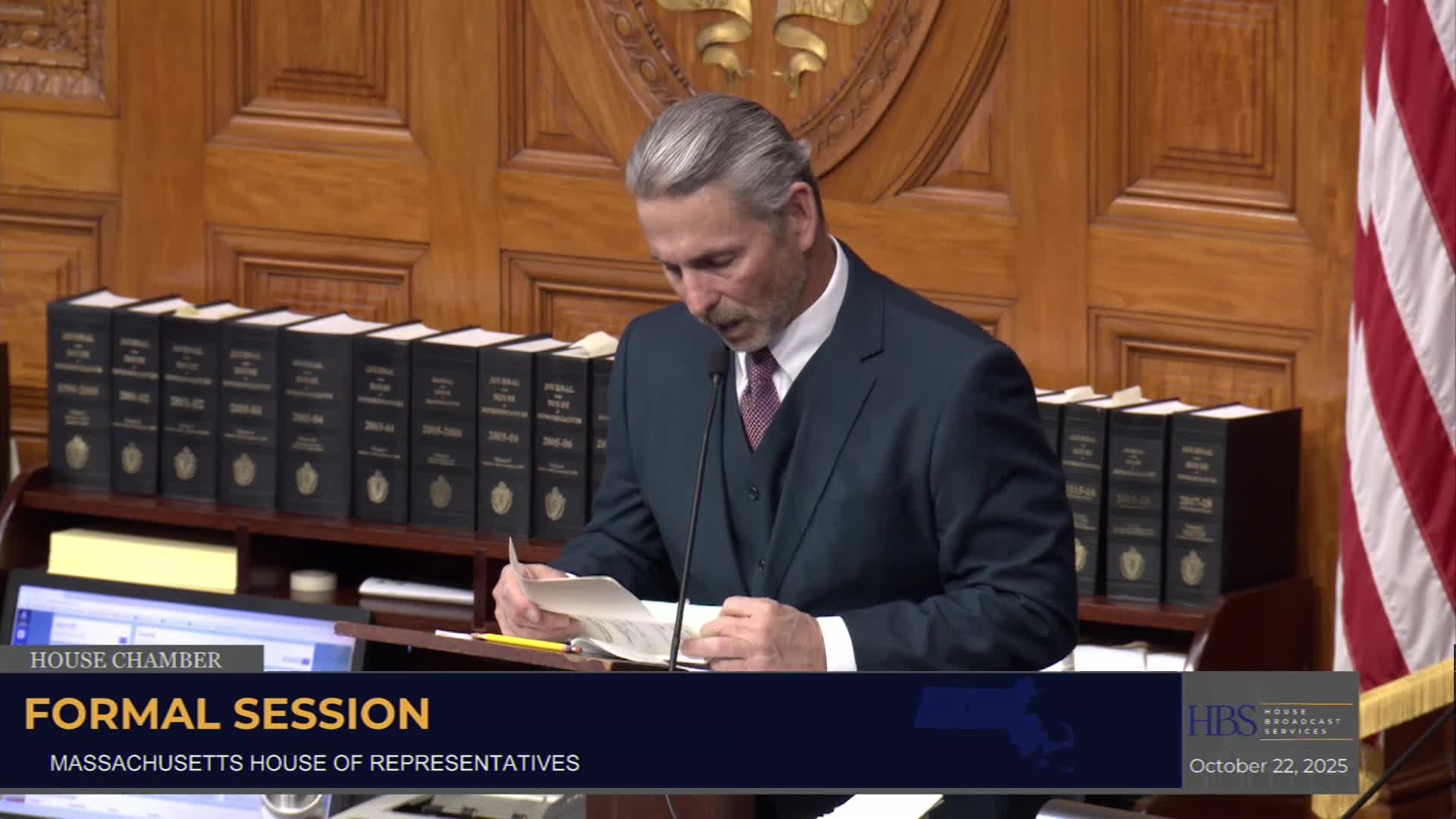
House approves bill increasing penalties for assaults on transit workers; roll call 116-0
Summary
The Massachusetts House passed a substitute bill that designates assaults on public transit workers as assaults on public employees and increases minimum penalties; the measure was passed to be engrossed by a 116-0 roll call.
The Massachusetts House of Representatives passed a substitute bill addressing assaults and batteries on public transit workers, voting 116-0 to send the measure to engrossment.
The bill, H 46 45, was debated on the House floor after committee action and sponsor remarks emphasizing a rise in attacks on transit employees. Representative Day of Stoneham said the legislation makes explicit that public transit employees are public employees and therefore eligible for heightened statutory protections; the bill also specifies penalties, including fines and possible jail time, and names throwing or projecting bodily fluids as conduct that constitutes assault and battery on a public employee.
The measure’s sponsor, Representative McGonigal of Everett, told colleagues he had received accounts from transit workers who had been stabbed, threatened with firearms, spat upon and otherwise assaulted while on duty. McGonigal cited federal and local figures in urging passage and recounted workers’ experiences to illustrate the consequences. He said, “This is just a job. I'm just trying to take you from point A to point B. I'm a person. I'm a human being. I'm a mom.”
McGonigal and Representative Day described data and examples during debate. Day noted Federal Transit Administration material and said Massachusetts transit systems reported hundreds of incidents in 2024; McGonigal described 634 incidents statewide in 2024 and said operators accounted for 77 percent of assaults in the incidents he cited. Those figures and individual accounts were offered as reasons the House should adopt the heightened penalties.
After debate, the House ordered a roll call (roll call number 93). The clerk displayed a tally of 116 yeas, 0 nays; the chair announced the substitute bill “passed to be engrossed.” The committee substitute was previously accepted and adopted by the chamber during the proceeding.
The bill, as described on the House floor, (1) clarifies that public transit employees are public employees under the commonwealth’s assault and battery statutes; (2) establishes a penalty range the House described as not less than $500 and not more than $5,000 or incarceration of not less than 90 days and up to 2½ years in a house of correction depending on severity; and (3) specifies that throwing or projecting bodily fluids or secretions constitutes assault and battery on a public employee. The text read on the floor used those terms; the official enrolled text should be consulted for precise statutory language and penalty structure.
What happens next
Passage to be engrossed means the bill next proceeds through the legislature’s enrollment and bill-passage process and may be sent to the Senate for further action. The House’s action does not itself make the changes into law.
Votes at a glance
- House substitute H 46 45, “An act relative to assault and battery upon a transit worker” — Roll call 93: 116 yeas, 0 nays; substitute adopted and bill passed to be engrossed.
Speakers quoted or cited in this article are drawn from the House floor debate as recorded in the session transcript.