Get Full Government Meeting Transcripts, Videos, & Alerts Forever!
Get email alerts on the Just Transition Workforce topic
No spam. Unsubscribe anytime.
Unions, trades push for 'just transition' bill to protect workers as Massachusetts shifts to clean energy
Summary
Dozens of union representatives and building-trades witnesses asked the Joint Committee to advance H 3475 / S 2276, a bill they say would require registered apprenticeships, prevailing wages, labor peace agreements and just-transition planning to protect fossil-fuel workers and create high-quality clean-energy jobs.
A coalition of unions, building-trades groups and workforce advocates asked the Joint Committee on Telecommunications, Utilities and Energy to favorably report H 3475 / S 2276, an act promoting a just transition and clean-energy workforce standards.
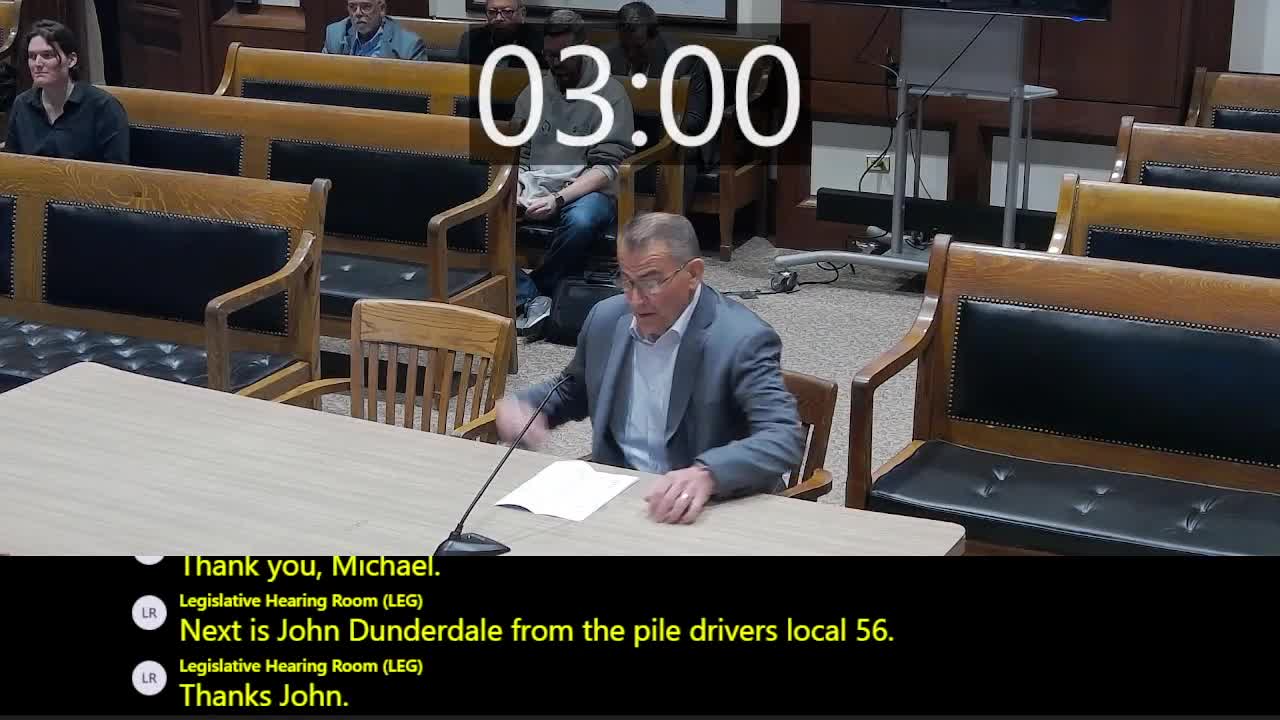
John Dunderdell, business manager for Pile Drivers Local 56, said clean-energy projects already under construction — including an offshore wind project he described as "Winyard Wind 1" — will deliver large-scale power and union jobs and must be coupled with state labor standards. "Once completed, this project will deliver over 800 megawatts of power to the New England grid," Dunderdell said, and he described more than 1,500 union jobs created on that project.
Speakers including Rich Marlin (Massachusetts Building Trades Unions), Kristen Gowen (National Electrical Contractors Association of Greater Boston), Jonathan Grossman (SEIU Local 509), Neil Crowley (United Steelworkers Local 12012), Lindsey Kenny (Massachusetts AFL-CIO) and Ryan Murphy (Climate Jobs Massachusetts Action) urged provisions that would expand prevailing wage coverage, require project labor agreements or labor-peace arrangements, prioritize state-certified apprenticeships and mandate utility just-transition plans addressing retention, retraining and workforce planning.
Jonathan Grossman and Neil Crowley recounted past technology transitions in other sectors and warned that workers can lose pensions, benefits and union representation if new industries are built without labor standards. "When we made the switch in mental-health technology, you could say, that was done without any guarantee of labor standards in the new technology," Grossman said, urging protections to avoid repeating that outcome.
Witnesses linked current federal uncertainty — including changes in the federal permitting and funding environment cited during testimony — to an immediate need for state action. Several witnesses said thousands of trained tradespeople and apprentices are currently unemployed due to federal decisions slowing projects, and they argued state-level standards could ensure new clean-energy jobs offer family-sustaining wages and benefits.
Proposed statutory tools described in testimony included requiring utilities to file just-transition plans detailing workforce retention and training, expanding prevailing wage application to off-site and supply-chain work, encouraging project labor agreements, and prioritizing registered apprenticeship programs for publicly funded projects.
Committee members asked technical questions about rate impacts and whether changes should be conditioned on utilities demonstrating rate reductions; witnesses said the coalition could provide written comments on detailed amendments. No committee vote was taken on H 3475 / S 2276 during the hearing.