Get Full Government Meeting Transcripts, Videos, & Alerts Forever!
Get email alerts on the Clean Energy Equity topic
No spam. Unsubscribe anytime.
Advocates and Senator Miranda press committee to center environmental justice in clean-energy bills
Summary
VoteSolar and Senator Liz Miranda urged the committee to adopt clean-energy equity measures ensuring benefits reach environmental justice communities, including tenant protections, disaggregated benefit tracking and enforceable targets tied to emissions timelines.
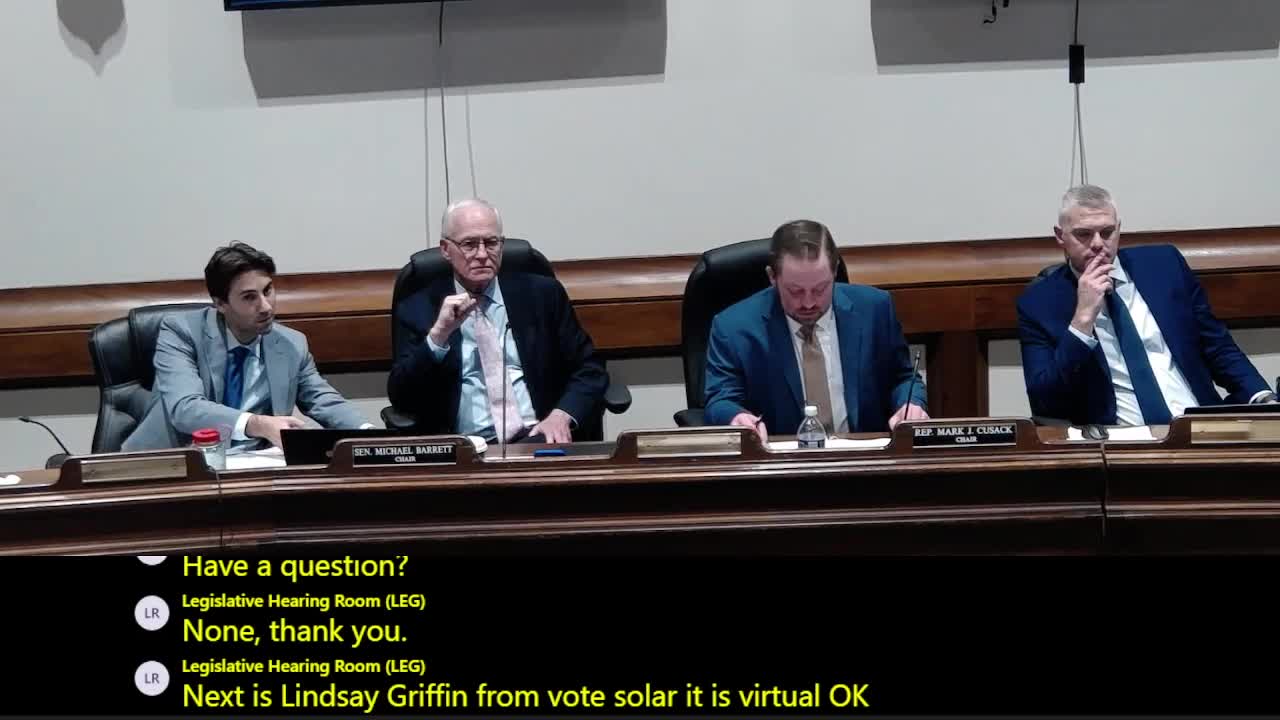
Lindsay Griffin of VoteSolar and Senator Liz Miranda (Second Suffolk) urged the Joint Committee on Telecommunications, Utilities and Energy to advance bills that embed equity into clean-energy policy and ensure environmental-justice communities share program benefits.
"This bill is built on a simple principle that energy is a right and not a commodity," Lindsay Griffin testified in support of H 3540 / S 2303, which she said empowers the Undersecretary of Environmental Justice and Equity to ensure clean-energy benefits flow proportionately to environmental-justice populations and establishes measurable compliance goals tied to emissions reductions timelines under Chapter 21N.
Griffin noted clean-energy funding is largely collected through utility bills and said low-income households often receive few benefits while paying a larger share of household income on energy costs. She highlighted barriers that exclude roughly 30% of Massachusetts households living in rental housing from distributed generation programs, and urged tenant protections against rent increases following solar installations.
Senator Liz Miranda described long-standing environmental injustice in communities such as Roxbury and said empirical disparities justify statutory guardrails. "After a long history of redlining, segregation, divestment, and pollution, black residents are actually 39 times more likely to live in one of the state's most environmentally hazardous areas than white residents of the Commonwealth," Miranda said, citing state research. She asked the committee to ensure disaggregated benefit tracking and accountability so the distribution of reduced energy bills, air-quality improvements and job creation reaches the 137 environmental-justice communities identified in state policy.
Both witnesses urged the committee to report the clean-energy equity bills favorably and to include enforceable tracking and tenant protections in final language. No formal committee vote occurred during the hearing.