Get Full Government Meeting Transcripts, Videos, & Alerts Forever!
Get email alerts on the Alternative Portfolio Standard topic
No spam. Unsubscribe anytime.
Green Energy Consumers Alliance urges ending or narrowing Massachusetts APS, citing costs and inequities
Summary
A Green Energy Consumers Alliance witness asked the Joint Committee on Telecommunications, Utilities and Energy to eliminate or sharply curtail the Alternative Portfolio Standard (APS), arguing it raises rates, subsidizes fossil-fuel equipment and disproportionately benefits businesses over residential ratepayers.
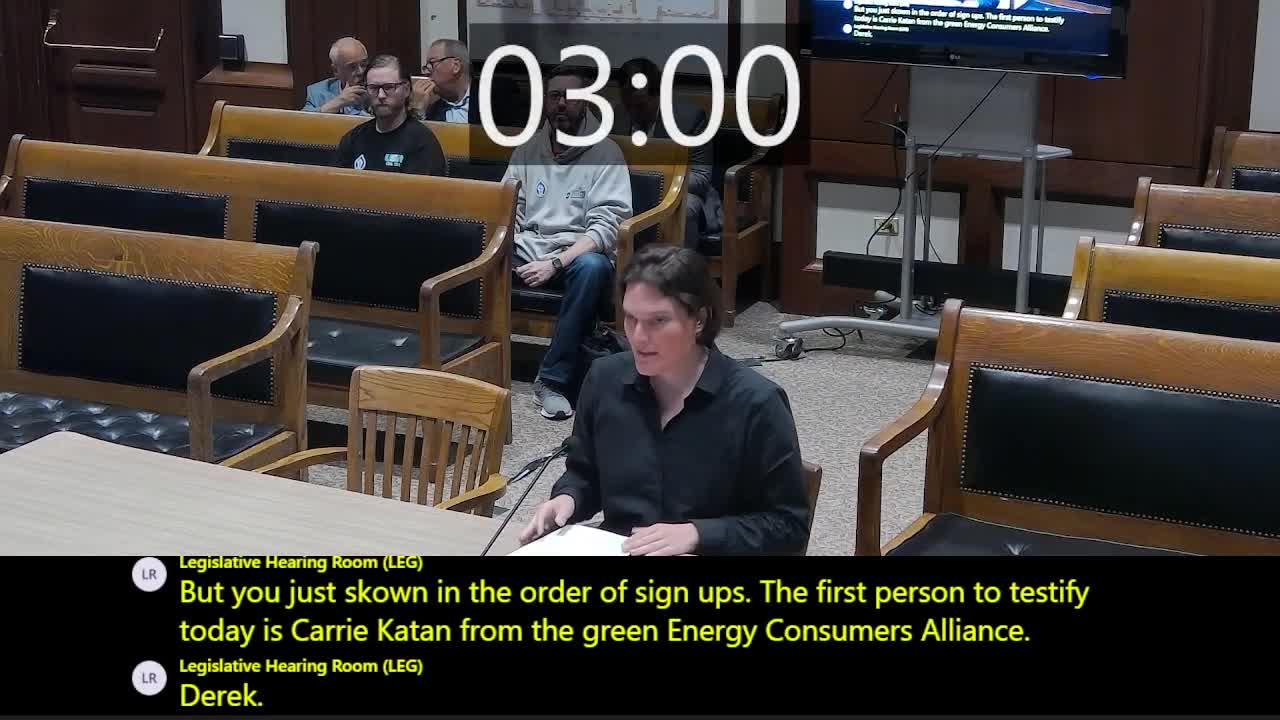
Kerry Catayan, a policy advocate with Green Energy Consumers Alliance, told the Joint Committee on Telecommunications, Utilities and Energy that Massachusetts ratepayers pay roughly $30,000,000 a year more because of the Alternative Portfolio Standard and that the program often subsidizes projects that would have been built without state support.
"Every year, the ratepayers of the Commonwealth pay electric bills that are roughly $30,000,000 higher than they otherwise would be because of the APS," Catayan said, urging the committee to advance H 35, 52 and S 22 68 to cut back on or eliminate the APS.
Catayan told the committee the APS funds fossil-fuel-fired combined heat and power systems and heating oil dealers blending biodiesel, and that woody-biomass systems receiving APS credits produce high levels of air pollutants such as fine particulates (PM2.5). She noted the legislature previously removed woody biomass from the Renewable Portfolio Standard because of air-quality impacts.
Catayan also raised distributional concerns: although residential customers fund APS through their utility bills, most benefits flow to businesses. She said a recent year’s data showed roughly 10% of APS subsidies went to heat pumps, and that many heat-pump installations receive a single lump-sum APS payment at installation rather than ongoing credits.
Committee members asked how removing or narrowing the APS would affect municipal projects that rely on APS credits to make deep-efficiency or renewable thermal investments pencil out. One legislator said a Lexington high school counts on roughly $4,000,000 a year in APS credits for a net-zero plan that includes ground-source and air-source heat pumps and solar thermal. Catayan responded that many of the same technologies are supported through Mass Save and that shifting funding into stronger Mass Save funding would be preferable to keeping both programs, but she acknowledged that precise legislative language would need refinement to avoid disrupting projects that rely on APS payments already committed or paid as lump sums.
Catayan also cited counts from the Department of Energy Resources, saying there are 11,995 small air-source heat pump units and 831 solar-thermal units that have qualified for APS credits across the Commonwealth; she said many larger units earn credits over time while many smaller heat-pump systems receive an upfront payment.
The hearing record shows the APS question overlaps with pending bills and with portions of the governor’s energy affordability bill; Catayan said the APS sections require more careful drafting to avoid unintentionally eliminating currently eligible installations.
Closing the discussion, Catayan said: "In a better world, they would be served by Mass Save, which is our main system," and urged the committee to consider narrower approaches if it does not move to full abolition.
No committee votes were taken on APS policy during the hearing; the proceeding concluded after public testimony.