Get Full Government Meeting Transcripts, Videos, & Alerts Forever!
Get email alerts on the Public Safety Workforce Retirement topic
No spam. Unsubscribe anytime.
Committee hears testimony on bill to reclassify county correctional nurses for retirement benefits
Summary
Lawmakers and correctional officials urged the Joint Committee on Public Service to move House Bill 2980, which would classify county correctional nurses as Group 4 employees for retirement, citing workplace danger, high acuity of jail populations and recruitment difficulties.
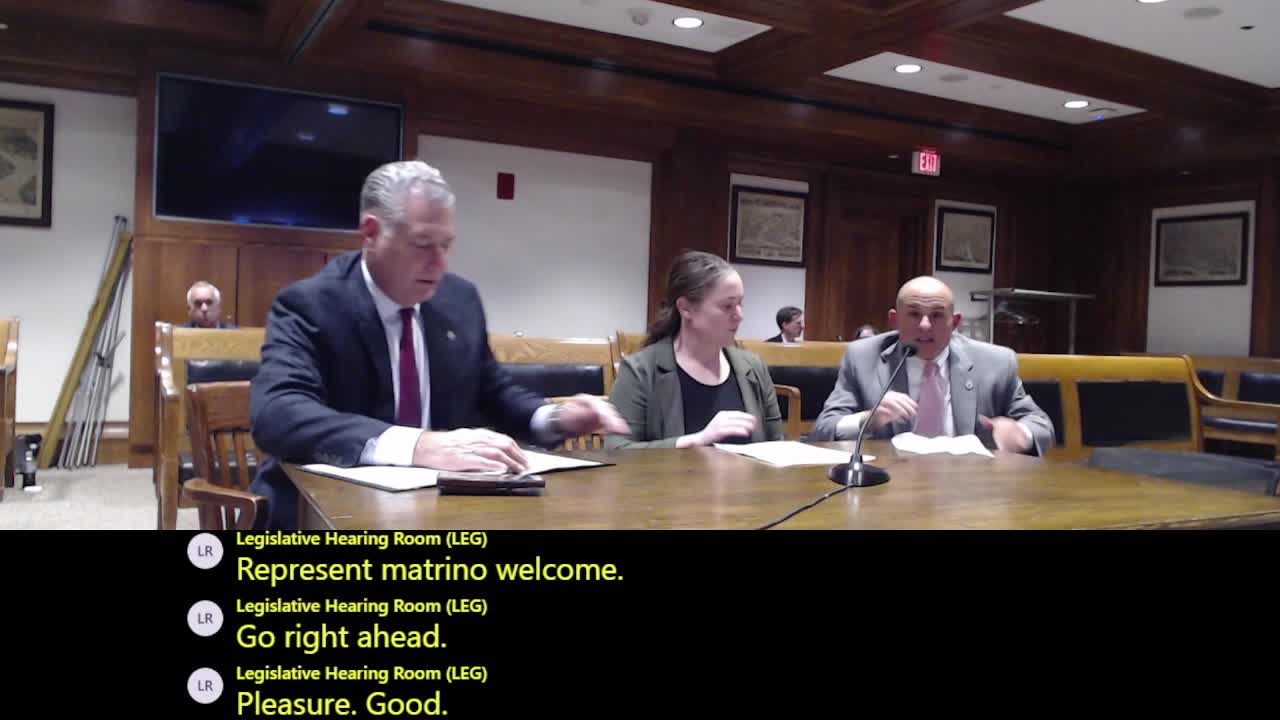
House Bill 2980, which would reclassify county correctional nurses into Group 4 retirement status, drew hours of testimony before the Joint Committee on Public Service on Tuesday. Representative Altrino, who filed the bill, and county officials urged the committee to treat correctional nurses on par with correction officers because of the medical acuity and safety risks they face.
The bill’s sponsor said he filed written testimony and spoke from his own experience working alongside nurses in county jails. "They provide critical care ... these folks are just as important as our correction officers," Representative Altrino said, arguing nurses often work one-on-one with incarcerated people in isolated settings.
Middlesex County’s sheriff told the panel the county’s nurses handle a medically and behaviorally complex population and that classifying them as Group 4 would address recruitment and retention problems. The sheriff said the jail’s health services unit logged more than 135,000 patient contacts in a year and cited other measures of acuity, including that roughly 55% of individuals entering custody had a diagnosed mental illness and 41% a diagnosed substance-use disorder.
Leanne Cameron, a MAT nurse manager at the Middlesex Jail and House of Correction, described the daily responsibilities and safety risks for correctional nurses: intake assessments, medication administration including MAT and mental-health medications, sick calls and recurring interaction with patients who may be behaviorally dysregulated. "Working in a correctional facility can be a high stress, fast paced, and, at times, volatile work environment," Cameron said, urging the committee to support the reclassification to aid recruitment and retention.
Witnesses cited research and local data to support the request. The sheriff referenced a study by UMass Lowell showing high rates of sharps injuries and perceived risk of workplace violence among correctional nurses, and said a prior fiscal analysis estimated only about 18 state-employed nurses statewide would be directly affected because many counties contract medical services to private vendors.
No formal committee action or vote was recorded during the hearing. Committee members asked about day-to-day duties and safety procedures; testimony included concerns about outsourcing medical services and the effect that has on local control and data.
If reported favorably by the committee, the bill would move to the next legislative steps for consideration by the full legislature.