Get Full Government Meeting Transcripts, Videos, & Alerts Forever!
Get email alerts on the Municipal Code Penalties topic
No spam. Unsubscribe anytime.
Committee advances code changes to widen forfeiture ranges for ordinance violations after debate
Summary
The Ordinance and Licensing Committee voted 3–1 to recommend changes to municipal code sections 11.01 and 25.05 to expand the range of forfeitures for certain ordinance violations; committee members debated potential for disproportionate fines and clarified judicial and bond-schedule limits.
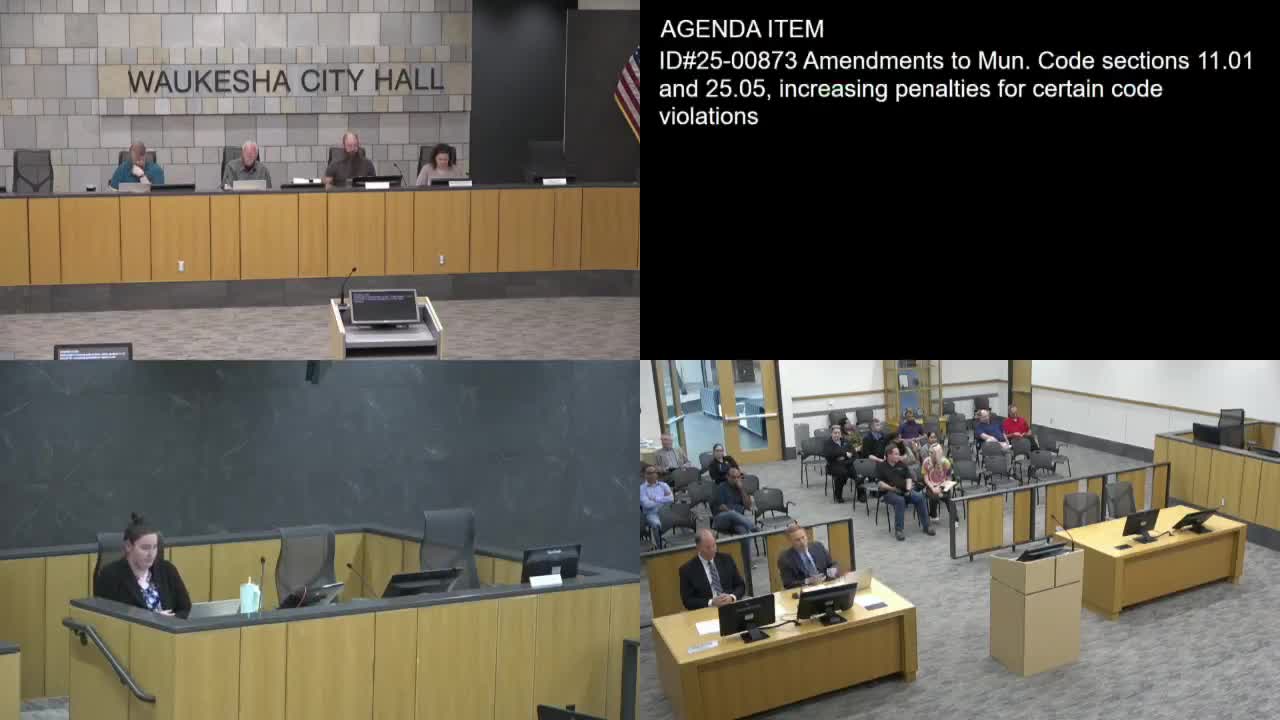
The Waukesha City Ordinance and Licensing Committee voted 3–1 on June 9 to recommend amendments to municipal code sections 11.01 and 25.05 that expand the range of forfeitures that may be charged for ordinance violations.
Assistant City Attorney Michael Radovich told the committee the changes update the city’s general penalty provisions and a chart of specified ranges in 11.01(10)(a). “We’re just requesting to expand the range for the forfeitures that can be charged for different kinds of ordinance violations,” Radovich said, and noted the city has not changed those provisions since 2005.
Committee members raised concerns about the proposed maximums. One member said raising the cap to $2,500 for a first offense and $5,000 for subsequent offenses “looks tyrannical” and could, in their view, risk bankrupting residents for relatively minor violations. That member asked whether a common complaint such as long grass could result in a thousands-of-dollars forfeiture; Radovich and other city staff replied that specified forfeiture amounts already exist elsewhere in the code and the general provision would apply only where the code does not set a penalty.
Radovich and the city attorney’s office explained the municipal judge and the bond schedule control actual charges and that the proposed changes simply expand the statutory range the city may authorize. As Radovich said, “we would have to comply with what the bond schedule is that's determined by the municipal judge and approved by the council.” A representative of the city attorney’s office emphasized the amendments are intended as a deterrent and that the city’s recent bond-schedule proposals set most ticket payment amounts in the $124–$313 range for common minor violations.
After discussion, Alderperson Helvins Laban moved to approve the amendments to municipal code sections 11.01 and 25.05 as presented; Alderperson Manion seconded. The motion passed 3–1. The committee record shows Van Trieste cast the lone recorded no vote.