Get Full Government Meeting Transcripts, Videos, & Alerts Forever!
Get email alerts on the Higher Education Finance topic
No spam. Unsubscribe anytime.
House offers initial higher-education funding package in HF24301 conference; committee moves to recess after public comment
Summary
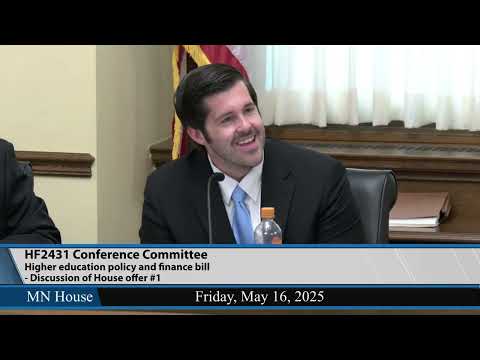
The conference committee on House File 24301 opened at 1 p.m. and the House presented its initial offer, a public spreadsheet summarizing proposed changes to higher-education funding and policy included in the bill.
The conference committee on House File 24301 opened at 1 p.m. and the House presented its initial offer, a public spreadsheet summarizing proposed changes to higher-education funding and policy included in the bill. House fiscal staff said the offer meets targets set in a prior global agreement and outlined increases and reductions across the state grant program, Minnesota State and the University of Minnesota appropriations, and several student-support programs.
Ken Savory, identified as House fiscal staff, summarized the House spreadsheet, dated 05/15 at 5:22 p.m., saying the House is "hitting the targets as assigned by the global agreement of $22,000,000 in 26-27 and $4,500,000 in 28-29." He described specific line-item changes, including increases to the state grant program and reductions or alignments on other student supports.
The House offer includes a $47,230,000 increase above base for the state grant program in fiscal years 2026-27 and a $31,564,000 increase above base in fiscal years 2028-29, according to Savory's walk-through of the spreadsheet. The House also maintained a $5,500,000 reduction for the state work-study program in each biennium. Savory said the House proposed a negative $6,058,000 change to the emergency assistance for postsecondary students (EAPS) to align with the Senate, and a reduction of $1,600,000 for hunger-free campus grants to match the Senate position.
Savory said the House and Senate align on an $8,000,000 appropriation in each biennium for fostering independence grants, and that the House would reduce concurrent enrollment grants by $680,000. He said the House proposed cuts to student-parent support initiatives of $4,000,000 and $6,000,000 (described in the spreadsheet as reductions in each biennium). He also said the House would cancel an ALS research grant in FY25 and redistribute that funding to the University of Minnesota.
On campus operations and administration, Savory said the House partially agreed with the Senate on consolidation of operations and maintenance (O&M) riders and on a tuition relief rider and a separate appropriation for campus sexual-assault reporting policies, which he listed as a $75,000,000 tuition-relief rider and $80,000 for campus sexual-assault reporting policies in the rider consolidation lines. He described technical changes that would make a cannabis research grant a separate line outside the O&M appropriation.
Nathan Hopkins, from House Research, reviewed policy provisions the House included in its offer and which differing Senate provisions the House accepted. Hopkins said the House kept a tuition-cap provision for four-year programs; accepted the Senate approach to extended availability for the state grant appropriation, the EAPS grant approach and the Senate language on hunger-free campus grants; and pulled the cannabis research appropriation out of the University of Minnesota operations and maintenance section and placed it as a separate appropriation line.
Hopkins outlined additional items the House included or accepted from the Senate: provisions on opioid antagonists, protections for pregnant and parenting students (using House language), dual training grant provisions (House), the University of Minnesota Permanent University Fund (Senate), and creation of a Mid-State enrollment fraud working group (Senate language accepted; the House also requested the report be sent to the House fraud committee). Hopkins also said the House planned amendment language to carve a law-enforcement pilot from the workforce development scholarship appropriation at Minnesota State.
Committee members asked few questions during the presentation. One member said they remained uneasy about shifting reductions onto student parents and Minnesota State students and hoped to circulate a counteroffer during the recess. The committee then opened the floor to public testimony; a member of the public identified in the record as "Mr. Omen" indicated interest in offering remarks. The conference committee chair said the process would remain public and that subsequent offers and counteroffers would be posted online for public review.
Before recessing, the chair said the committee would post the Senate counteroffer when submitted, provide 30 minutes' notice before reconvening to review the counteroffer publicly, and continue the exchange of public offers and discussion until a deal is reached. A motion "to recess to the call of the chair" was made and the committee voted to recess; the chair announced the motion prevailed and the committee stood in recess.
The committee's initial House offer and the spreadsheet presented were the substantive items on the record; no final conference agreement on House File 24301 was reached during this session. The committee intends to post subsequent offers and reconvene after Senate conferees produce a counteroffer.