Get Full Government Meeting Transcripts, Videos, & Alerts Forever!
Get email alerts on the Ethics Procedure Reform topic
No spam. Unsubscribe anytime.
Community Board 11 ethics committee revises complaint process, adds anonymity option and timelines
Summary
At a May 19 remote meeting, Community Board 11's Ethics and Disciplinary Committee agreed on a package of procedural changes including a centralized intake email and shared drive, a required redacted copy to respondents, a 90-day review window and new rules for anonymous complaints. No formal votes were taken because the agenda posting missed the
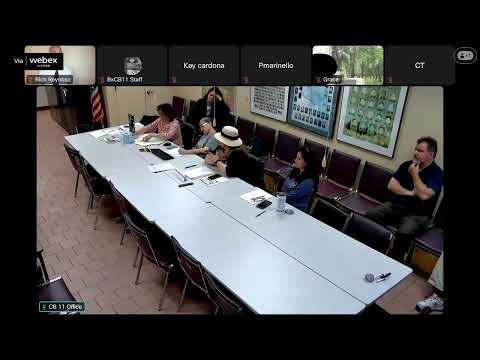
Community Board 11's Ethics and Disciplinary Committee met remotely May 19 and agreed on a set of procedural changes to how ethics complaints are handled, including a centralized intake email and office-held shared drive, a requirement to send respondents a redacted copy of complaints, and clearer timelines for review and hearings. The committee did not take any formal votes because the meeting agenda was posted with the wrong month and therefore did not meet the 72-hour posting requirement.
The changes grow out of a line-by-line review of a flowchart and the committee's complaint form. Jeanette Wilson, acting chair of the Ethics and Disciplinary Committee, opened the meeting by saying, "Good evening, everyone. And welcome to the meeting of the Ethics and Disciplinary Committee. We do have a quorum." Committee members focused on making the process transparent, protecting confidentiality where required, and ensuring the committee meets statutory or board notice requirements.
Under the revised procedure the committee agreed to centralize intake: any complaint received by an individual board member or staff must be forwarded to the CB11 ethics inbox so the filing time is recorded and the 90-day review clock can begin. Staff (Jeremy, Chris and Harriet were identified as having access) will maintain an office-held shared drive for complaint files to preserve continuity when membership changes. Each submission will receive a case number placed in a footer on every page of the form.
The committee confirmed several deadlines and hearing rules that will be reflected in the revised form and flowchart: complaints should be filed within one year of the incident; supporting documents should be submitted at least one week before the scheduled monthly hearing; the committee has 90 days from the hearing addressing the complaint to investigate and submit findings to the board leadership; and the subject of a complaint will receive a redacted copy of the complaint in advance. During hearings the complainant will have five minutes to state their case, up to two witnesses may speak for 1—2/2 minutes each, and the respondent will have five minutes to respond. The committee agreed a timekeeper should be designated for fairness.
The committee added a clear anonymity option to the form. Members agreed that complainants may file anonymously but that the respondent must still be provided the complaint's substance (with personal contact details redacted) so the respondent can prepare a response. The cover sheet will include an explicit checkbox near the top for a complainant to request anonymity; the form will also provide the option for the person to submit identifying contact information to staff while keeping it off the document shared with the respondent.
Committee members debated how to handle no-shows. They agreed the rules should differentiate: if a complainant who has been notified does not appear, the case may be dismissed (the complainant may resubmit); if a respondent does not appear, the committee will decide whether to reschedule promptly (the group discussed a two-week reschedule window) or proceed with decision-making. The committee emphasized the 90-day investigation clock requires timely scheduling and recommended scheduling interim meetings when necessary.
Members also removed an item on the public flowchart that had suggested e-voting via Google Forms; committee members said such a process would violate open-meetings rules and must not appear on the public flowchart. The committee affirmed that the leadership committee will receive an email summary of findings before leadership meets and that leadership may review or vote on recommendations before bringing matters to the full board.
Several administrative edits to the complaint form were agreed: add a clear anonymity checkbox on the first page, include a case-number footer on every page, clarify who may forward paper submissions to staff (and require that staff scan and upload them to the central inbox), and explicitly state whether certain categories (for example, union employees) follow other protocols. The committee also clarified that complaints alleging staff misconduct are forwarded to the board's leadership committee for review and that Equal Employment Opportunity complaints or matters outside the committee's remit may be referred to the borough president's office or other agencies.
The committee said it will implement the edits and bring a cleaned-up flowchart and revised form to the next meeting. Because the agenda was posted for the wrong month and the 72-hour notice requirement was not met, there were no votes taken at the May 19 meeting; however, the committee agreed to schedule three pending cases for the June meeting so the 90-day timeline can be met.
Ending: The committee closed the business portion of the meeting with agreement on the edits and a directive to staff to make the changes and circulate the revised form and flowchart. Members repeatedly emphasized that once the flowchart is finalized the committee must follow it consistently to protect complainants, respondents and the board.