Get Full Government Meeting Transcripts, Videos, & Alerts Forever!
Get email alerts on the Elections topic
No spam. Unsubscribe anytime.
Committee backs bill giving party-recommended election judges priority, adds clerk authority to remove disruptive judges
Summary
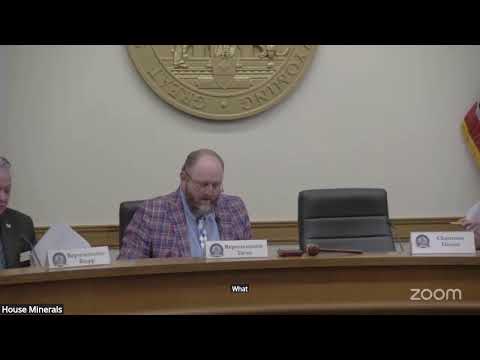
House Bill 321, Election Judge Selection, was advanced by the Minerals, Business & Economic Development Committee after testimony from the bill sponsor, county clerks and local party members and a conceptual amendment that clarifies county clerks’ authority to remove election judges for violations or disruptive conduct.
House Bill 321, Election Judge Selection, was advanced by the Minerals, Business & Economic Development Committee after testimony from the bill sponsor, county clerks and local party members and a conceptual amendment that clarifies county clerks’ authority to remove election judges for violations or disruptive conduct.
The bill would amend state statute to require county clerks to give priority to election judges and alternates recommended by the county chairmen of major and minor political parties when filling precinct judge positions; clerks may still appoint others if party lists are insufficient. Sponsor Representative Anne Lucas, who represents House District 43, described the bill as “pretty simple” and said it was intended to ensure party-submitted lists receive priority when clerks select judges.
Supporters said the change responds to inconsistent county practices. Karen Drost of Weston County said county officials there had not followed the intended order and that local volunteers were excluded: “When it came time for the clerk to send the letter ... the clerk of Weston County sent a letter ... and she had filled all the rest and would not be using our list,” Drost testified. County clerks and the County Clerk’s Association told the committee they routinely rely on party lists but also need authority to remove judges who do not follow training or the law. Fremont County Clerk Julie Friese described operational realities in larger counties: “In this last election, I think I was short about 50 to 70 people,” and said clerks must be able to replace judges who refuse to follow prescribed procedures.
Secretary of State staff and some testifiers said the statute was ambiguous in places and that clarifying language would reduce uneven implementation across counties. Secretary of State counsel Joe Rubino told the committee the office supported the bill, describing it as “codifying existing statute or ability” and as a tool to enable uniform implementation statewide. Rubino added that clarifying the priority for party lists would help align practice across counties.
Committee members discussed balancing party role and clerk responsibilities. During debate members proposed and the committee approved a conceptual amendment to add a new subsection explicitly granting county clerks authority to remove election judges from party lists for violating their oath, failing to follow law, or disrupting the process. Members said administrative details such as documentation and appeals could be handled through rulemaking or further drafting.
After discussion the committee voted to advance the bill with the conceptual amendment. The roll call recorded eight ayes and one excused: Representative Kevin Campbell (aye), Representative Knapp (aye), Representative Larson (aye), Representative Lolli (aye), Representative Schmidt (aye), Representative Tarver (aye), Representative Weber (aye) and Chairman Heiner (voted aye); Representative Riggins was excused. The committee recorded the tally as 8 ayes, 0 no, 1 excused.
The measure will next go to a committee of the full House for additional consideration; if enacted it would take effect July 1 as written in the bill’s text.
Less-critical details: Testimony included a range of local perspectives. Gail Simmons of Civics307/YVote argued the statutory priority being proposed already exists in law and that the bill may duplicate current language; other witnesses described specific local incidents and supported the clarifying language. Committee members said they expect clerks, the Secretary of State’s office and party chairs to work through remaining implementation details.