Get Full Government Meeting Transcripts, Videos, & Alerts Forever!
Get email alerts on the Food Waste topic
No spam. Unsubscribe anytime.
Southeast Alaska Food Bank describes grocery‑rescue operations, urges donations and volunteers
Summary
At a virtual Juneau Commission on Sustainability event, Dan Parks of the Southeast Alaska Food Bank outlined how grocery‑rescue, a public pantry and member services reduce food waste in Juneau, described limits on what the bank can accept, and urged volunteers and donations ahead of the winter season.
Dan Parks, general manager of the Southeast Alaska Food Bank, told the Juneau Commission on Sustainability at a virtual meeting that grocery‑rescue — collecting perfectly edible food retailers would otherwise discard — is the food bank’s largest source and central tool for reducing food waste in Juneau.
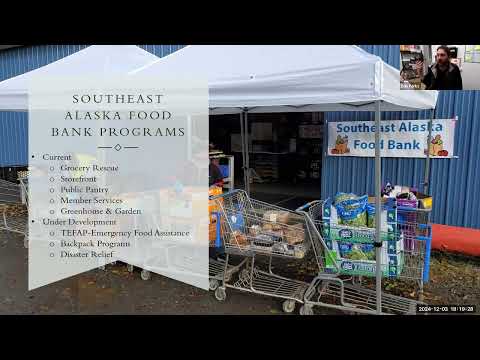
Parks said the food bank runs grocery‑rescue routes Monday through Thursday, collecting from Foodland, Safeway, Super Bear, Costco and Fred Meyer and rotating other distributors, and that most of the food redistributed in the region comes from that work. "Grocery rescue is a big thing for food banking in general," Parks said.
The presentation summarized how the food bank operates and why some donations cannot be redistributed. Parks said the organization tracks activity in pounds ("food in, food out") and that public pantry hours are every Thursday from 3 p.m. to 5:30 p.m., when the food bank serves roughly 100 to 150 families (about 300 to 400 people). The pantry and member services supply other local agencies, including the Glory Hall and the Juneau Alliance for Mental Health, which use the food in different ways.
Parks described internal rules and national guidance the food bank follows. He recommended donors consult USDA Food Safety and Inspection Service guidance about date labeling and said many items stamped with a "best by" date remain safe and usable. "If you have old food in your pantry and you're not sure, there's a pretty good chance that we might be able to use it," Parks said, urging residents to bring uncertain items to the food bank rather than discard them.
Parks also said the bank is starting participation in the Emergency Food Assistance Program (TFAP) in the coming month to add a federally supplied distribution stream and is expanding backpack programs with the Juneau Community Foundation and the Zach Gordon Youth Center for children over school breaks.
On waste and handling limits, Parks said the food bank composts, recycles packaging, and gives surplus inedible items to animal owners when possible. He estimated that less than 10% of food the organization receives ends up as waste, attributing some losses to damaged packaging, opened containers, or items already unsafe on arrival. He also noted limits: the food bank cannot accept noncommercially processed game or home‑slaughtered meat, and produce and prepared foods present storage and shelf‑life challenges.
The presentation highlighted capacity and staffing constraints. Parks said the paid staff totals three employees (general manager, storefront program coordinator, and driver/warehouse lead) supported by about 20 regular volunteers and another ~20 on call; grocery rescue requires a full workload from one driver plus volunteers. He said increased freezer and refrigeration capacity would help move more donated protein and frozen items. "We are a team of 3," Parks said. "We’re only doing a small fraction of the work that needs to be done here."
Commission member Nick (moderator) and Diana, the Juneau City and Borough environmental project specialist, discussed logistics and partnerships. Diana said Tlingit and Haida recently received a large grant for Southeast composting and recycling and offered to connect Parks with colleagues to discuss regional transport and recovery efforts. She told Parks she would email him to follow up.
Parks raised distribution challenges to other Southeast communities and asked for improved transport links to use Juneau as a stronger hub for neighboring members on the ferry system. He said heavy canned goods and bulky donations can be hard to ship to island communities without reliable freight schedules.
Parks closed by stressing winter demand: "The winter is the busiest time of the year for the food bank," he said, and he asked residents to consider volunteering or donating as utility bills rise and seasonal job income diminishes in late winter.
The event was informational; no formal actions, motions or votes were taken.
Sources: presentation and Q&A at the Juneau Commission on Sustainability virtual meeting, remarks by Dan Parks (Southeast Alaska Food Bank), Nick (JCOS moderator), and Diana (Juneau City and Borough environmental project specialist).