Get Full Government Meeting Transcripts, Videos, & Alerts Forever!
Get email alerts on the Digital Equity topic
No spam. Unsubscribe anytime.
Board presses staff for concrete plan on 1-to-1 devices and affordable home internet after superintendent report
Summary
Board members pressed staff for a timetable and specific plan to achieve districtwide 1:1 devices and affordable or no-cost home internet for students, citing persistent gaps in take-home deployment and cost barriers for families.
Board members used the annual CCC settlement discussion to press district staff for a clearer, time-bound plan to make device and home internet access consistent across Broward schools.
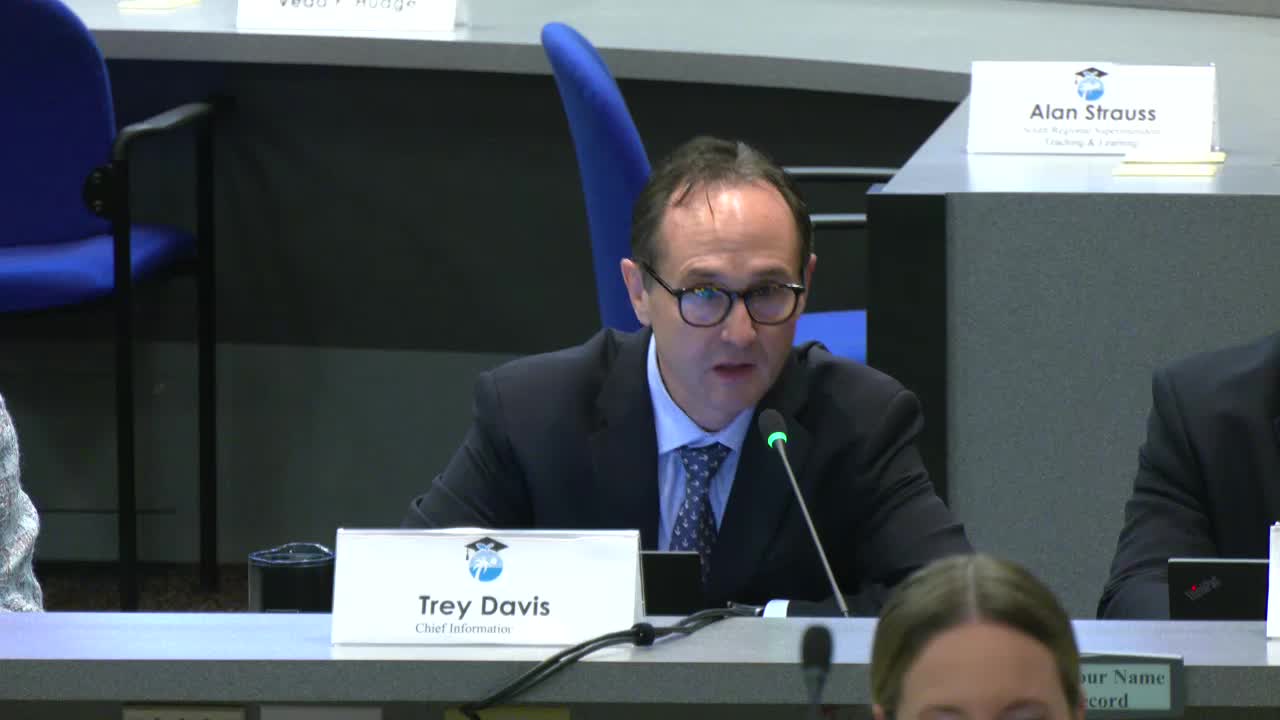
Chief Information Officer Trey Davis told the board the district currently inventories about 1.2 devices per student but noted gaps in deployment: some principals issue take-home devices to needy students and others do not. Davis said the district is formalizing policies so schools consistently issue devices to students identified as having need; he estimated the logistics of deployment, maintenance, and broken/stolen device handling were being formalized after a recent proof-of-concept at about a dozen schools.
On home internet access, Davis and Superintendent Dr. Vickie Hepburn said district staff are pursuing low-cost and no-cost options with partners including major carriers, nonprofits and federal programs. Davis estimated the fully enabled, district-paid home Wi-Fi for every student could cost tens of millions of dollars (he cited an order-of-magnitude "north of $20,000,000" figure when describing universal connectivity). Staff said several lower-cost options exist, such as programs with monthly fees as low as $10, and some zero-cost options through federal programs and limited partner offerings, but availability depends on partner eligibility and funding.
Board members repeatedly pressed for more than outreach: several asked staff to set firm timelines for rolling back principal-level autonomy and making device distribution and Wi-Fi assistance district policy. Board member Dr. Ziem said the district should set an implementation date and make connectivity a district priority; other members urged more rapid action given students' reliance on online assignments. Staff said they have a phased approach: validating inventory and device age, piloting take-home deployments in high-need schools, then scaling and working with the STO office to prioritize distribution.
Board members also raised equity concerns: some lower-enrollment schools and certain neighborhoods reportedly have older library collections and weaker infrastructure. Members asked staff for breakdowns by school and to report back to the board with a schedule for achieving equitable take-home and home-internet access.
No formal policy was adopted. Staff agreed to provide a follow-up that will include inventory age data, a proposed take-home deployment schedule, partner options for reduced-cost or no-cost internet service, and an equity-based rollout plan.