Get Full Government Meeting Transcripts, Videos, & Alerts Forever!
Get email alerts on the School Attendance topic
No spam. Unsubscribe anytime.
Proviso Township HSD 209 outlines Jan. 21 ‘reset’ of tardy and truancy procedures
Summary
Superintendent Chris Mobius and school leaders described a set of attendance measures — including ID-scanning tardy stations, daily detentions and a progressive discipline schedule — to begin Jan. 21 to increase on-time class arrival and reduce unverified absences.
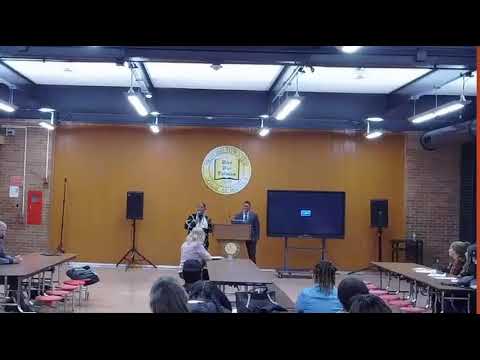
Proviso Township High School District 209 Superintendent Chris Mobius and building leaders presented a “tardy and truancy reset” at a community meeting, announcing a set of new attendance and discipline measures the district plans to begin Jan. 21 to improve on-time arrival and reduce unverified absences.
School leaders said the changes are intended to improve student safety and instructional time. Principal Martinez told the meeting the goal is to create “a climate where learning is of the utmost importance” and to ensure staff can locate students quickly if an emergency occurs.
District and school officials described several new or expanded measures. The school purchased 14 ID-scanning “tardy pass” stations that will feed information directly into PowerSchool so passes can be printed and students routed to class faster. The stations will be placed around the building, with several located at unlocked bathrooms, and security staff trained to operate them.
District staff said passing periods will remain five minutes but will include a new auditory cue: when one minute remains, music will play throughout hallways and classes will begin when the music ends. The change is intended to give a clearer signal than the previous two-minute chime.
Officials described a progressive discipline schedule tied to weekly tardy counts. Under the plan presented, students may accumulate up to three tardies with corrective steps; the fourth tardy in a week triggers a detention. Missed detentions escalate to additional detentions, then to a Saturday detention after three missed detentions in a week. Missing a Saturday detention would result in an in-school suspension, with further noncompliance leading to additional in‑school days or, ultimately, out-of-school suspension. School leaders said they will attempt outreach before suspensions and do not want to remove students from class unless necessary.
Superintendent Chris Mobius, who said he began his tenure Dec. 2, framed the effort as immediate rather than waiting for a longer entry plan: “some things could not wait until May. And so we are starting on January 21st, we will be doing a reset on some expected behaviors.”
Mr. Mohave, a district staff member who outlined operational details, described how the new scanning stations will replace handwritten passes and increase speed: “we bought 14 stations to put around the entire school … so the hope is that within 5 to 7 minutes of the bell ringing, the hallways are clear.” He also stated the district’s expectation on fights: “the acceptable amount of fights within a building is 0, and the expectation is that our students don't fight.”
The school also plans a weekly report for families (referred to in the meeting as the “weekly bag report”) to be emailed each Friday and printed for students; the report will list attendance, behavior and grades so parents can follow up. Administrators said teachers will receive daily attendance reports and that detention will be held daily Monday–Friday, with additional Saturday sessions.
Officials addressed phone use and bathroom monitoring. The school told parents that every classroom will have a phone holder so students store phones during class; phones taken for violations will be held by security and returned at the end of the day. Bathrooms that were previously locked will be unlocked, and staff and security will monitor restroom areas. School leaders said these steps are intended to reduce unsupervised hallway time and incidents tied to social media or substance use in bathrooms.
Parents and teachers asked questions about excused tardies, record accuracy and how the new system will treat cases where parents report a child is present but records show a tardy. School leaders acknowledged past record inaccuracies when passes were handwritten and said the scanned system should reduce those errors, but they also encouraged parents to contact the school directly for individual cases.
School leaders repeatedly asked for parent partnership. Principal Martinez said the changes will take time and asked for patience during rollout: “we're asking that people be understanding and everyone working together to get the kids engaged in learning and transition well.”
The measures described are administrative changes by the district and school; no board votes or formal policy adoptions were reported during the meeting. Officials said they would monitor the rollout and revisit procedures if needed.