Get Full Government Meeting Transcripts, Videos, & Alerts Forever!
Get email alerts on the Drinking Water Infrastructure topic
No spam. Unsubscribe anytime.
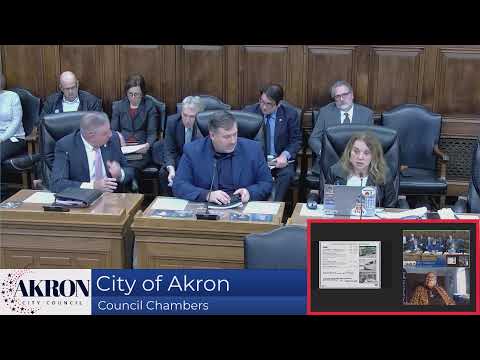
Akron staff outline water capital projects and near-complete lead service-line replacement effort
Summary
Drinking-water staff told council members the bureau serves roughly 300,000 people across multiple jurisdictions, previewed water-main extensions (Copley and Portage Lakes), reservoirs and pump-station upgrades, and described a lead-service-line removal program funded by grants and loan principal forgiveness.
Jeff Bernowski, responsible for drinking-water operations for Akron, briefed the committee on the water portion of the capital budget, describing system coverage, upcoming water-main extensions, reservoir replacement and a near-complete lead service-line replacement program funded largely by grants and loan principal forgiveness.
Bernowski said Akron’s water system “serve[s] about 300,000 people” and supplies customers in multiple townships and municipalities including Copley, parts of Hudson, Cargill Falls, Stowe and Tallmadge. He described several projects in the 2025 capital plan: a Copley Road water-main extension (construction expected to begin in April and last six to eight months), the Portage Lakes water-main extension (a roughly $7,000,000 project under contract with 53% principal forgiveness from Ohio EPA and the balance paid by tap fees), a US-20/224 Springfield Township extension, Archwood pump-station rehabs, and the Britton Road reservoir replacement (design complete and expected to be a two-year project).
On meters and redundancy, Bernowski said the city is closing out a meter-replacement program and will bid several force-main and water-main rehab projects in 2025. He noted the airport-sized force-main rehab is a substantial undertaking, replacing a section of an original main that has experienced wall-thickness wear.
The presentation highlighted the lead service-line replacement effort. Bernowski said of the city’s historical inventory “dating back to about 1964, there were 50,000 homes in the city of Akron served with a lead service line. Today, we have 601.” Later in the same exchange he said funding in the program will “remove 1,500 of those 1,601 in 2025.” The transcript contains both figures; council and staff exchanges show the city expects to remove a large portion of remaining lines in 2025 using outside funding, but the exact current-count figure in the transcript is inconsistent and requires verification.
On funding, Bernowski cited multiple sources: an H2Ohio grant of $5,000,000, $17,900,000 in principal forgiveness on long-term loans, American Rescue Plan Act (ARPA) money and other grants; he emphasized the program would not be funded solely by Akron ratepayers. Council members asked about contractor diversity for the lead-replacement work; staff said they would provide a follow-up answer on minority-contractor participation.
Council members asked technical questions about pipe-sizing decisions and project timing; staff explained those sizing determinations come from hydraulic modeling and said several projects will be bid this spring. The session included scheduling notes: a public hearing is set for Jan. 27 and council must approve the budget by Feb. 15 under the city charter. No formal votes were recorded in the transcript excerpt.