Get Full Government Meeting Transcripts, Videos, & Alerts Forever!
Get email alerts on the Mental Health Justice System topic
No spam. Unsubscribe anytime.
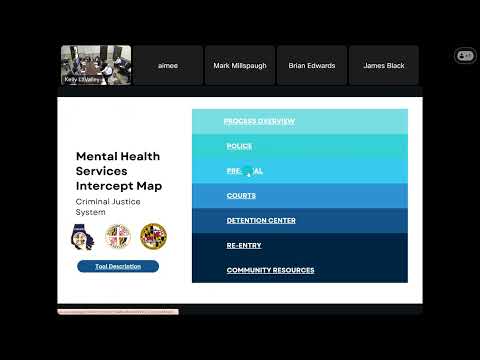
Baltimore County presenters map mental‑health crisis response across police, courts and jail and identify major capacity gaps
Summary
County staff and police outlined a cross‑system map showing limited mobile crisis capacity, few crisis beds, long waits for competency restoration and a one‑person reentry program, and urged more community stabilization options.
Baltimore County officials and police on the workgroup described a cross‑system “process map” for how people with behavioral‑health needs move from police contact through pretrial, the courts, the Baltimore County Detention Center (BCDC/BCBC) and back into the community, and identified key capacity shortfalls that they said are delaying care and contributing to repeated police involvement.
The presentation, led by county staff and Lieutenant Catherine Greenback, commander of the Behavioral Assessment Unit at the Baltimore County Police Department, traced three common police outcomes after a behavioral‑health call: resource referral, emergency petition and arrest. Staff and police said the county’s Mobile Crisis Team (MCT)—a co‑responder pair of a clinician and a trained officer—plays a central role but has limited clinician capacity and cannot meet all calls for service.
The mapping exercise matters because limited crisis capacity affects how long people wait for evaluation, whether they are released from hospital emergency departments, and whether they ultimately enter the criminal‑justice system. Workgroup members repeatedly described a shortage of short‑term crisis beds and limited inpatient capacity as a primary bottleneck that drives repeated emergency responses and jail placements.
Workgroup presenters said the county’s MCT is intended to stabilize people in the community or get them to the hospitals when needed, but that MCT and hospital capacity are both constrained. “Most of our calls come through 911, and patrol will typically be the first on the scene,” Lieutenant Greenback said while explaining response pathways. She added that hospital staff sometimes tell police they cannot keep people because of bed shortages: “There is a very real shortage of mental health beds.”
Presenters outlined how cases move through corrections and courts. Pretrial staff provide resource packets and use the SAMHSA locator tool; courts operate problem‑solving dockets that include a competency docket, mental‑health court and recovery court. Presenters said the Office of Court Psychiatry completes competency evaluations but that current turnaround can exceed the intended timeframe—workgroup members cited cases where the wait extended far beyond the target window (presenters said the office’s standard timeframe is 30 days but recounted examples with waits of 77 days or more). Those waits, the group said, can prolong jail stays for people found incompetent to stand trial.
Within the detention center, presenters described medical and mental‑health screening at intake, special observation for people with suicidal ideation and mental‑health housing units with program names cited in the presentation (START and TAMAR for female housing; a mental‑health wellness program on some male units). Presenters also said the medically assisted treatment (MAP) program in the jail has limited capacity and a wait list. Youth services in detention were described as very limited. For people who participate in BCDC mental‑health programming, staff said some programming and supports may continue for up to 12 months after release, but follow‑up is constrained by staff capacity.
Workgroup members said the county’s reentry program is staffed by a single person, limiting the ability to do systematic postrelease follow‑up. Presenters described the process the jail uses to help people transition—assisting with insurance, providing a short medication supply and linking to community services—but emphasized follow‑up is inconsistent because of staffing limits.
Presenters illustrated system challenges with three anonymized case vignettes. In one example, a 34‑year‑old woman who generated 29 calls to 911 was eventually emergency‑petitioned and admitted to an inpatient psychiatric bed at Saint Joseph Hospital—an outcome the presenters called an uncommon success. Other examples described chronic high‑utilizer individuals whose delusions or repeated calls have not been managed successfully by existing community resources; presenters said those people often cycle through repeated 911 calls, emergency‑department visits and short jail stays.
Workgroup discussion touched on system responses other counties have tried: crisis‑care centers, expanded crisis‑bed authorizations and community‑based residential programs. Presenters and attendees repeatedly said adding short‑term crisis or stabilization beds and increasing community residential options would reduce the repeated criminal‑justice responses they currently see. Attendees described state funding and reimbursement rules as part of the challenge for expanding crisis beds and said some state‑authorized bed allocations date from decades earlier and may not match current need.
The workgroup did not take formal votes. Presenters said staff will follow up with additional mapping materials and with a future presentation from counties that operate crisis‑care centers.
Ending
Presenters asked workgroup members to consider whether the county should press the state for more crisis beds and community residential options; future meetings will include presentations from other counties about their crisis‑care models and additional mapping refinements.