Petitioners argue functional and economic obsolescence sharply reduce assessed value of Oak Hill Hospital; appraiser cites Marshall & Swift and permit history
Loading...
Summary
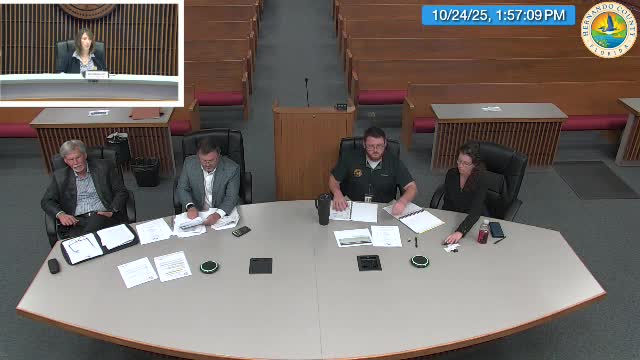
Colleen Millett, special magistrate, presided over petition number 25-018 on Friday, a hearing in which petitioners Tim Hart and expert witness Craig Smith challenged the Hernando County Property Appraiser's 2025 assessment for Oak Hill Hospital (11375 Cortez Boulevard, Brooksville).
Colleen Millett, special magistrate, presided over petition number 25-018 on Friday, a hearing in which petitioners Tim Hart and expert witness Craig Smith challenged the Hernando County Property Appraiser's 2025 assessment for Oak Hill Hospital (11375 Cortez Boulevard, Brooksville).
The property appraiser's packet described the subject as a private hospital complex owned by HCA Health Services of Florida Inc., with roughly 460,042 square feet under roof on approximately 96 acres. Appraiser materials noted Marshall & Swift cost calculations and reported a depreciated improvement value and land total that produced a pre-adjustment valuation (the packet showed a final figure of about $123,240,328 before a 15% cost-of-sale adjustment and an indicated figure of $104,754,278). The packet also recorded the county's 2025 just, assessed and taxable value for the parcel as $89,529,735.
Petitioners presented an alternative cost analysis and retained Craig Smith, who described broad industry changes he argued reduce the economic life and competitive value of older hospitals. Smith said removal of certificate-of-need rules nationally and in Florida has increased competition and altered hospitals' economic life; as he summarized in the hearing, "Certificate of need... was passed in the early eighties... We passed that in Florida in about 1984. It was just, removed in 2020." Smith said new facilities and shifting care models reduce the functional and economic utility of older inpatient space and that those factors should be quantified as obsolescence adjustments in a cost approach.
Tim Hart and their valuation team presented a Marshall & Swift-derived replacement cost and a depreciation schedule that produced a materially lower depreciated-improvement figure than the appraiser's packet. Petitioners argued the appraiser's depreciation inputs (effective age and percentage depreciation) overstated remaining value for this older complex and did not fully account for functional obsolescence and reduced inpatient utilization.
The property appraiser's representatives countered that their cost and sales approaches followed Marshall & Swift guidance and that their packet reflects permit history, recent additions and remodeling that support an effective age the office used in its calculations. Appraiser staff pointed to more than $16 million in historical remodeling permits and additional permits still open in the record and said the office's approach balanced cost and sales information in absence of reliable income comparables. The appraiser noted its replacement-cost estimate and depreciation percentages were derived from its internal Marshall & Swift application and related references and said staff could apply additional depreciation if demonstrated by evidence.
The hearing record includes detailed disagreement over replacement-cost inputs, the correct application of Marshall & Swift depreciation schedules and the magnitude of functional and economic obsolescence. Magistrate Millett admitted the parties' materials and said she will review the evidence and issue a recommended decision to the Value Adjustment Board in the coming weeks. No administrative change was made at the hearing.